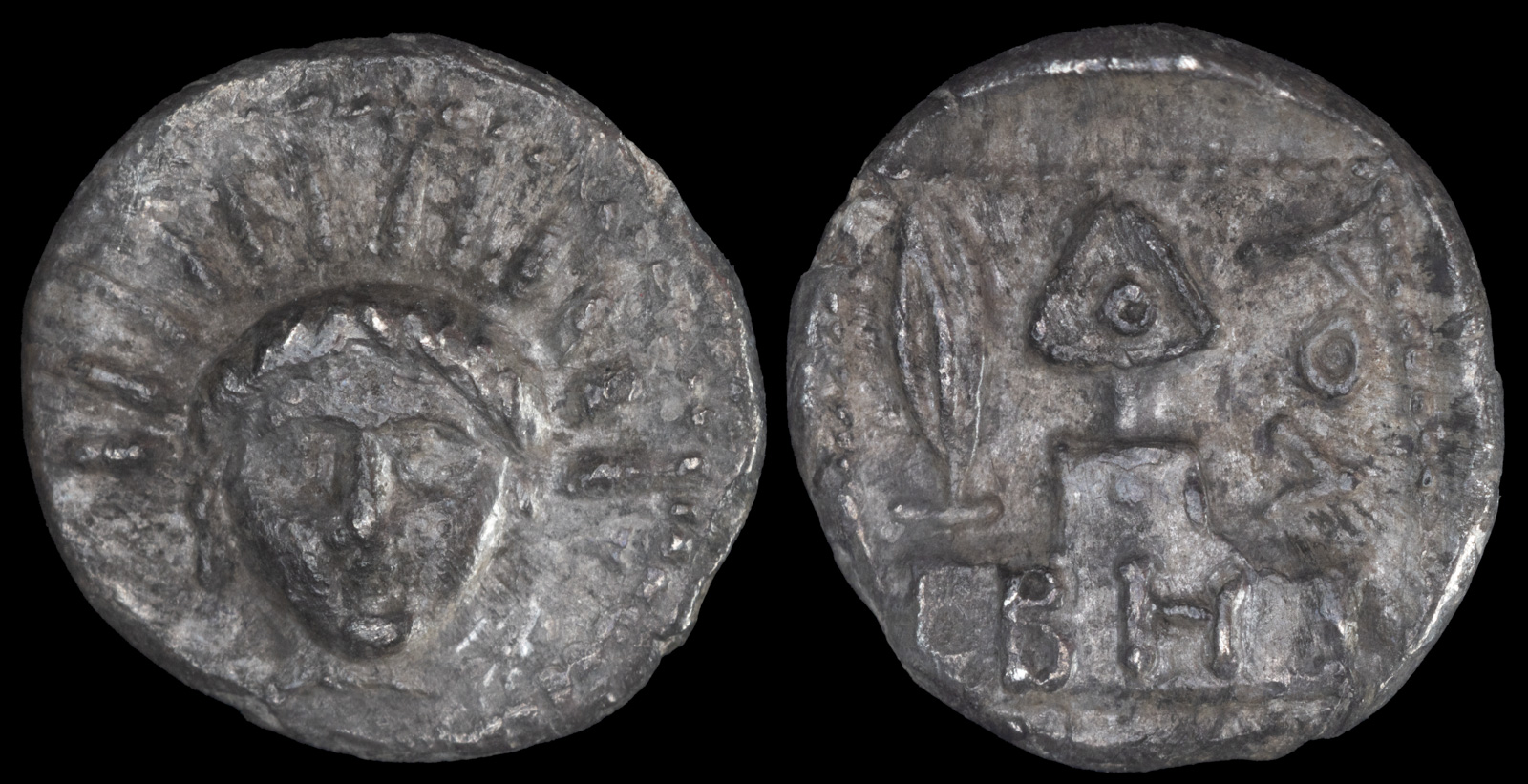
Emesa(?) Syria
460-430 BCE
AR Hemiobol 9.5mm, 0.31 g, 2h
Radiate facing head of Belos /
Triangular baetyl with eye set on base; ΒΗΛΟΥ below and left; olive leaf to left; all in dotted square border
Unpublished
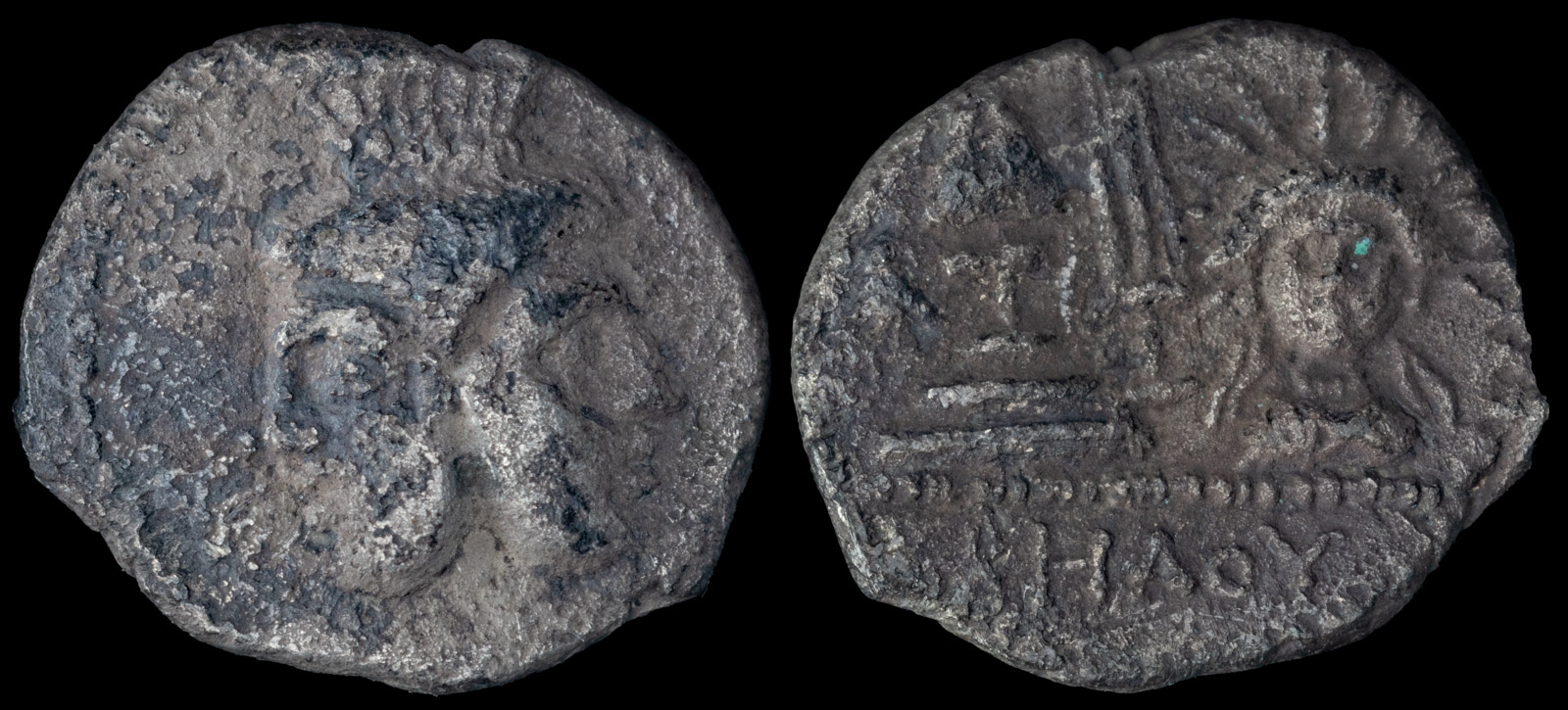
Belos, Syria
460-430 BCE
AR Obol 10mm, 0.63g
Janiform heads of Athena /
Triangular baetyl with eye set on base L; Radiate facing head of Belos R. Priestly instrument between. ΒΗΛΟΥ below
Unpublished
Based on two denominations and the presence of two deities on the second, this strongly suggests that ΒΗΛΟΥ depicts a place name, and is not just a friendly key to the deity pictured. There are now two deities, and naming one but not the other would be odd. The genitive form of the name itself also implies that, saying “of Belos”. If it was just naming Bel, I would expect ΒΗΛΟΣ.
Who is the deity on the obverse? My belief is it’s a janiform image of Athena, based on the crest. The same verdict was given for this coin from Cilicia. That’s not far off from where I believe these coins were minted, though I don’t believe it’s from the same city based on the different weight.
From the weight, this is clearly a hemiobol. Many cities used a heavier hemiobol standard, but this is in line with some cities in Cilicia. The fifth century coins of Tarsus and Isaura were within this range (4th century coinage appears heavier). Many of the “uncertain” Cilician coins are also in this range. The weight appears to light for Phoenicia or Judea/Samaria, as well as for Manbog-Bambyke.
I spent a tremendous amount of time on this aspect, and even purchased a copy of Jeffery’s “The Local Scripts of Archaic Greece”, which is by far the best resource on the subject.
From what I see, this appears to be an Aeolian script. Most telling are the unconnected beta below and “backwards” upsilon above. This script died out roughly in the mid 5th century BCE. The script style suggests no later than the mid 5th century BCE. From similar inscriptions I found in Jeffery, I believe it’s in the range of 460-430 BCE.
Note also that the weight standard for Poseidion is the same as for my coin. While this didn’t always happen, one would expect neighboring cities to have the same weight standard to facilitate trade.
Also, the obverse of this coin (off flan – I got this coin cheap 🙂 ) depicts Athena. Thus, the janiform Athena on mine is consistent.
The object in the middle of the coin appears to be some priestly instrument. Initially I thought it was a grain, but the second point strongly suggests this false.
To me, it actually looks like some form of pinhole projector – Indiana Jones style – either used to view the sun or perhaps aim its beam to a particular spot. Maybe this was placed somewhere around the baetyl for the sun to project something on it during a particular time of year. That’s my best guess. Its presence in the middle suggests to me an association both with Bel (the sun) and the baetyl.
Where was Belos?
The big question I’ve been trying to figure out is, “where was Belos?” I feel I have a much better idea now, though nothing definite. First, I’ll go through what I’ve ruled out.
Emesa – This was just wishful thinking.- that the baetyl depicted was the same Elagabalus paraded around. The bitter truth is there’s no evidence of a Greek settlement at Emesa during the Archaemenid time, nor would it make sense for a Greek colony at the time to be located so far inland.
Belos River
I spent a great deal of time poring through my Barrington Atlas to find the Belos river. Numerous Greek cities during the time were named after nearby rivers and mountains, so this made sense to me. However, none of the potential matches made much sense.
Acre – The first Belos River drained into ancient Acre. I quickly ruled this one out because it seemed to far south for a sizable Greek settlement, and Acre has undergone a tremendous amount of archeology, and thus suddenly finding these coins would be unlikely.
Aleppo or Chalcis ad Belum – Another Belos River passed through both of these cities. For both, we essentially have no information about the Achaemenid period. However, both are also far inland and neither would make sense for a Greek settlement at the time.
Therefore, I’m inclined to believe there was a place called “Belos” that was not named for a river we at least know of. The area where I believe this was most likely was the northern Syrian coast.
Unlike elsewhere in Syria, there were documented Greek settlements in this area in the 5th century BCE. Note that I still stick by a mid-5th century dating, based on the archaic ‘B’. That form was mostly gone when the 4th century came around. Which settlement? I don’t know. I’m sure find spots would make this clear, but we don’t have them. The following are possibilities.
Poseidion (Ras-al-Bassit)
This was a Greek colony since roughly the 7th century BCE and was mentioned by Herodotus. I believe it highly unlikely to be the location of “Belos” because coins from Poseidion are already known. The following coin is today attributed to Poseidion, Cilicia, but I believe that incorrect based on the following (this really requires a separate post):
In the article “A New Greek Fraction, in: The Celator Vol. 19, No. 5” one of the primary reasons for not attributing it to northern Syria was the statement that the style isn’t consistent. I believe that false. This area had Greek colonies and the style would be expected to be similar to other Greek colonies in nearby Cilicia.
– In a survey of the ruins of non-named cities in Cilicia Trachea, where the Cilician Poseidion was, none was of a size capable of minting coins during this period.
– Poseidion, Syria was a well-attested city. It would make sense that they minted coinage – far more than some barely heard of city in Cilicia.
Note also that the weight standard for Poseidion is the same as for my coin. While this didn’t always happen, one would expect neighboring cities to have the same weight standard to facilitate trade.
Also, the obverse of this coin (off flan – I got this coin cheap 🙂 ) depicts Athena. Thus, the janiform Athena on mine is consistent.
Finally, there is a chance that Belos and Poseidion were the same place, since the two coins may have been minted as much as 100 years apart and the city may have been renamed. I believe that unlikely, but possible.
Al Mina
This was a Greek trading post since roughly 8th century BCE. Its name during this time is unknown, though there was speculation that it was the same Potamoi Karon mentioned by Diodorus Siculus. Al Mina was originally believed to be the location of Poseidion, but that is mostly disproved now.
One thought I’ve had is the other Cilician coin with Athena may come from here, but that’s pure speculation.
Tell Sukas
It was established as Greek trading post roughly 825 BCE and destroyed by the Babylonians in 550 BCE. Archeological evidence suggests it was inhabited by Phoenicians from 380 to 69 BCE.
Ugarit
This was a major city in pre-antiquity. Archeology shows a hellenistic presence from 500-300 BCE.
Ras Ibn Hadi
This city was a known Ptolemaic base. Before then, it may have had Greek settlers.
Minet el Beida
This town served as the harbor for Ugarit.
One thing to keep in mind is that Hellenization was a slippery slope at this time. As Fergus Millar explains in “The Problem of Hellenistic Syria” , the designation of a city as “Greek” during this time is complicated. For one, we have virtually no information from this area in the Achaemenid period. The little we do have is from ancient works that have survived. Very little archeology has occurred here due to the sketchy political situation, and very little of what we do have is from this period.
In the 4th century BCE, Seleukos I Nikator “founded” several Greek settlements in this area, such as Beroia, Seleukis Pieria, etc, but we don’t know if any Greeks were already living in those cities. There are some theories that Seleukis Pieria in particular was a new settlement, populated by the inhabitants of Poseidion, but we have no real proof.
In terms of using religious angles to narrow this down, the presence of Bel strengthens the attribution to Syria in general, and especially northern Syria. He was a very popular deity in this area at this time.
The presence of the baetyl narrows it less. Baetyls were worshipped from Caria down to Judea, and from Cyprus to Arabia – a huge area. Numerous cities minted coins depicting baetyls. Seleukis Pieria itself minted provincials depicting a baetyl. Perhaps that baetyl had been moved there from Poseidion or from Belos, but who knows.