Belos
View All Tags
In Greek historiography, especially in authors like Herodotus, Belos appears in a semi-mythical genealogical role. He is sometimes described as the father of figures such as Aegyptus and Danaus, weaving Near Eastern divine kingship into Greek mythic tradition. This blending reflects how Greeks interpreted foreign gods through familiar frameworks rather than preserving strict theological distinctions.
In the Levant, particularly at Palmyra, Bel (often called Bel-Marduk or simply Bel) was worshipped as a supreme sky god. His great sanctuary, the Temple of Bel, dedicated in 32 CE, became one of the most important religious centers of Roman Syria. There, Bel formed a divine triad with Yarhibol (a solar deity) and Aglibol (a lunar deity), symbolizing cosmic order. In this Syrian context, Belos was not merely “Marduk renamed,” but a locally integrated supreme god combining Babylonian, Aramaean, and Greco-Roman elements.
Roman rule did not suppress Bel’s cult. Instead, it flourished within imperial religious pluralism. Inscriptions from Palmyra show dedications by merchants and caravan leaders, highlighting Bel’s role as a protector of trade routes that linked the Mediterranean with Persia and beyond.
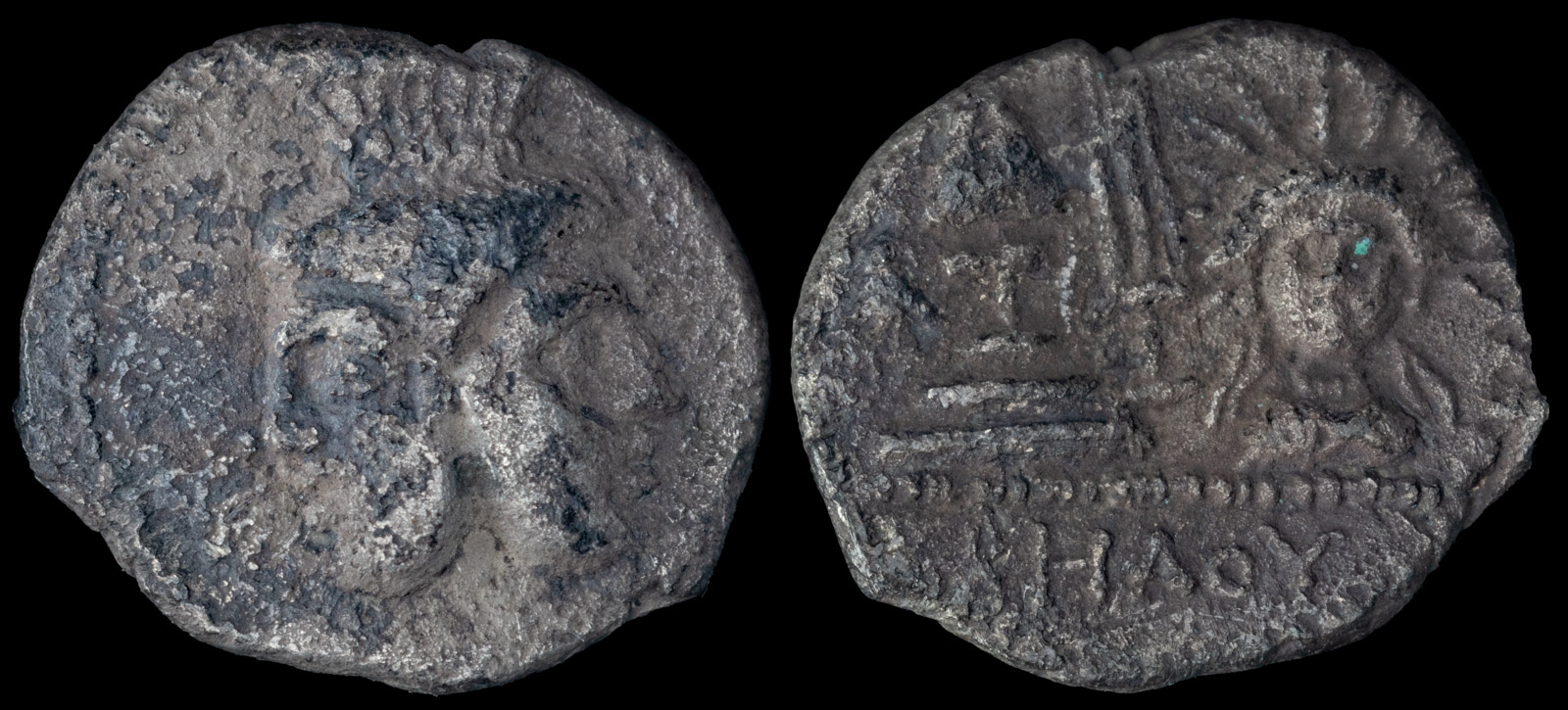
Belos, Syria
460-430 BCE
AR Obol 10mm, 0.63g
Janiform heads of Athena /
Triangular baetyl with eye set on base L; Radiate facing head of Belos R. Priestly instrument between. ΒΗΛΟΥ below
Unpublished