Mên
View All Tags
Iconographically, Mên is almost always recognizable by the crescent moon placed behind his shoulders or radiating above his shoulders like a luminous backdrop. He typically appears as a youthful or middle-aged male wearing a Phrygian cap, a distinctive symbol of his Anatolian origin. Often he stands or strides forward holding a spear or scepter, sometimes accompanied by animals such as a cock or a bull. In many images he tramples a panther or lion, a gesture that conveys his sovereignty over wild and cosmic forces. Temples and shrines dedicated to him frequently contained baetyls. Some of these sacred stones were conical or pyramidal and seem to have represented the god directly, indicating that his cult preserved an older aniconic tradition even while adopting sculptural forms.
Mên was also closely tied to concepts of healing, prophecy, and divine justice. Inscriptions from Asia Minor mention oracles of Mên, sanctuaries where individuals sought guidance or cures, and priesthoods that held considerable local prestige. His nocturnal and lunar nature made him a god of cycles, transitions, and thresholds, which explains his association with both protection and retribution. In some regions he took on aspects of the Persian god Mah or the Mesopotamian moon-god Sin, evidence of the cultural exchanges that shaped Anatolian religion. By the Roman period his sanctuaries often functioned as centers of local identity and regional pride, and many cities featured Mên prominently on their civic coinage.
On coins Mên appears seated or standing with his crescent, spear, and Phrygian attire, usually framed by stars or symbolic animals. These images were not purely devotional. They expressed a city’s heritage and highlighted its connection to a powerful and ancient protector. Especially in central Anatolia, coins with Mên served as a visual assertion of local religious identity amid Greek and Roman influences.

Lydi, Nysa
Circa 69-96 CE
AE 15.5mm 4.60g
Obv: bust of Mên right, wearing Phrygian cap
Rev: ΝΥCΑ/ΕꞶΝ in two lines within wreath
Kurth, GRPC Lydia Vol. 3, 41 var. (legend in three lines)
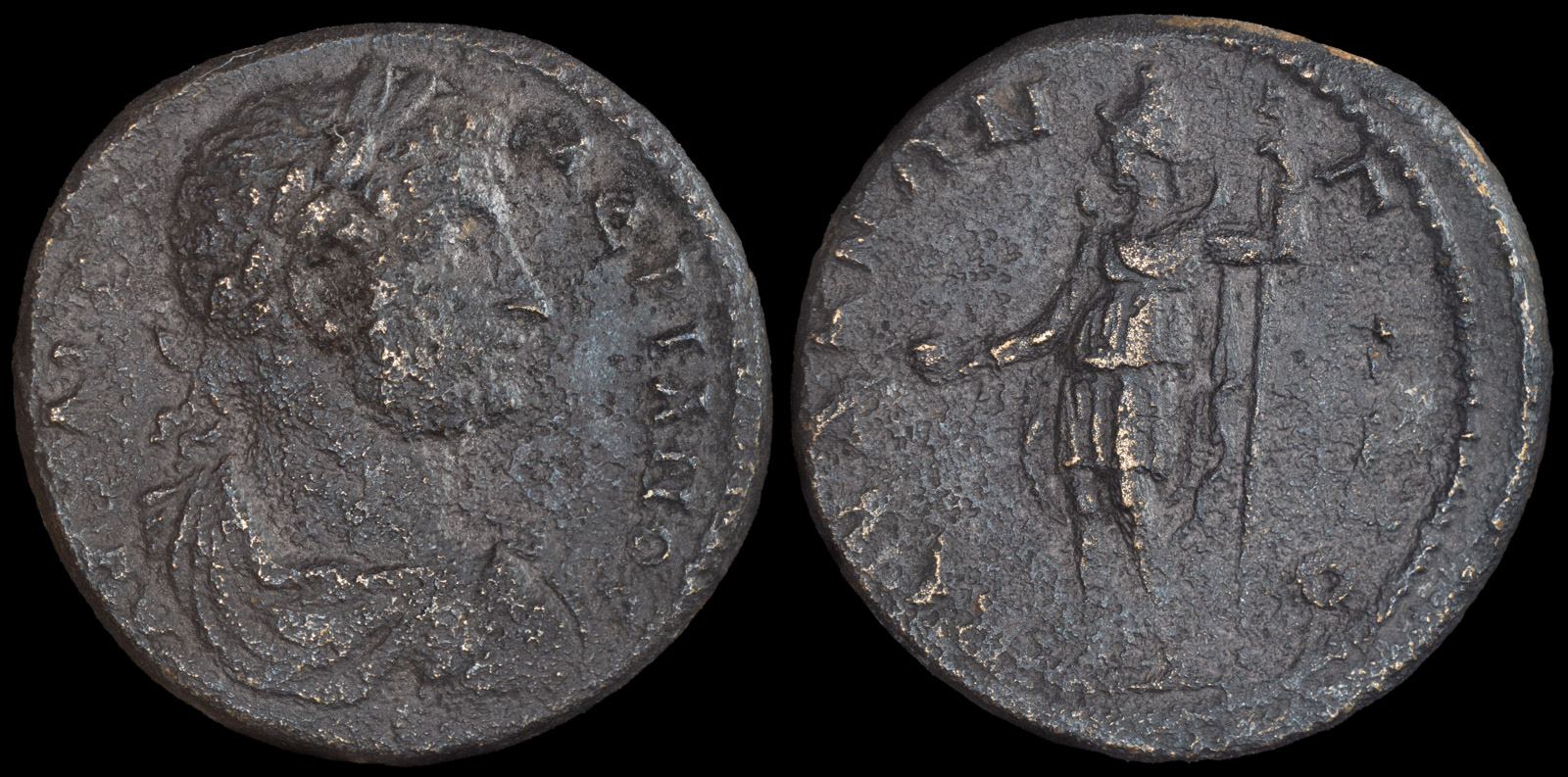
Phrygia, Palaeobeudus
Hadrian, 117-138 CE
AE 4.92g 21.04mm
Obv: AV ΚΑΙ ΤΡΑ ΑΔΡΙΑΝΟС. Laureate, draped and cuirassed bust right.
Rev: ΠΑΛΑΙΟΒЄVΔΗΝΩΝ. Mên standing left, holding pine cone and spear.
RPC III 2621; BMC 2