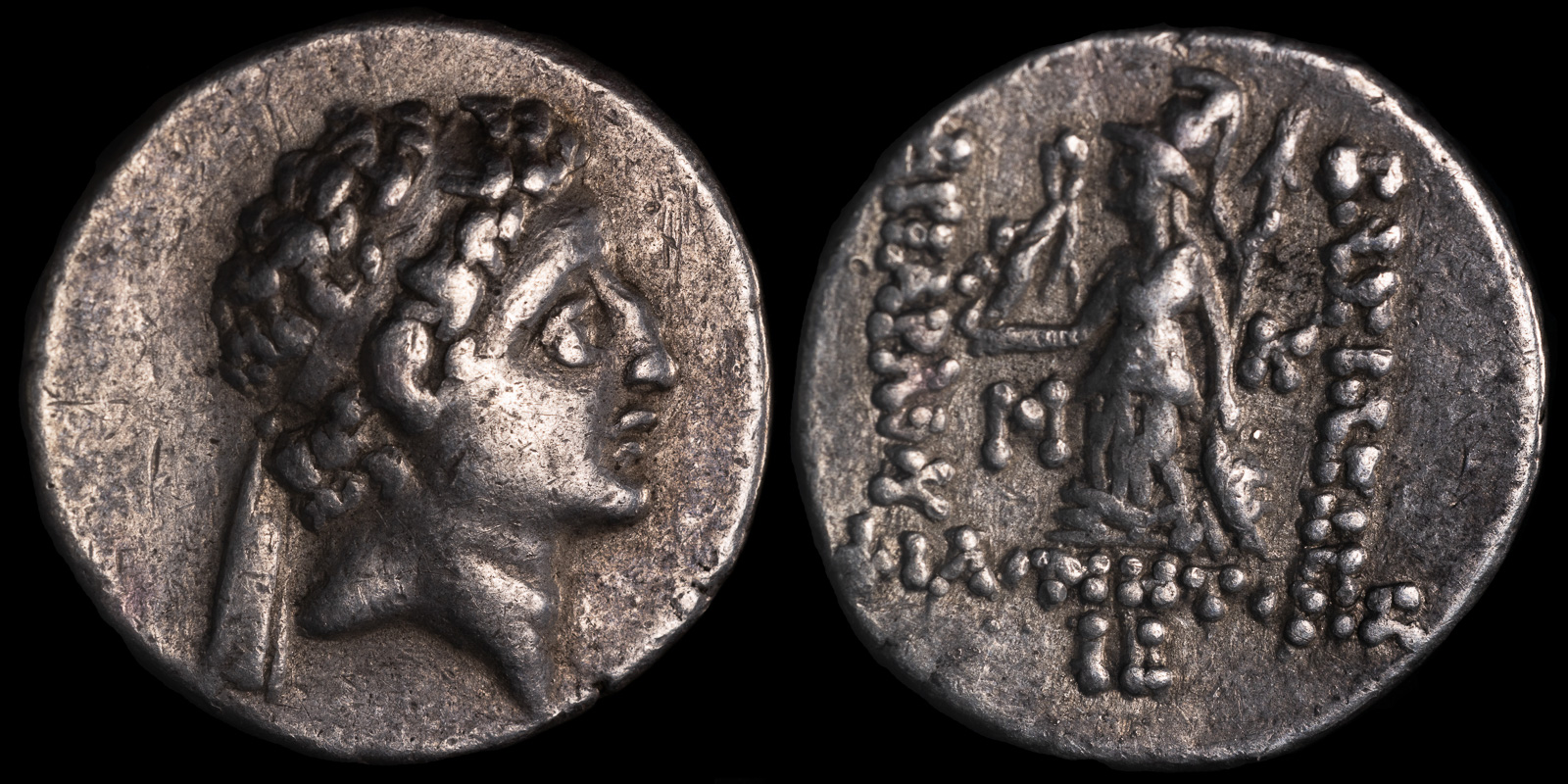
Kings of Cappadocia, Ariarathes VII Philometor
Mint C (Komana) dated RY 12 = 104/3 BCE
AR Drachm 4.04g, 18mm, 12h.
Diademed head to right /
ΒΑΣΙΛΕΩΣ ΑΡΙΑΡΑΘOV ΦIΛOMHTOPOΣ, Athena Nikephoros standing to left, with spear and shield; M inner left, K inner right, IB (date) in exergue.
HGC 7, 832
Ex Roma 2019
There may be no problem more complex than the four ancient cities of the form “Komana”, all with similar names.
Komana, Pontos
This was a famed temple city in the Pontos that was home to a temple to the goddess Ma. Per Strabo, six thousand temple servants saw to the war goddess’ needs. Its chief was supposedly second in line behind Mithridates VI himself. After the severe temple duties, I expect that these six thousand would do a night on the town, and thus they needed money for beers and “other things” of the night, so there was clearly a need for this coinage. Much of it was minted around the time of Mithridates VI.
Although the coinage for Komana in Pontos isn’t rare, it took me a bit to buy one. Some time ago there was a gorgeous example that I found pricy, so I kept putting things off until someone else bought it. This one has the same design, and so I picked it up, only for it to get lost in the mail until finally showing up. Most likely it had been routed to the other Komana.
Komana, Cappadocia
Complicating matters was the fact that the city of the same name in Cappadocia also had a similar temple. Per Strabo, much of the traditions of the Pontos temple were taken from the Cappadocian. If this weren’t bad enough, another name for the city was Hierapolis (“sacred city”), which was also shared with several other cities! The city minted its own pseudo-autonomous coinage during Roman times, but here I’m using an example from he Cappadocian kingdom, which minted some of their coinage here.
Komama, Pisidia
Now we get to the slight letter shifts and to Pisidia, which contained two of these confusing cities. First up was Komama, whose full name was Colonia Iulia Augusta Prima Fida Comama, but as you can see from this coin, the locals just called it “Ko”. It was founded sometime after Augustus became Augustus, but not much else is known about the city. Some milestones suggest it was founded in the 6th century BCE.
Konana, Pisidia
Now we get to the real nitpicks. So outrageous was the fact that this city simply changed the first ‘m’ to a ‘n’, that it was forced to rename itself to Justinianopolis later on. I’m sure Justinian had a role to play there, but I’m sure simply the amount of lost mail must have been horrendous.