Bes
View All Tags
Bes stood apart from most Egyptian gods in both iconography and function. While others were depicted in profile and followed strict artistic conventions, Bes was often shown frontally, staring directly outward. This distinctive visual style helped amplify his power to confront and repel malevolent forces. His image was common on amulets, household items, and furniture, especially in contexts associated with fertility and protection. Over time, his cult spread beyond Egypt, gaining popularity in the Levant, Cyprus, and throughout the Mediterranean.
Bes also appears on ancient coinage, particularly during the Hellenistic and Roman periods, when Egyptian religious motifs blended with Greco-Roman artistic and religious sensibilities. His image was notably used on coins minted in Ptolemaic and Roman Egypt, especially in the city of Alexandria. On these coins, Bes could be depicted alone or as part of syncretic iconography, combining his protective symbolism with that of other deities. His frontal, often mask-like depiction lent itself well to coin design, serving not only as a recognizable motif but also as a charm against evil.
In addition to Alexandria, coins featuring Bes were issued in the Near East, especially in cities under strong Egyptian influence. For example, coins from Ake-Ptolemais (modern Acre) and Gaza occasionally bore his image. These issues reflected Bes’s role not just as a domestic god but as a guardian of communities and a symbol of cultural hybridity.
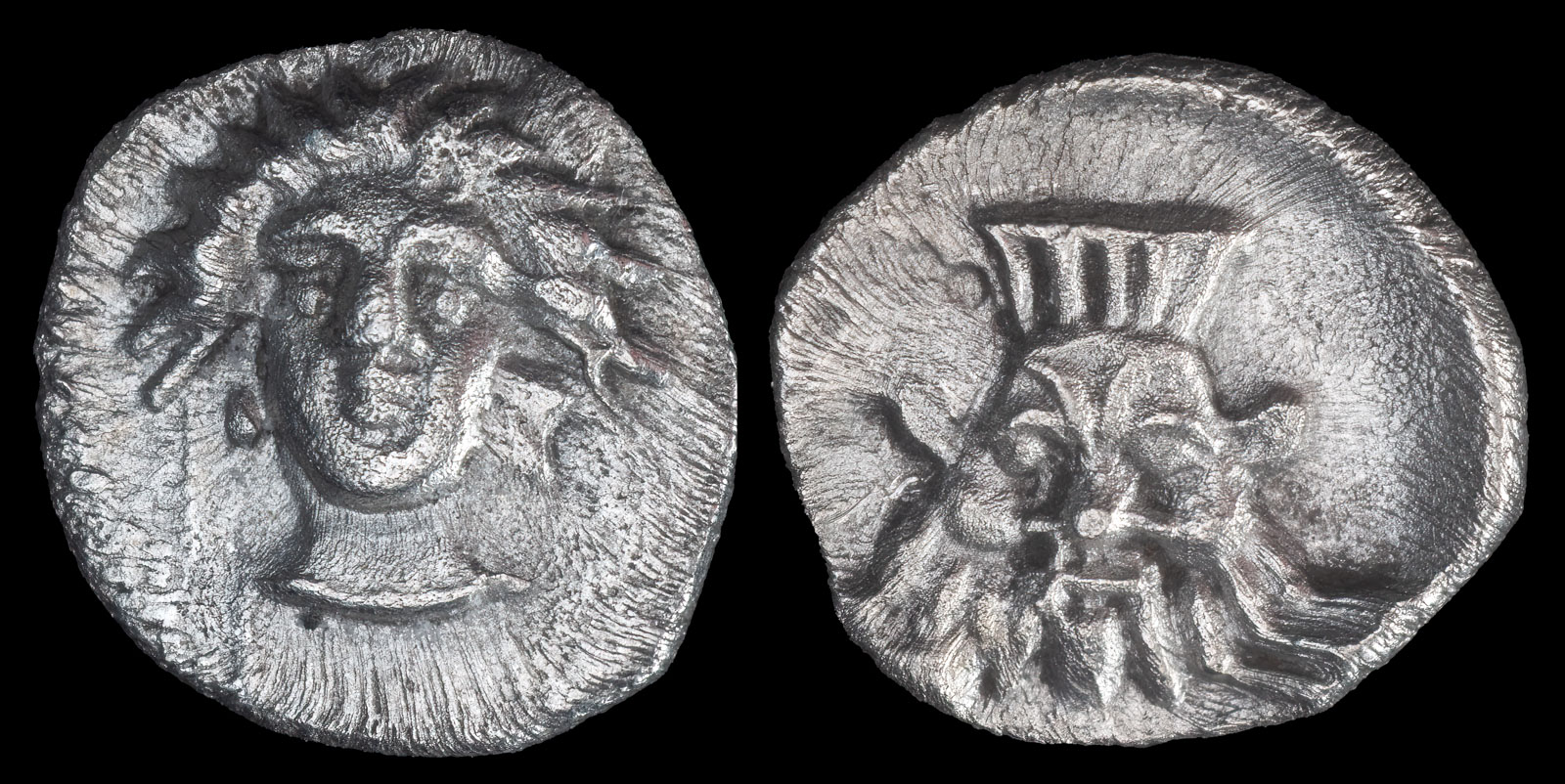
Cilicia, Uncertain
4th century BCE
AR Tetartemorion 6,3mm 0,15g
Obv: Female head (Arethousa?) facing slightly left, wearing single-pendant earrings and necklace with pendants
Rev: Facing head of Bes
SNG Levante 235; cf. SNG France 486 (obol)