Iberian
View All Tags
One of the most remarkable aspects of Iberian is that its writing system can be read phonetically, even though the language itself is not understood. Iberians employed several related scripts, most notably the northeastern and southeastern Iberian semi syllabaries, which combine syllabic signs for plosives with alphabetic signs for other sounds. Because the values of these signs are known, scholars can transliterate Iberian texts with confidence, yet the meanings of most words remain uncertain. This places Iberian in a rare category of ancient languages that are readable but not truly translatable.
Linguistically, Iberian is not Indo European, and despite many attempts, it has not been conclusively linked to any known language family. Earlier theories suggested a relationship with Basque or with Afroasiatic languages, but modern scholarship remains cautious. While Iberian and Aquitanian share some structural similarities, these parallels are not sufficient to establish a genetic relationship. As a result, Iberian stands as an isolate, reflecting a linguistic landscape in Iberia that was far more diverse before Roman domination.
The survival of Iberian inscriptions into the Roman period shows that the language continued to be used alongside Latin for some time, particularly in local and civic contexts. Eventually, however, Latin replaced Iberian as Roman administration, law, and culture spread throughout the peninsula. Today, the Iberian language remains a fascinating puzzle.
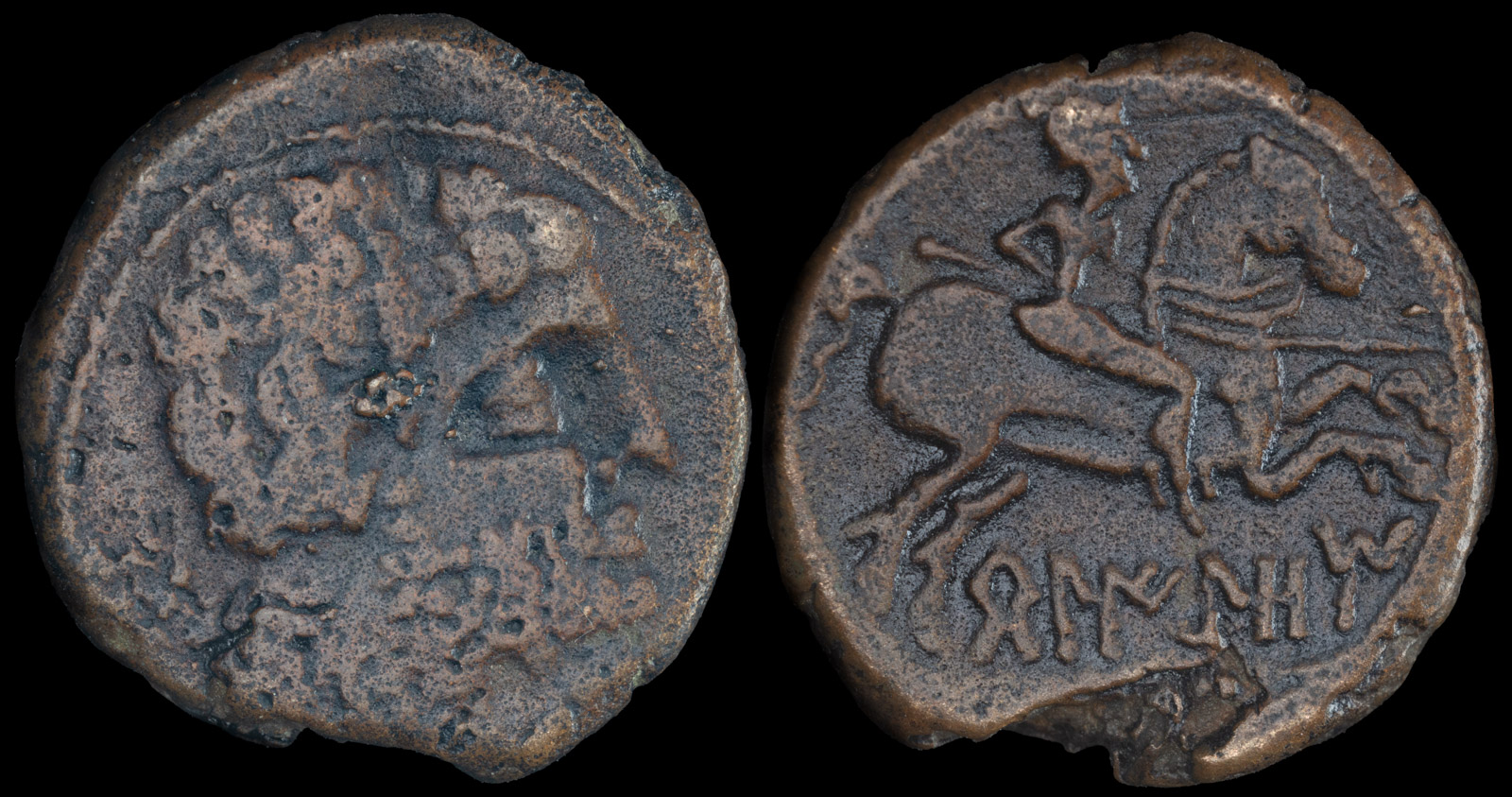
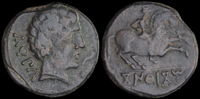
Beligiom, Hispania
120 – 20 BCE
Ae As 21.5mm, 9.3g
Obv: Bearded male bust right, BE in Iberian characters behind
Rev: Rider with spear on prancing horse right; BELIGIOM in Iberian characters below
Burgos 243; Heiss p177 4 (Olague)
Filter coins
Beligiom, Hispania 120-20 BCE
Castulo, Iberia 200-150 BCE
Celsa, Spain 120-50 BCE
Conterbia Carbica, Iberia ca 120-80 BCE
Gades, Iberia ca 2nd century BCE
Ilipense, Iberia 120-20 BCE
Sekaisa, Spain 120-20 BCE