Pentagram
View All Tags
For the Pythagoreans, the pentagram was more than just a shape; it was a reflection of the mathematical and cosmic order that governed the universe. They believed that the number five was a symbol of health and well-being, and the pentagram’s five points were thought to represent the five elements: earth, water, air, fire, and spirit. This association linked the pentagram to the natural world and the fundamental forces that controlled life, with the shape embodying the harmony of these forces coming together in a balanced way. As a result, the pentagram became a symbol of the Pythagoreans’ philosophical ideals, representing their belief in the interconnectedness of numbers, nature, and the divine.
In addition to its mathematical and philosophical connotations, the pentagram also had a more mystical and protective significance in Greek thought. It was often associated with the goddess of wisdom, Athena, and considered a symbol of divine protection. The pentagram’s symmetry and its connection to sacred geometry made it a powerful emblem that could ward off evil spirits or negative forces. In some instances, it was used as a protective charm, etched onto objects or amulets to provide safety and bring good fortune to the wearer.
While the pentagram’s association with the Pythagoreans is the most prominent in Greek culture, it was not the only use of the symbol in ancient Greece. The shape was occasionally used in art and design, both for its aesthetic qualities and for its deeper philosophical meaning. As a symbol of order, harmony, and balance, the pentagram’s geometric beauty reflected the ancient Greek appreciation for symmetry and proportion, which were essential values in their art, architecture, and understanding of the universe.

Thrace, Kypsela
circa 420-380 BCE
Æ 13 mm, 1,75 g
Obv: Head of Hermes right wearing petasos.
Rev: K – Y / Ψ – Ε.
Diota (cup with two handles); uncertain symbol above.
BMC 1 var. (pentagram above cup); SNG Copenhagen 532 var. (same); Mouchmov 3889a
Filter coins

Kypsela, Thrace 420-380 BCE
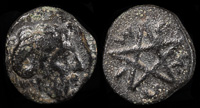
Pitane, Mysia 350-300 BCE
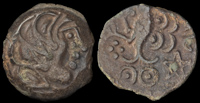
Senones, Gaul ca 100-50 BCE
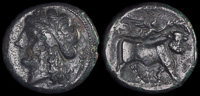
Teanum Sidicinum, Campania 265-240 BCE