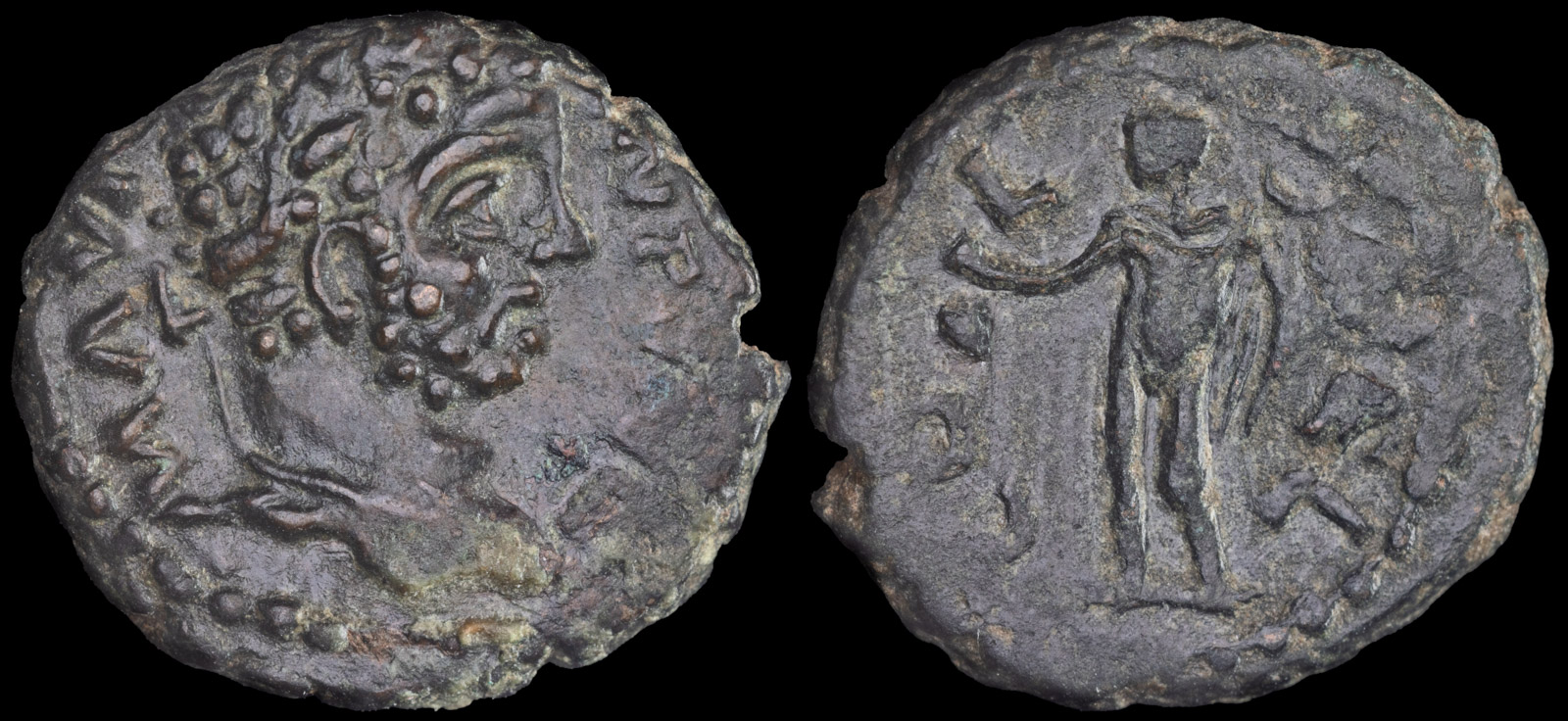
Heliopolis, Coele Syria
Marcus Aurelius 211-212 CE
AE 16.0mm 3.40g die axis 45o
obverse M AVR ANTONI (Latin: Marcus Aurelius Antoninus), laureate head right, seen from behind;
reverse COL HEL (Latin: colonia Heliopolis – colony of Heliopolis), Hermes standing slightly left, head left, nude but for cloak over shoulder, messenger bag in right hand, caduceus in left hand;
Sawaya 383 ff. var. (D74/R152) unlisted die combination, SNG Cop 430, Lindgren-Kovacs A2162A
Heliopolis, Coele Syria is now the city of Baalbek, Lebanon. Its ruins are among the best preserved in the country. In particular its Temple of Bacchus and Temple of Jupiter are tourist attractions. When the country is not in conflict, the site is a major attraction.
Its history goes back at least 11,000 years, but the name Heliopolis was obtained when Alexander the Great conquered and renamed it in 334 BCE. At the time, and later, the deity Ba’al Hadad was worshipped. He was equated with the Greek sun god Helios, hence the name. His temple was eventually replaced during Roman times by the current one to Jupiter.
During antiquity, the city was well known for its oracle. Trajan consulted it twice. When given a sealed but unopened question, the oracle responded with a blank reply. When he asked whether he would return alive from the Parthian wars, he received back a centurion’s staff, broken to pieces.