Erinys
View All Tags
In this Arcadian myth, Demeter’s dual nature is expressed symbolically. After her purification in the river Ladon, she became known as Demeter Lousia (“the Washed”), representing the restoration of fertility and the cycle of renewal after devastation. The local cult at Phigaleia worshipped both aspects—Erinys and Lousia—reflecting a deep understanding of nature’s balance between death and life, sterility and growth. The temple there reportedly contained a statue of Demeter with a mare’s head, holding a dolphin and a dove, symbols of both the sea and the sky, which further emphasized her dominion over all realms of creation.
The worship of Demeter Erinys likely predates the more widely known Eleusinian mysteries, preserving an older, more elemental form of the goddess. She embodied the untamed, avenging forces of nature that punish transgression and disrupt the harmony of the world until balance is restored.
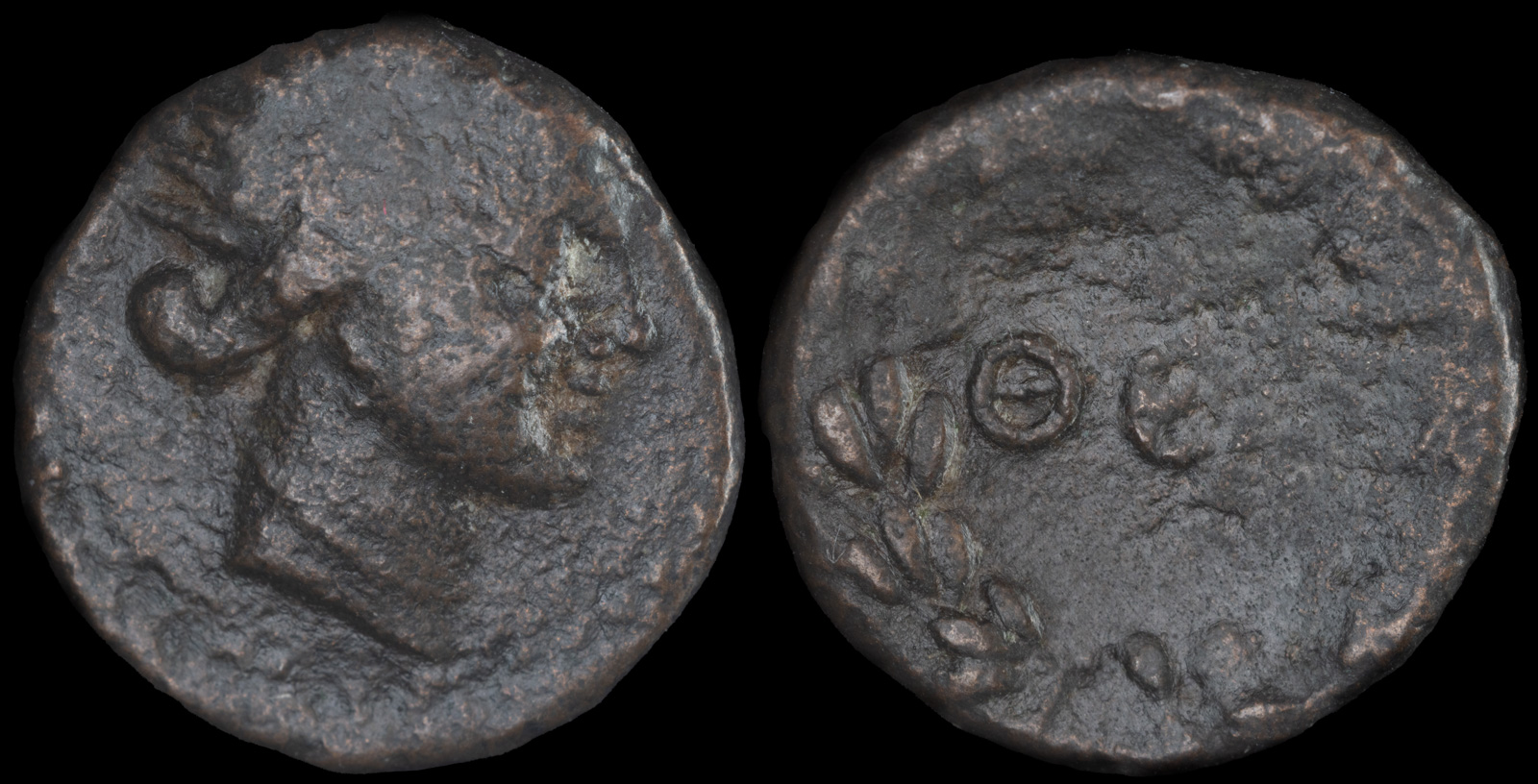
Arkadia, Thelpusa
Circa 50-25 BCE
Dichalkon AE 16mm, 3.66g, 10h
Radiate head of Demeter Erinys to right, wearing a small earring and a necklace with her hair rolled.
Rev. ΘΕΛ Legend within a laurel wreath
BCD Peloponnesos 1762. HGC 5, 1087. SNG Copenhagen 319. Traité III 938
Ex collection of John Aiello
Ex BCD collection
Ex Baldwins May 1970