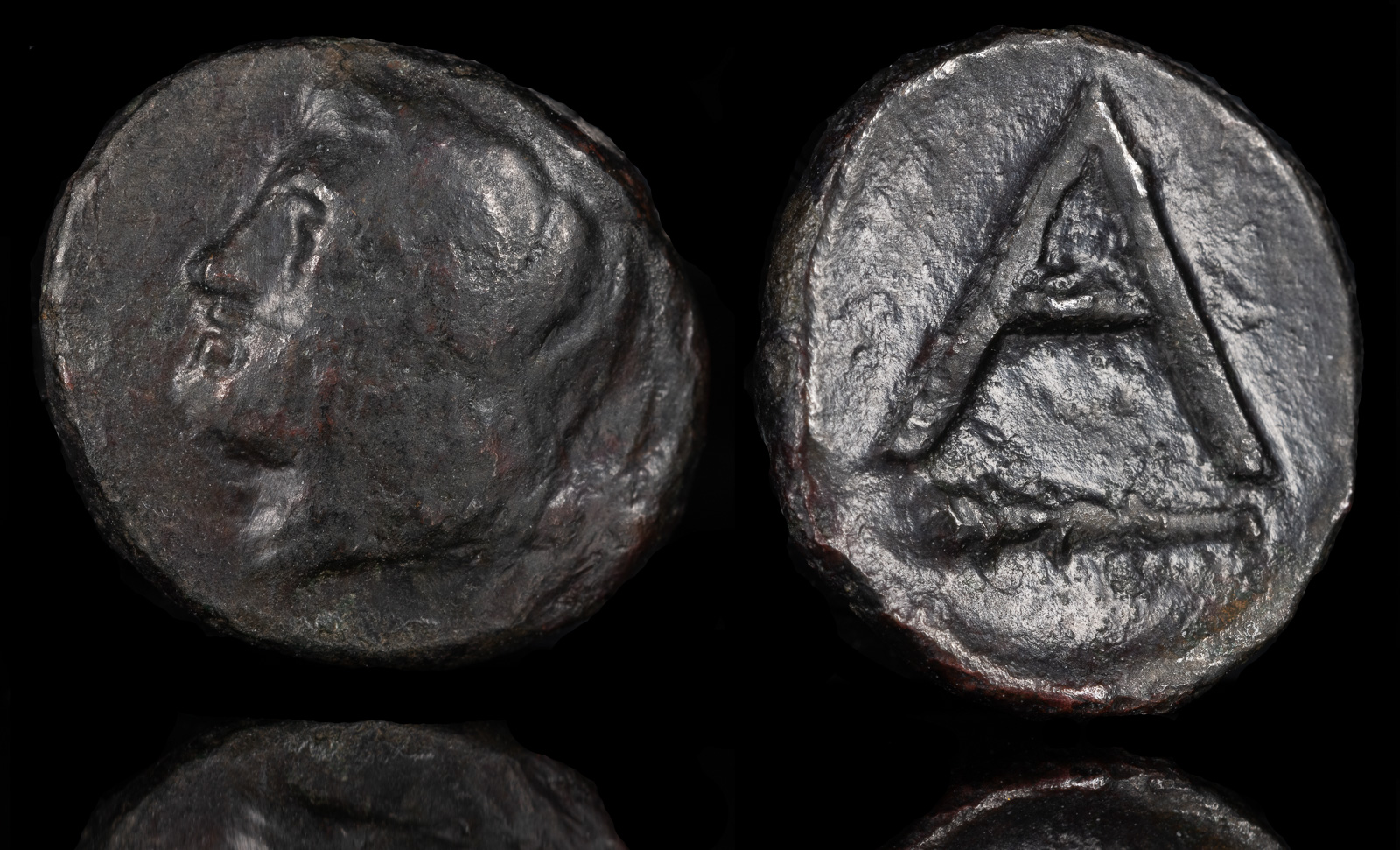
Argolis, Argos
400-350 BCE
13.56mm 1.82g
Obverse: Head of Hera left, wearing stephane
Reverse: Large A; club below
BCD Peloponnesos 1057.1
Ex BCD Collection (not in LHS sale)
Ex CNG
Ex Marc Breitsprecher
Argos was perhaps the most potent rival to Sparta in the Peloponnese. A large and powerful city, it fought against Sparta for hundreds of years and for brief period assumed hegemony over the Peloponnese.
At other times Argos was neutral, notably when the Persians invaded. Here, their neutrality provoked the ire of the other Greeks, though they were also mostly neutral in disputes between Athens and Sparta
Although Argos was never conquered by either Philip II or Alexander III, they did have to respect their will, such as honoring a peace treaty brokered by Philip II against Sparta Among the Diadochi, only Pyrrhos attacked Argos. He was killed in the attempt. During Pausanias’ time there was a memorial to him.
Pausanias visited and spent a great deal of his Book 2 in Argos. He details many of their temples and several stories that occurred there. For example, during one bitter dispute between Argos and Sparta Argos raised a thousand men to attack and put a man named Bryas in charge. They made a number of raids into Lakedaimon and on one occasion interrupted a bridal possession by snatching a young girl. When Bryas fell asleep, the girl blinded him.
The soldiers then chased after the girl, who fled back the procession. When the Argives demanded the girl, the commoners refused. There was then a battle where every single one of the soldiers were killed.
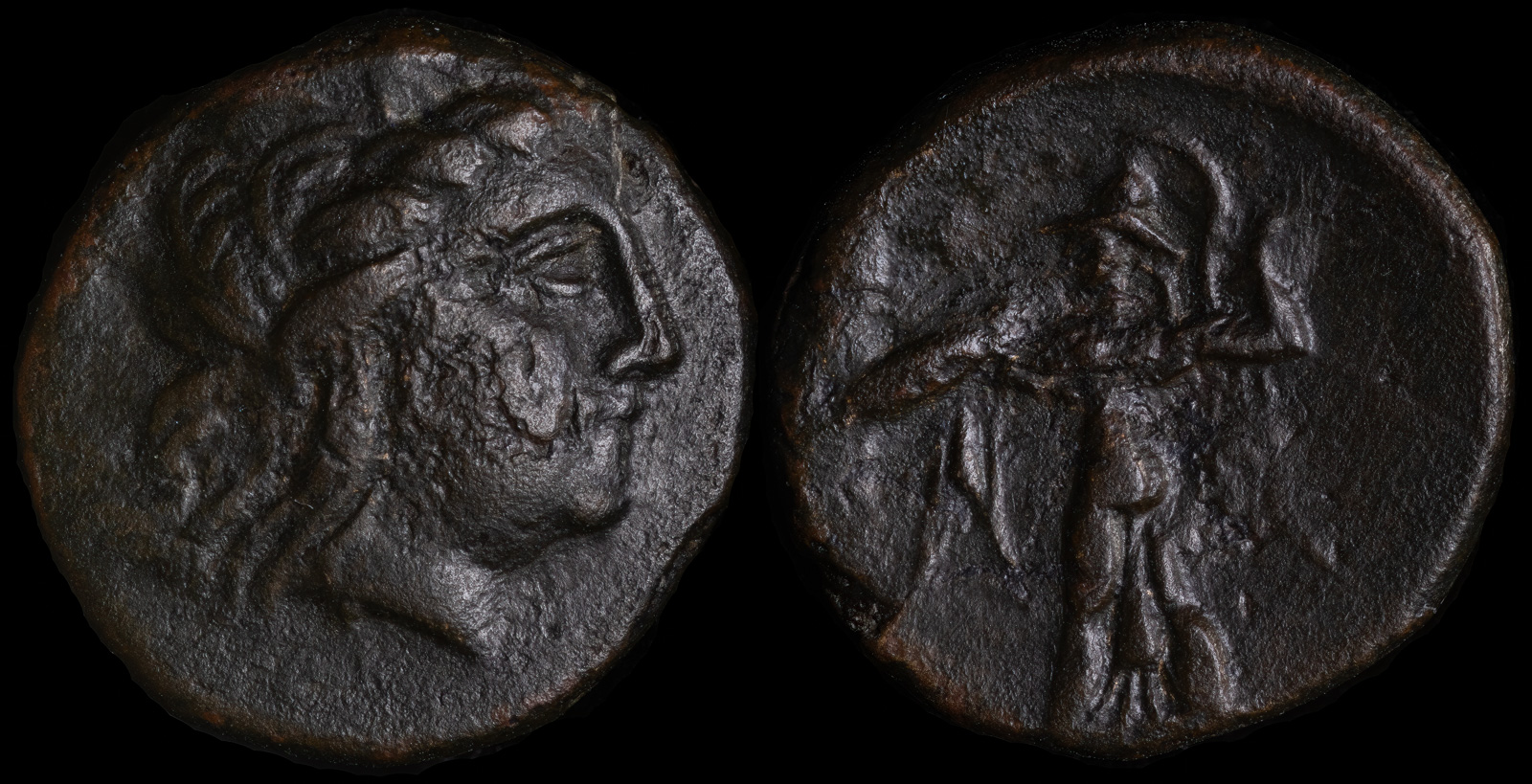
Argos, Argolis
ca 280-260 BCE
Ae Dichalkon 16.3mm 3.2g
Obv: Head of Hera right wearing stephane inscribed ARGE
Rev: The Palladion standing left holding spear and shield
SNG Cop 57
Pictured on this coin is the Palladion, which was a small sacred statue that originally protected Troy. Legend had it that as long as they possessed the Palladion, the city could not be taken. Odysseus and Diomedes snuck into the city and stole the statue. Shortly thereafter, Troy fell.
After the Trojan War, one story has Diomedes returning with the Palladion to Argos, hence its depiction on the reverse.

Argolis, Argos
Septimius Severus, 193-211 CE
Bronze, 21.5mm, 4.07g, 2h
[CE]Π CEYH [ΠΕΡ ΚΑΙ CΕΒ] Laureate head of Septimius Severus to right.
Rev: Α-ΡΓΕΙΩΝ Demeter standing to right, holding grain ears and poppies in both hands.
BCD Peloponnesos 1212.4. NCP p. 38, 17
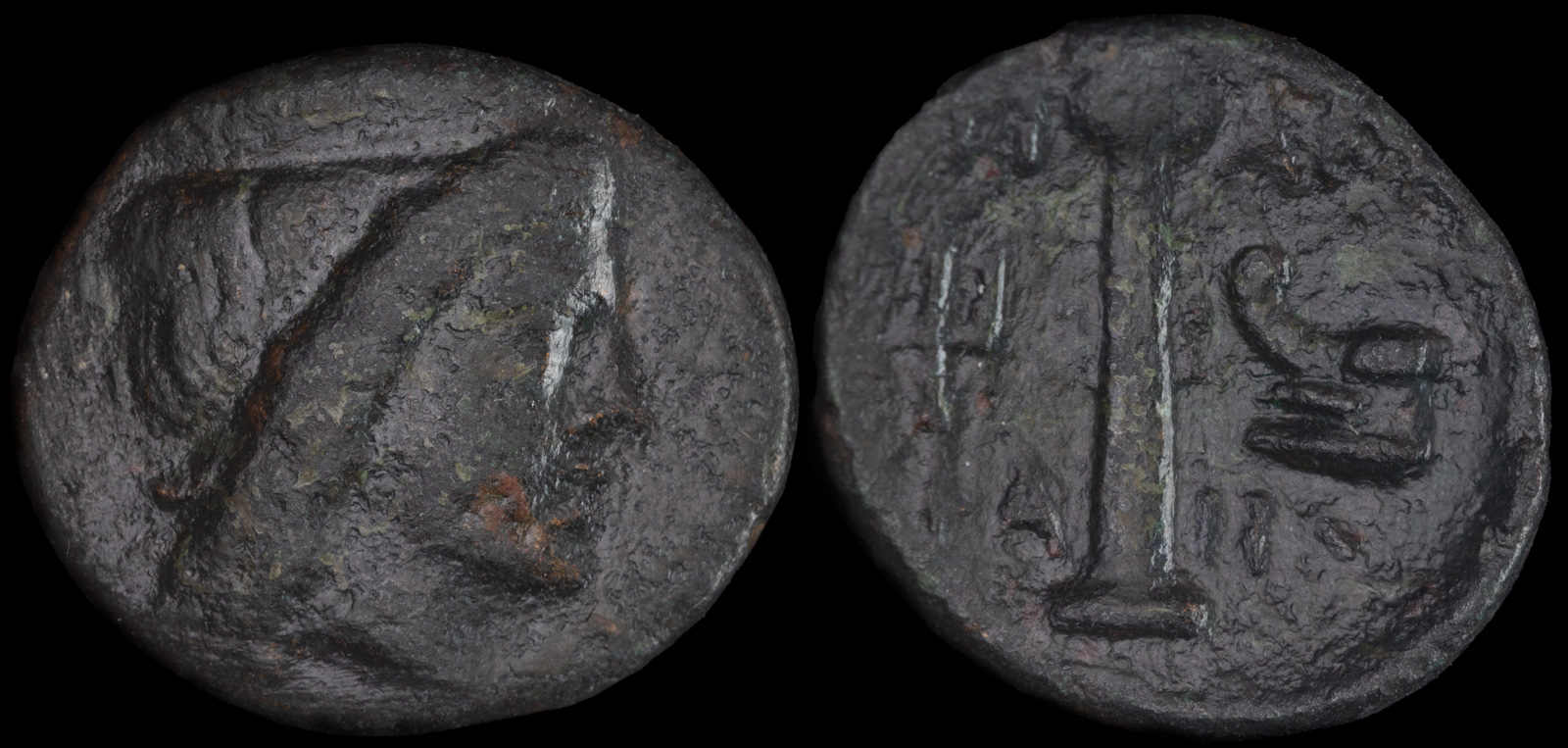
Argos, Peloponnesos
Pamphaes, magistrate
Late 3rd-2nd centuries BCE
AE 17.46mm 3.42g
Obverse: Head of Hera right, wearing stephane
Reverse: Π-AM / ΦA-HΣ, pillar fountain, trident to left, prow to right
BCD Peloponnesos 1155
Ex BCD Collection
Ex Spink Numismatic Circular (April 1987)
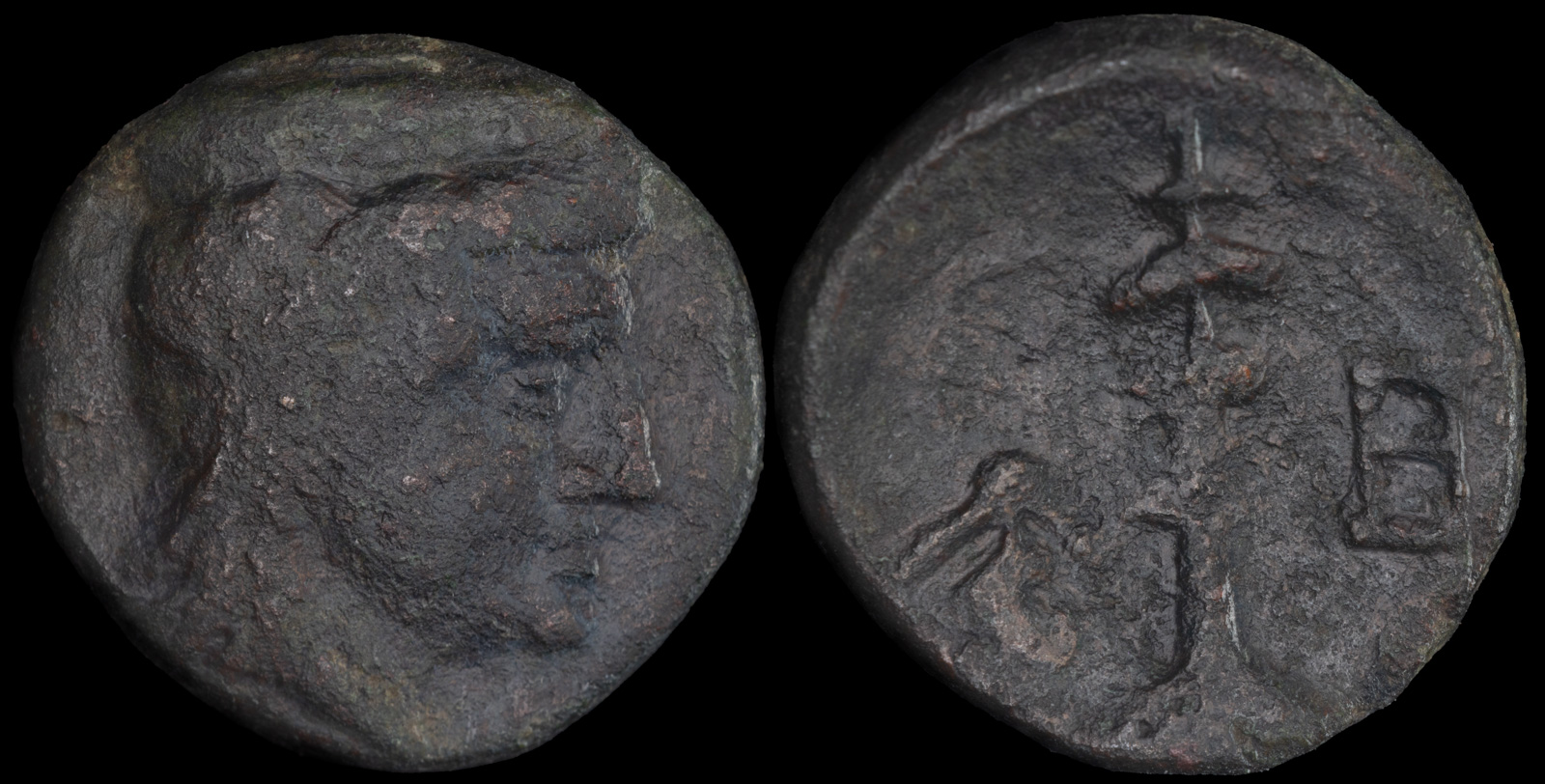
Argolis. Argos
Late 3rd-Early 2nd Century BCE
Æ Dichalkon 16.72mm 3.84g
Obverse: Head of Hera right, wearing ornamented stephanos
Reverse: Pillar fountain, uncertain object to left, archaic heta to right
BCD Peloponnesos 1124-6 types (symbol)
Ex CNG
Ex BCD Collection (not in LHS sale)
When I first saw these coins my first reaction was “Huh? A fountain?”. Around the same time, I was reading Callimachus and the mention of the fountains near Argos was not missed.
I’ve since attempted to find more information about this coinage, but I can’t even locate anything definitive about the dating. The coinage is not overly rare and these types are included in several references, but so far without any arguments for the dates.
While I’m still unsure of the dates, and I believe the best we can do so far is use a broad range of 4th-2nd centuries BCE, the reverse of the first coin is easier to identify. We have a fountain in the center, a prow to the right, a trident to the left, and the magistrates Pamphaes. I believe this depicts the Fountain of Amymone, mentioned in Callimachus’ Hymn on the Baths of Pallas.
“Today, ye water-carriers, dip not your pitchers — today, O Argos, drink ye from the fountains and not from the river; today, ye handmaidens carry your pitchers to Physadeia, or Amymone, daughter of Danaus.”
In mythology, Inachos, the first king of Argos, angered Poseidon by sacrificing to Hera and proclaiming the lands belonged to her and not Poseidon. In fury, he dried up all the fountains. Some time later, the nymph Amymone, one of the Danaids (we’ll get to them later), was sent to fetch water. How exactly she was supposed to obtain this water when the well were dried up we’ll never know, but perhaps Poseidon was gracious enough to leave a spigot.
Anyways, Amymone was walking along when she spotted a stag. For some reason, she figured the best thing to do was kill the thing, so she hooked and arrow and fired away.
Unfortunately in nymph school they didn’t teach archery, and so her arrow missed and hit a nearby satyr, because back then they had satyrs just wandering around everywhere. Unfortunately for Amymone, he was neither maimed nor hurt, but significantly aroused. He chased the poor girl around, hoping to show her his own little arrow, when Poseidon walked into the scene and put a stop to the whole thing.
Grateful, Amymone let Poseidon have what the satyr was denied, and evidently they had a good time of it because Poseidon turned back on all the fountains. They therefore named the fountain for her.
Amymone was one of the 50 daughters of Danaus, perhaps the most high-strung father in all history. To ease his problems, he arranged to marry all 50 daughters to the sons of the King of Egypt, who conveniently had 50 of them. However, the whole thing was a trick, because the Danaids killed their husbands on their wedding night. Only Hypermenestra refused to kill hers, so this time Amymone evidently hit her target.
We don’t know which event happened first, but going back to the Poseidon party, she became pregnant with Naupilos, who later gave his name to the port city of Napflio, which I visited.
Complicating the matter is that, according to Callimachus, the Amymone for whom the fountain was named was a daughter of Inachos, not Danaus. She had only three sisters – Messeia, Io, and Hyper.
Coming back to the coin, I believe the trident to the left is a symbol of Poseidon, and thus a reference to Amymone. It could also simply be a reference to Poseidon alone, since he founded all of the fountains, but then I would expect to see his trident on the other coins.
The prow is less easy to explain. My best guess is it represents Naupilos, the son of Amymone, and the namesake for Napflio, which was the primary port for Argos. Pamphaes seems to be the only magistrate for this particular type.
The second coin is a bit tougher. The fountain depicted here is prettier, with multiple levels of water. To the right is the “heta”, which is an archaic form of the H. To the left is a helmet. The heta is the most interesting. According to Jeffery “The Local Scripts of Archaic Greece”, this form was still in use in Argos in the third quarter of the 5th century BCE, which he states is remarkable. A fragment dated to 450-425 BCE shows its use.
However, it’s very difficult to say whether this coin dates to the beginning of the 4th century BCE, when the heta was still in use, or was simply an archaic addition much later. It was not uncommon, particularly in Sikyon, to include archaic characters in symbolic uses. Jeffery also remarks that “the letter was used with both values for some time before the aspirate was finally abandoned.” Thus, for some time the heta was either a vowel or similar to the English ‘H’.
So what does it mean? I honestly have no idea. My best guess is it’s short for some magistrate’s name. Similarly, I have no ideas for the helmet. According to Callimachus, there was another fountain named for Physadeia.
“Come forth, Athena, Sacker of Cities, golden-helmeted, who rejoicest in the din of horse and shield. Today, ye water-carriers, dip not your pitchers — today, O Argos, drink ye from the fountains and not from the river; today, ye handmaidens carry your pitchers to Physadeia, or Amymone, daughter of Danaus.”
They’re mentioned again in one of his fragments.
“on their heads, sitting on the sacred rock
around which you are flow on both sides.
Lady Amymone, and dear Physadeia,
Hippe, and Automate: Farewell, most ancient homes of the nymphs,
and flow on richly, Pelasgian girls.”
We know this isn’t Automate, because that was a river – not a fountain. This is explained in Antimachos’ commentary on Callimachus.
“Fair-flowing river named for Automate, with your water they bathe a household slave who has given him.”
There’s a well-known Hippe who was the daughter of Chiron, but I found no association of her with a fountain, so I believe this was a different Hippe. I did initially wonder whether the heta could refer to her. It’s technically possible that the Heta signifies her. In classical Greek, she’s spelled with an I, but perhaps in archaic times an aspirated Heta was used.
In terms of the helmet, I have less of an idea. I asked AI and it classified it as a Corinthian helmet, which was my best guess. That would make some sense since Argos and Corinth were close. Perhaps the helmet signified some part of the story of Hippe, if this does indicate her fountain.
These are not the only types to include a fountain. If my theory is true that different types refer to different fountains, then one would expect a coin that references Physadeia. However, her story has been lost as well.
While I understand that my theory is shaky, but the idea that this represents the fountains of Lerna is less so, yet another image of something long lost.
Argos defeats Sparta at the Battle of Hysiae.
Sparta crushes Argos at the Battle of Sepeia. Sikyon participates with 12 ships.
Argos does not participate in the Greek alliance against the Persian invasion, resulting in diplomatic isolation.
Argos obtains possession of Hermione.
Argos joins an alliance with Athens and Thessaly.
Sparta defeats Athens, with 1000 hoplites from Argos, in the Battle of Tanagra. Casualties are heavy on both sides.
The alliance of Athens, Argos, and Thessaly dissolves.
Sparta and Sikyon march under King Agis against Argos, but a truce is arrived at before battle.
As a result of their loss at the Battle of Mantineia and an invasion by Epidauros, Argos undergoes an oligarchic coup.
A union between Argos and Corinth is established.
Artaxerxes III Okhos finally succeeds in re-conquering Egypt under Nektanebo II, with the help of mercenaries from Argos, Thebes, and Mentor of Rhodes.
Melos and Kimolos dispute the ownership of the island Polyaigos. The turn to Argos to mediate, who decide in favor of Kimolos.
326 BCE
Demetrios Poliorketes seizes Epidauros, Sikyon, Corinth, Bura, Argos, and Orchomenos.
Pleistarchos is expelled from Argos.
Pyrrhos of Epiros attacks Argos, which is helped by Antigonos II, and is killed there when an old woman throws a brick on him.
Antigonos II installs the tryant Aristippos the Elder at Argos.
The Nemean Games are transferred to Argos from Nemea (in Kleonai), though some events continued to be held in Nemea.
Aratos of Sikyon takes the Acrocorinth and frees Argos. Xenon steps down in Hermione.
The Sparta s under King Kleomenes III defeat the Achaian League under Aratos of Sikyon (and including Argos and Megalopolis) in the Battle of Dyme.