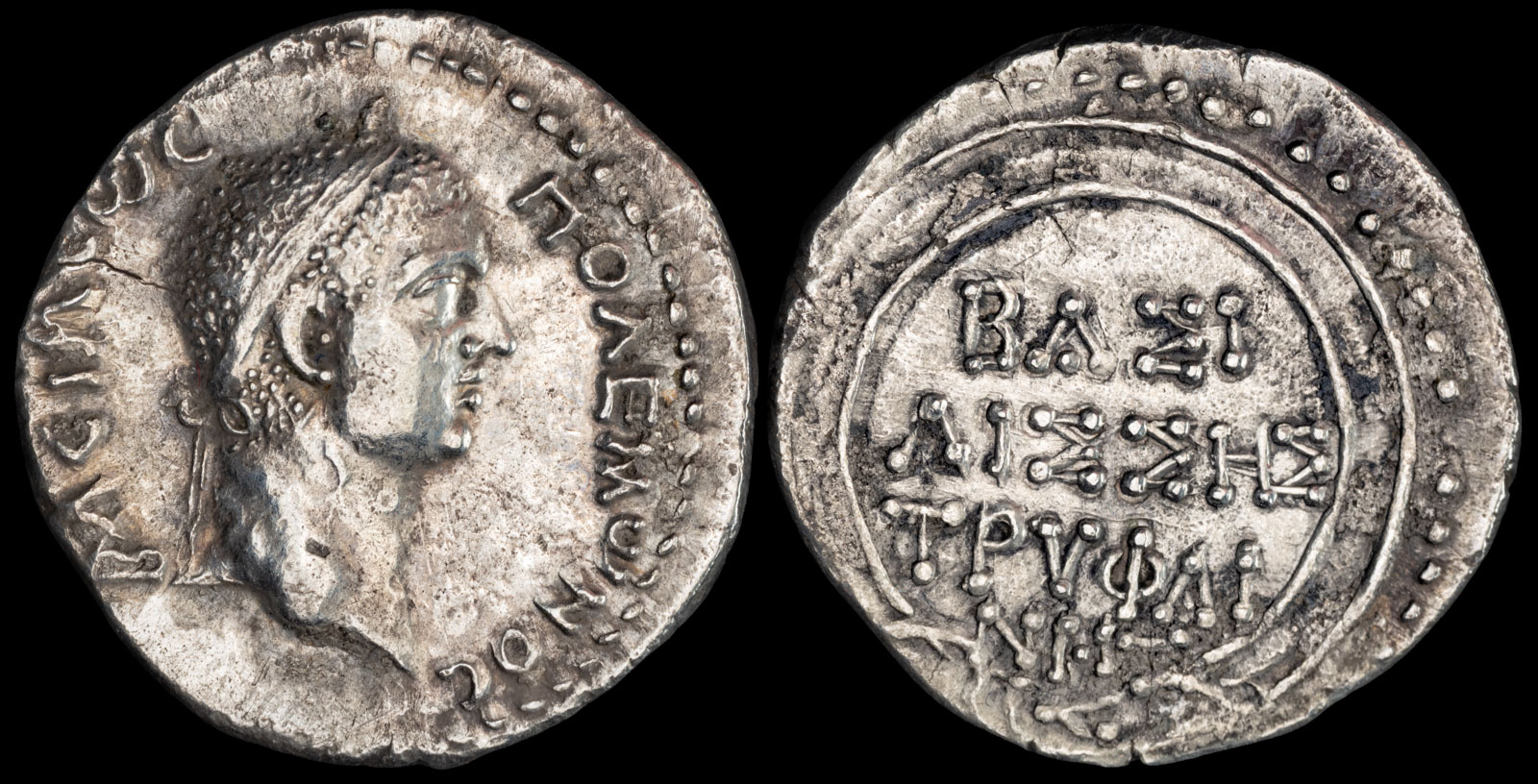
Kings of Pontus, Polemo II, with Tryphaina
7/8-64 CE
AR Drachm 3.57g 19mm
Diademed head of Polemo II to right
/ ΛΙΣΣΗΣ / ΤΡΥΦΑΙ/ΝΗΣ in four lines within diadem
RPC I 3812; SNG von Aulock 6686
Ex Bucephalus Numismatic 2023
Ex Leu 2024
Tryphaena was the daughter of Pythodoris. Her name in Greek means “sumptuous”. It was not the sole instance of the name, having been used prior in Egypt and Macedonia. She is mentioned in this passage from Strabo (12.3.29):
“She had two sons and a daughter by Polemon. Her daughter was married to Cotys the Sapaean, but he was treacherously slain, and she lived in widowhood, because she had children by him; and the eldest of these is now in power. As for the sons of Pythodoris, one of them as a private citizen is assisting his mother in the administration of her empire, whereas the other has recently been established as king of Greater Armenia. “
Tryphaena took an even greater part in Tacitus. Things came to a head after the death of Augustus, when Rhescuporis II desired to take most of Kotys III’s division of Thrace. This resulted in hostilities and the death of Kotys III. Tryphaena fled with her children to Kyzikos. In 19 CE, Tiberius ordered an investigation and invited Tryphaena to testify.
Tryphaena did so, and Rhescuporis II was found guilty. He was sent to Egypt but never arrived there, having been conveniently killed. Kotys III’s part of Thrace was placed in the charge of Trebellenus Rufus as guardian to the sons of Tryphaena. Rhescupooris III, the son of Rhescuporis II (though the two were supposedly not simpatico) received his father’s portion.
We know Tryphaena’s full name and her definite descent from Pythodoris through inscriptions in Kyzikos. The city had become her second residence and she ordered numerous restorations. Several inscriptions naming her have been found there, including one stating.
“Antonia Tryphaena, daughter of King Polemon and of Queen Pythodoris”
Victor Cojacaru mentions that Antonia Tryphaena’s first name “reminds us of Antonia Minor Hybrida, the second wife of the triumvirate Mark Antony, and his daughter Antonia.” She is believed to have been the mother of Pythodoris, and thus Pythodoris was Mark Antony’s granddaughter and Tryphaena her great-granddaughter. This genealogy is not universally agreed upon.
More interesting is Tryphaena’s presence on this coin. Although Cassius Dio labeled Polemon II as the son of Polemon I, Cojacaru points out that it’s no longer controversial that Polemo II was actually his grandson, thanks to inscriptions from Kyzikos.
Tryphaena must have been born between the marriage of Polemo I and Pythdooris, commonly ascribed to 13/12 BCE, and when Polomo I was killed by the Aspurgionoi in 9/8 BCE. She married Cotys III in roughly 12/13 CE (and thus was nearly an old maid by their standards), and he was killed in 18 CE. Inscriptions show that she was appointed as a priestess of the cult of Julia Drusilla by Caligula in 38 CE, and then again appointed by Claudius for Livia Drusilla in 42 CE. It is believed she spent the rest of her life in Kyzikos.
Therefore, why is she named on this coin? On other types, her portrait is also included. However, there is some debate in that area, since some of these types name her explicitly, while others don’t. CNG has argued that the portrait on those without a nmae are not of Tryphaena, but are instead of Agripinna Junior.
Clearly, Tryphaena’s image, veneration, and/or fame was important enough to Polemon II to include his mother on his coinage. It is believed that he took power around 38 CE, when Pythodoris died. There had been some speculation that Polemon II was the brother of Tryphaena mentioned by Strabo as helping her manage the kingdom, but as mentioned above, inscriptions have disproven this. It appears that, had this brother been capable of running the kingdom, he would have run it instead of Pythodoris.
How old was Polemon II at the time? He must have been born between 12 CE and 18 CE, and thus was between twenty to twenty-six years old, hardly an infant. Typically in this age women served as regents for their children, but Tryphaena had no need of being a regent. Nevertheless, she ruled together with Polemon II, even though she didn’t appear to live in the kingdom, until 49/50 CE, when coinage mentions only Polemon II.
It is possible that Tyrphaena ruled alone for some short time in Thrace. At the very least, she was powerful at the time, enough to dominate Kyzikos and be depicted and named as Queen of Pontos.
Polemon II also proved to be an interesting character. He was mentioned by Josephus as having converted to Judaism to marry he Cilician princess Berenike. It was a marriage of convenience, not of love. She needed certain rumors to stop, and he was enamored with her money. The marriage was short lived.