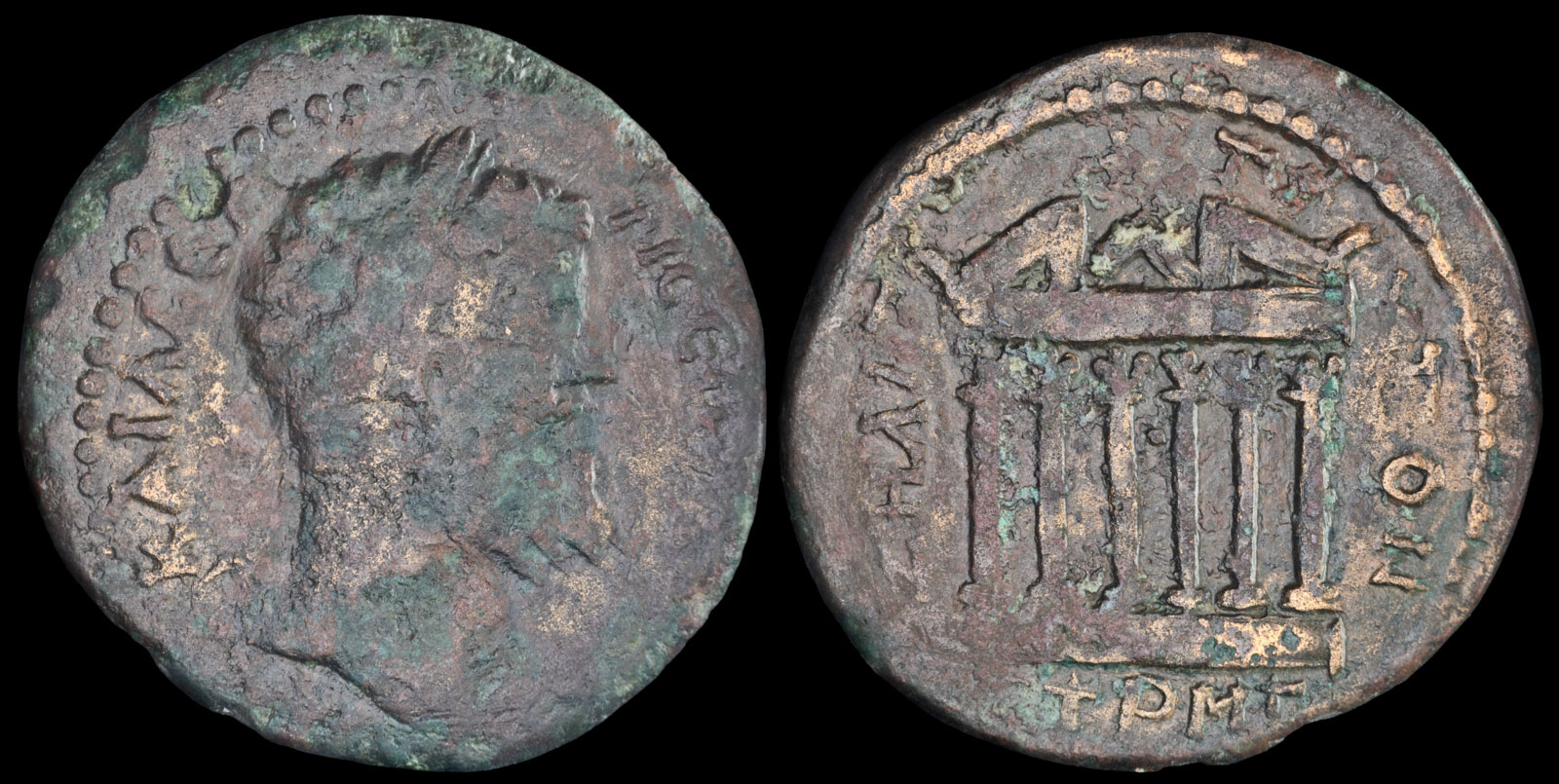
Pontus, Zela
Septimius Severus (193-211 CE)
Dated Year 143 – 206/7 CE
AE 29.02mm 14.45g
Obverse: AV KAI Λ CEΠ-TI CEOVHPOC AVΓ, laureate head right
Reverse: ZHΛIT-ΩN TO-V PON / ET PMΓ, hexastyle temple with broken pediment
RPC V.3 78675 – 2 specimens
I was initially very intrigued but this coin when the seller mentioned that the “broken pediment” could indicate the damage from an earthquake. A further search on other examples of the type indicated a similar assumption, but was it correct?
As far as I can tell, it is not. There were very damaging earthquakes in 344 (which destroyed Neocaesarea) and in 499 (which again destroyed Neocaesarea and Nikopolis ad Lykos), but no ancient source nor archeological remains suggest an earthquake around the time this coin was minted.
Further, there are other examples of temple coins from Zela, dated with the same year, which illustrate no damage. Likewise, no other city minted coinage that suggested damage to their temples. Thus, the statement that this coin depicts a broken pediment from earthquake damage seems to have no merit.
But what actually is depicted here? Well, the clue lies in the other temple coins without the “broken pediment” that were minted at the same time. Those depict a temple with a pointed top and a star in the middle. Looking closely at this coin, it becomes evident that the pediment was “removed” in order to show the exact same top, and between the columns appears a star.
Thus, this coin appears to depict the outside of the Temple of Anaitis. It either surrounded or served as the “gateway” to the inner altar to Anaitis, which is depicted on the other types. In the Weber Collection Catalog, a similar conclusion was made.
“front pediment through which the farther pediment can be seen.”
The Temple of Anaitis was extremely important in antiquity, and indeed Zela for most of its history was a virtual “temple state”. Strabo discussed it:
“and they instituted an annual sacred festival, the Sacaea, which the inhabitants of Zela (for thus the place is called) continue to celebrate to the present day. It is a small city belonging for the most part to the temple slaves. But Pompey added considerable territory to it, settled the inhabitants thereof within the walls, and made it one of the cities which he organized after his overthrow of Mithridates.”
And again:
“As for Zelitis, it has a city Zela, fortified on a mound of Semiramis, with the sanctuary of Anaitis, who is also revered by the Armenians. Now the sacred rites performed here are characterized by greater sanctity; and it is here that all the people of Pontus make their oaths concerning their matters of greatest importance. The large number of temple-servants and the honors of the priests were, in the time of the kings, of the same type as I have stated before, but at the present time everything is in the power of Pythodoris. Many persons had abused and reduced both the multitude of temple-servants and the rest of the resources of the sanctuary. The adjacent territory, also, was reduced, having been divided into several domains — I mean Zelitis, as it is called (which has the city Zela on a mound); for in, early times the kings governed Zela, not as a city, but as a sacred precinct of the Persian gods, and the priest was the master of the whole thing. It was inhabited by the multitude of temple-servants, and by the priest, who had an abundance of resources; and the sacred territory as well as that of the priest was subject to him and his numerous attendants. Pompey added many provinces to the boundaries of Zelitis, and named Zela”
Thus, it served primarily as a temple city until the time of Pompey. During Roman times, its influence increased, and from the time of Trajan to Septimius Severus it minted coinage. Its temple coinage peaked under Septimius Severus, and his reign seems to have been a time of increased building competition between the cities of Pontus, since several cities there issued exceptional architectural coins at this time.
The temple was supposedly founded by Semiramis, a legendary queen of Assyria. During the Achaemenid period, its influence grew and it’s believed during that time the temple reached its peak in influence.
Today, there are no remains of the temple. It’s believed to have been at the top of a steep mound, on top of which today is Zile castle.