Scorpion
View All Tags
The scorpion’s most famous place in Greek mythology came through the story of **Orion**. According to several ancient traditions, a giant scorpion was sent to kill Orion after the great hunter offended a deity, most commonly **Artemis or Gaia**, although the circumstances vary between authors. The scorpion succeeded in killing or defeating Orion and was subsequently placed among the stars. Orion and Scorpio were positioned on opposite sides of the heavens: as **Scorpio rises, Orion sets**, a celestial arrangement ancient writers interpreted as the hunter eternally fleeing from his killer. In this myth the scorpion represented the ability of divine or natural forces to humble even the strongest and most boastful mortal.
Within the zodiac, **Scorpio** was therefore closely connected with themes of **death, danger, struggle, and transformation**. The Greeks called the constellation *Skorpios*, while the Romans called it *Scorpius* or *Scorpio*. Ancient astrology regarded Scorpio as the **house of Mars**, the god of warfare, aggression, bloodshed, and force. This planetary association reinforced the scorpion’s martial and destructive qualities. Scorpio was also classified as a **water sign**, creating an interesting contrast between its fiery, venomous appearance and its astrological element.
Ancient astrologers frequently attributed intense or formidable characteristics to Scorpio. Because Mars ruled the sign and the scorpion itself possessed a poisonous sting, those born under it could be described as **forceful, secretive, dangerous, passionate, or capable of fierce retaliation**. Yet its symbolism was not entirely negative. The scorpion could also represent **defense and protection**, since its sting was principally a weapon against threats. In magical and astrological contexts, images of dangerous animals could themselves become protective symbols, using the feared power of the creature against hostile influences.
The scorpion also possessed broader cosmic significance because the constellation occupied a particularly dramatic portion of the night sky. Its bright reddish star **Antares**, whose name means “rival of Ares” because its color resembles the planet Mars, strengthened Scorpio’s connection with warfare and bloodshed in Greek astronomical tradition. The large, easily recognizable constellation made the scorpion one of the most visually convincing creatures of the zodiac.
For Greeks and Romans, therefore, the scorpion embodied a complex combination of **danger, vengeance, divine punishment, martial power, protection, and mortality**. In the zodiac these meanings were intensified through Scorpio’s association with Mars and the myth of Orion. Its central lesson was one particularly familiar to ancient mythology: **great power does not always belong to the largest creature, and even the mighty can be destroyed by something small, hidden, and underestimated**.
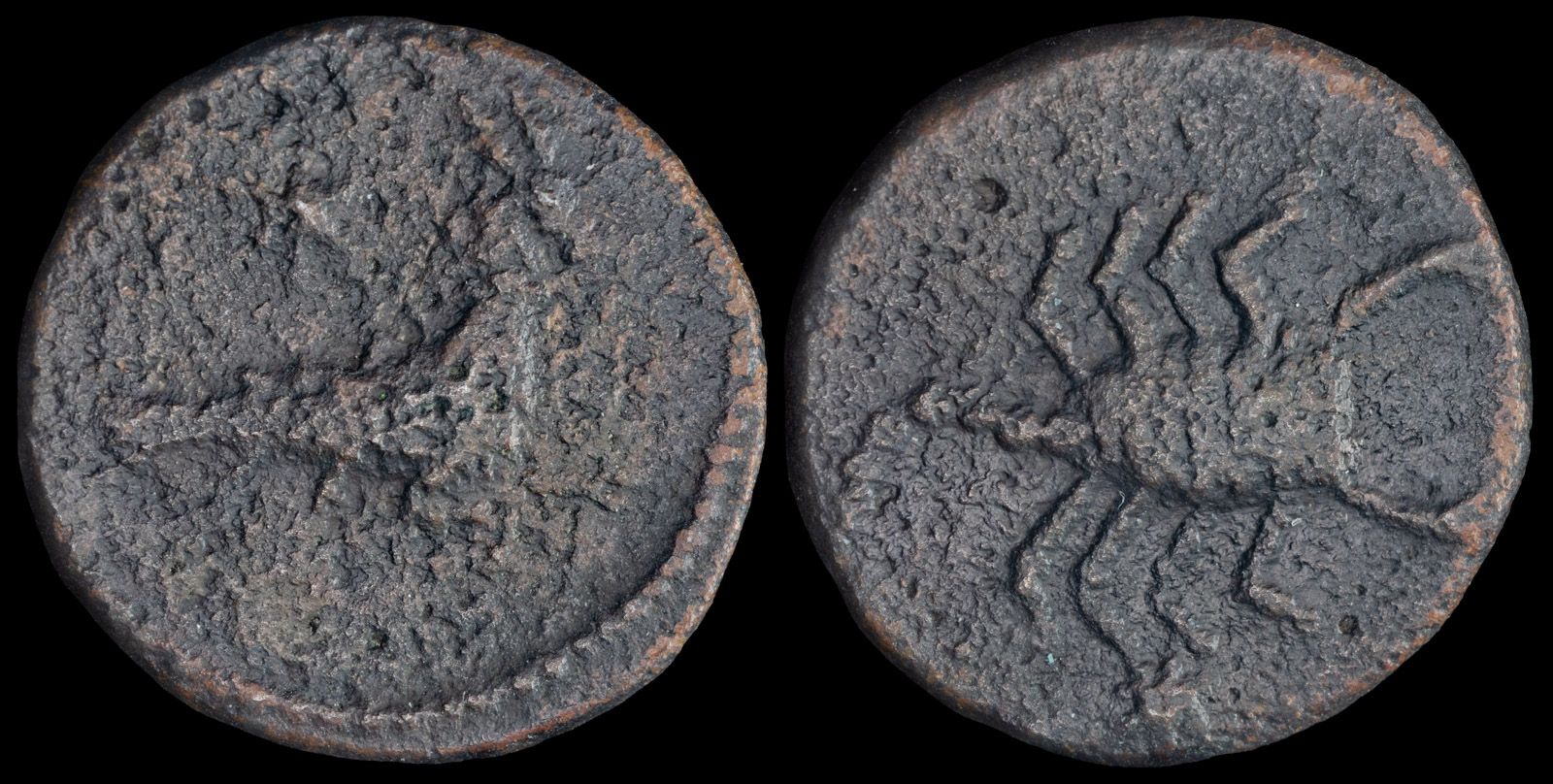
Cyprus, Koinon
Pseudo-autonomous 14-18 CE
AE 16.49mm 2.52g
Obverse: Capricorn right, star above
Reverse: Scorpion right
RPC I 3916