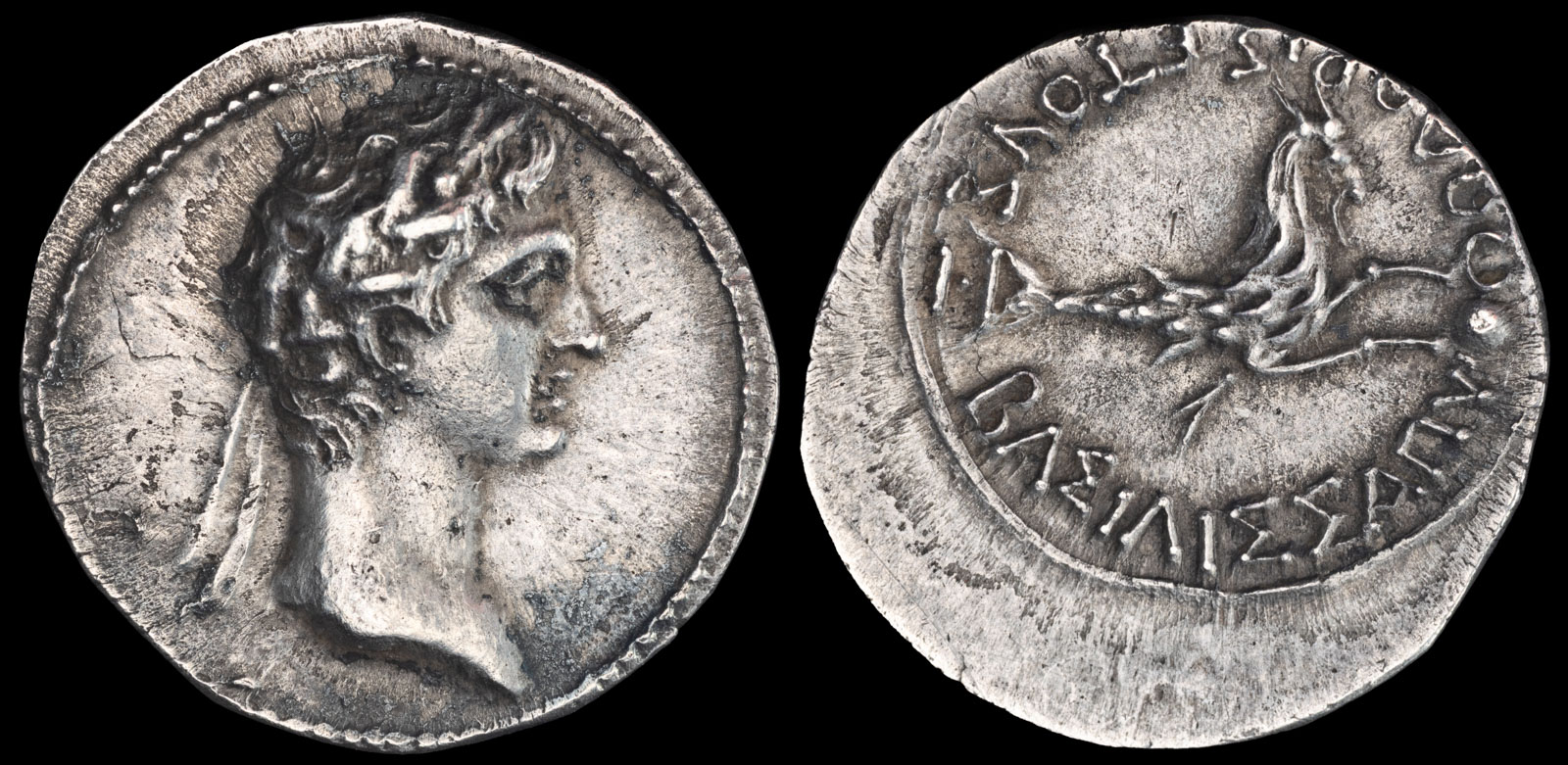
Kings of Pontus, Pythodoris, with Divus Augustus
Dated CY 60 (A22/3 or 23/4 CE)
AR Drachm 18.5mm, 3.70g, 12h
Struck under Tiberius
Laureate head of Divus Augustus right /
Capricorn right, globe between its forehooves; ETOYΣ Ξ (date) in legend.
Leschorn, Antike Ären 1a; RPC I 3803; RG 19
Thanks to her presumed friend Strabo, we know more about Pythodoris than we do most ancient queens. Not only is she attested to ruling in her own name, beyond even acting as a regent, but her reign was praised. She is thus one of the most important women to have ruled along in antiquity, and also one of the most difficult in terms of coinage to obtain.
The ancient collector and historian will first have to get by the fact that there were at least three queens around the same time by the name of Pythodoris. Besides Pythodoris of Pontos, there was Pythorodoris I of Thrace, who appears on coins with her husband Rhoemetalkes I. They had a son Kotys III, who married Tryphaena, daughter of Pythororis of Pontos. Kotys III and Tryphaena then had a daughter Pythodoris II of Thrace, who married Rhoemetalkes III. They were the last monarchs of Thrace before it became a Roman province. Confusing enough?
Strabo spent some space discussing Pythororis. Since he was from Pontos itself, many have surmised he personally knew her. Certainly, from his description, he had warm feelings both for her person and for her rule.
11.2.18
At last Polemon got Colchis; and since his death his wife Pythodoris has been in power, being queen, not only of the Colchians, but also of Trapezus and Pharnacia and of the barbarians who live above these places, concerning whom I shall speak later on.
12.3.29
But the Tibareni and Chaldaei, extending as far as Colchis, and Pharnacia and Trapezus are ruled by Pythodoris, a woman who is wise and qualified to preside over affairs of state. She is the daughter of Pythodorus of Tralles. She became the wife of Polemon and reigned along with him for a time, and then, when he died in the country of the Aspurgiani, as they are called, one of the barbarian tribes round Sindice, she succeeded to the rulership. She had two sons and a daughter by Polemon. Her daughter was married to Cotys the Sapaean, but he was treacherously slain, and she lived in widowhood, because she had children by him; and the eldest of these is now in power. As for the sons of Pythodoris, one of them as a private citizen is assisting his mother in the administration of her empire, whereas the other has recently been established as king of Greater Armenia. She herself married Archelaus and remained with him to the end; but she is living in widowhood now, and is in possession not only of the places above mentioned, but also of others still more charming, which I shall describe next.
There has been some debate over when these coins were minted, and when Pythodoris was actually in power. According to Strabo, she twice ruled Pontos. First, there was an interval between the death of her first husband Polemo I and her marriage to Archelaos of Capadoccia. She then returned to Pontos and again ruled it alone after the death of her husband Archelaos. My feeling is we can take Strabo for his word on his description of the events, since he was well-connected with Pontos and may have even finished his career there.
Therefore, let’s take a look at the dates based on Strabo.
37 BCE Mark Antony names Polemon I as king of Pontos
8 BCE Suspected death of Polemon I
14 CE August 9th the death of Augustus
17 CE Pythodoris’ second husband Archelaos dies. He had been summoned to Rome by Tiberius to stand charges of rebellion, but died of nature causes before the trial.
18 CE Artaxias III, son of Pythodoris, takes the throne in Armenia
23 CE This is believed the last published edition of Strabo’s “Geographica”.
When Polemon married Pythodoris is still up for debate. Traditionally, this has been 12/13 BCE, based on the identification of 14 BCE as when Polemon divorced his first wife Dynamis. However, Peter Thonemann argues that a M. Antonius Polemo was active in Laodikeia around 5 BCE, and if he was Pythodoris’ son then they could not have possibly married in 12/13 BCE. He therefore suggests a date of 30 BCE.
My opinion is Thonemann is incorrect and the traditional date is the most likely. Thonemann’s argument is based off an inscription that names Antonius Polemo as being descended from “kings and tetrarchs”. The contrary view is that this family line was descended from an Antonius Zenon, son of Zenon of Laodikeia and brother of Polemo I.
Victor Cojocaru, in his paper about Tryphaena, considers this argument absurd, and I tend to agree with him.
This coin is dated with the year 60, though we’re not quite sure from which year. Other types also from Pythodoris state year 63. The coinage of Polemo II, who I’ll cover in a future post, appear to date from his own reign, which appears to have started in 37 CE. Since Leschorn makes a good point that Pythodoris was unlikely to have reigned alone for 63 years, his statement that this is the reign of Polemo I makes sense. But from which year?
If we take 37 BCE as the starting year, then this coin would date to 23 CE and the later issues to 26 CE. We don’t know in which year Strabo wrote about Pythodoris, but this would align with those dates. A date substantially earlier wouldn’t make sense since it’s generally thought that Pythodoris married Archelaos not long after Polemo died, and thus before 17 CE she did not rule Pontos.
According to Leschorn, the identification of the reverse is still debated between Tiberius and Augustus. However, given that the reverse has a Capricorn, which was the zodiac of Augustus (Tiberius was a Scorpio), I believe the obverse depicts Augustus, even if it was minted after his death. Augustus was considered the originator and guarantor of her reign, and thus by referencing him on her coinage, it’s likely that Pythodoris was paying homage to Rome itself through him.
The link between Pythodoris and Mark Antony is also debated. Her mother was a noblewoman named Antonia, and has been thought to have been a daughter of Mark Antony. Other scholarship makes her his niece. My suspicion, partly because I have a bias now that I own this coin, is that Antonia was his daughter. Pythororis’ son was Marcus Antonius Polemon Pythodoros and daughter Antonia Tryphaena. Thus, it seems clear that at least Pythororis wanted to promote this direct lineage. As a granddaughter, she lived in a time when there lived people who would have known if this were false.
If the relationship is true, then Pythodoris’ grandmother would have been Antonia Hybrida Minor, Mark Antony’s second wife and paternal cousin. In 44 BCE, she was engaged to a son of Lepidus, but that was broken.
Pythodoris is also well-attested in extant inscriptions. A statue base in Athens provides “Queen Pythodoris Philometor”. In the Asklepion of Kos, there is “[The] people [honored] Queen Pythodoris Philometor, on account of goodwill.”, dated to around 7 BCE, presumably just after the death of Polemon.
From Smyrna, we have an inscription for her son Zenon, who became Artaxias III of Armenia.
“The people honored Zenon, son of Queen Pythodoris Philometor and King Polemon, and grandson through his mother of the benefactress Antonia.”
It is from this inscription we know her mother as Antonia.
In 2009, another inscription was found in Pantikapaion. It is believed to reference an offering by Pythodoris herself in a visit to the Bosporus capital during the reign of Aspurgos. It may have been a goodwill mission to arrange the marriage of Aspurgos with Gepaepyris, the daughter of Antonia Tryphaena and thus Pythororis’ granddaughter.
Amazingly, it appears that not only Pythodoris, but her daughter Tryphaena and granddaughter Gepaepyris (as regent to a young son) also ruled alone at some point, and all three have coins referencing them as queen. This doesn’t include Polemo I’s first wife, Dynamis, who ruled the Bosporan kingdom herself after the divorce.
The date of Pythodoris’ death is uncertain, but if we go by the regal dating of Polemo II’s coinage, then she passed in 37 CE.