Praefericulum
View All Tags
The actual appearance of the praefericulum is somewhat uncertain, despite the confidence with which the term is often used in modern coin catalogues. Festus, the Roman antiquarian whose work preserves much older religious terminology, describes the praefericulum as a bronze vessel without a handle, open at the top and resembling a basin, used in sacrifices in the sanctuary of Ops Consiva. This description does not correspond particularly well to the elegant, one-handled sacrificial pitcher that older antiquarian and numismatic literature frequently calls a praefericulum. Some modern scholars have therefore argued that the familiar pitcher seen in Roman sacrificial imagery is more properly called a guttus or, more generally, an urceus. The terminology is consequently not entirely settled.
In practice, however, the object traditionally called a praefericulum in numismatics is closely associated with libation ritual. An attendant, often a youthful camillus, could carry the wine or other liquid to the altar, while the principal sacrificer poured the offering using a shallow patera. Wine and incense commonly formed part of the preliminary stage of Roman sacrifice, the praefatio, in which offerings were made upon the altar before the animal victim was killed. The vessel therefore belonged to the visual vocabulary of correctly performed Roman religion: altar, patera, incense box, sacrificial implements, and ritual pitcher together immediately identified a scene as one of sacra, the proper rites owed to the gods.
This explains why the praefericulum became especially important in Roman coin iconography. It frequently appears together with other priestly objects such as the lituus, simpulum, secespita, and patera. Such objects did more than illustrate a religious ceremony; on a coin they could advertise the emperor’s or magistrate’s membership in a priestly college and therefore his legitimate role within the Roman religious establishment. The American Numismatic Society’s OCRE catalogue, for example, still identifies the vessel beside Pompey’s portrait on one restored imperial type as a praefericulum, while Roman Provincial Coinage uses the same term for prominent vase types on issues of Roman colonies such as Parium.
The symbolism was therefore broader than simply “a jug for wine.” The praefericulum represented sacrifice, ritual purity, priestly office, and the maintenance of the pax deorum, the harmonious relationship between Rome and its gods created through the correct performance of religious obligations. When it occurs prominently on a coin, particularly alongside another priestly implement, it should usually be understood as a badge of religious authority and sacerdotal status. At the same time, because Festus’ description differs from the pitcher conventionally given this name, it is worth remembering that “praefericulum” in modern numismatic descriptions is partly a traditional identification rather than an archaeologically certain one.
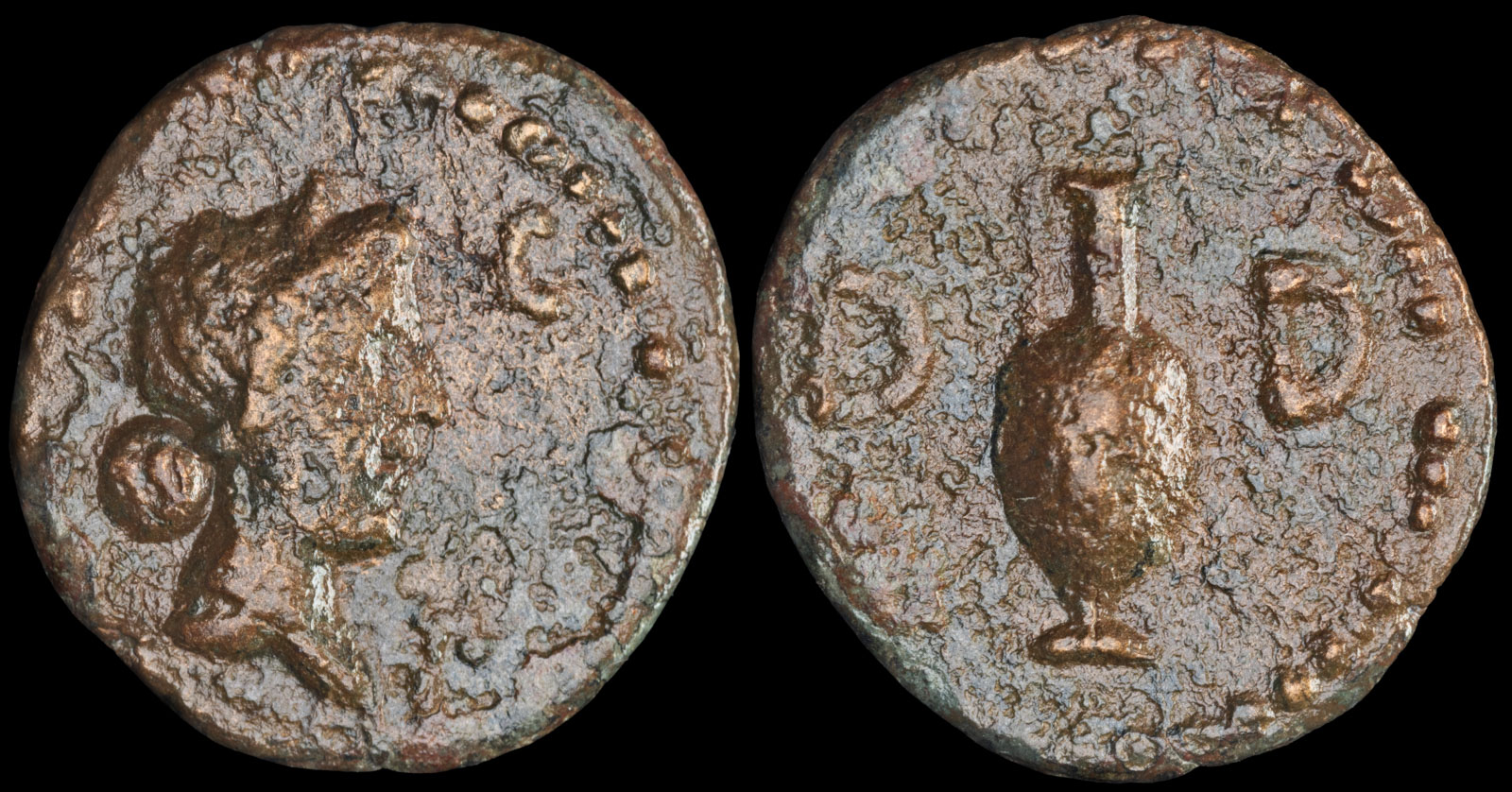
Mysia, Parium
Pseudo-autonomous issue, struck under Julius Caesar
circa 45 BCE
Æ Semis 2.20g, 15mm
Female head right, wearing stephane; C G I P (Colonia Gemella Iulia Pariana) around /
Praefericulum, D-D across fields
RPC 2259