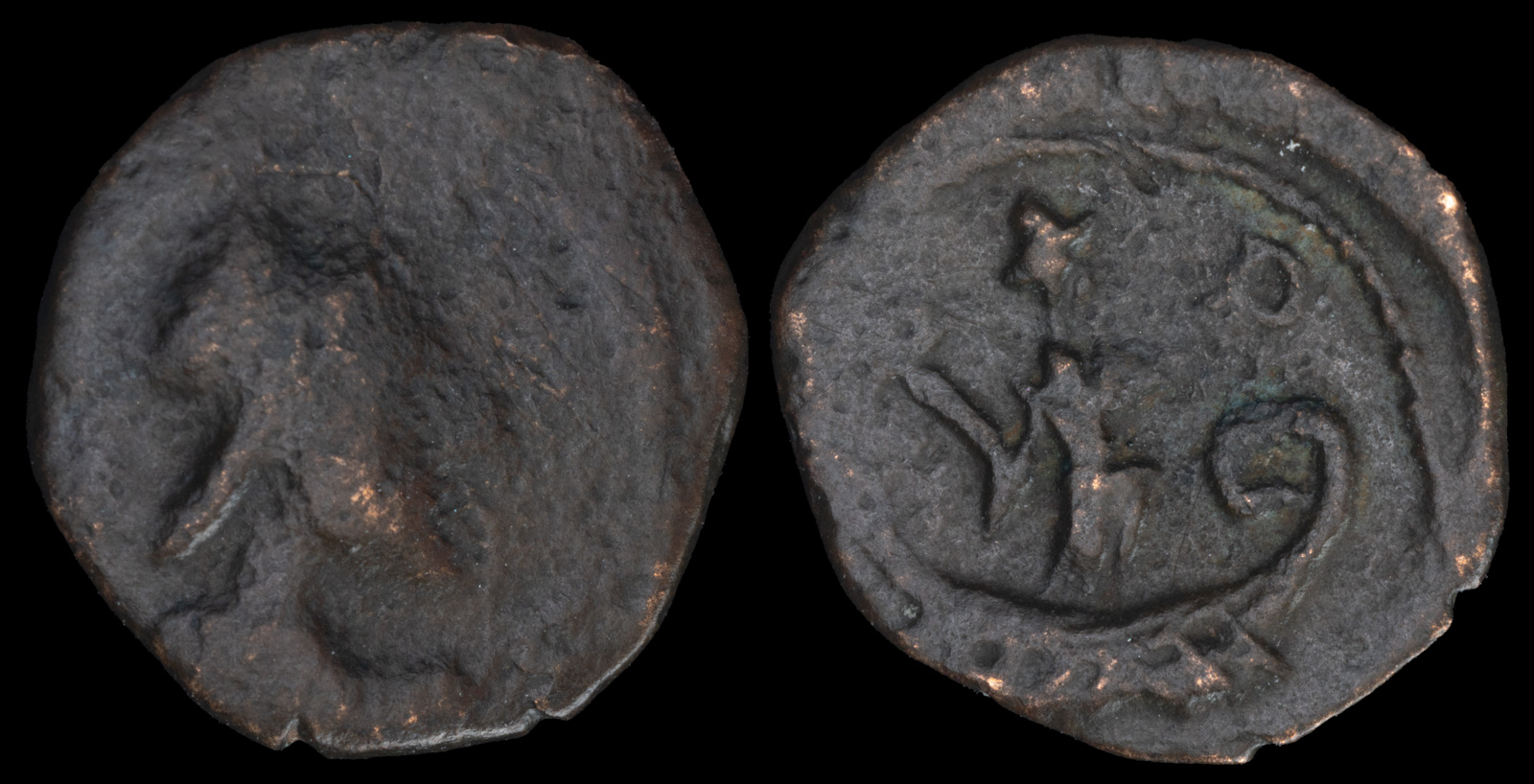
Palmyrene, Palmyra
Circa 2nd-3rd centuries CE
AE 9mm 0.43g
Obv: turreted bust of Tyche right
Rev: Astarte(?) standing in galley facing, holding uncertain object in raised hand; illegible inscription or object to left.
Unpublished in the standard references, but cf. Stephen Album 28, 14
Palmyra was an ancient city first mentioned in the 2nd millennium BCE. It grew extremely wealthy with trade, being a major stop on the Silk Road. Under the Roman Empire, it grew to be a flourishing multicultural center that spoke numerous languages, though most of its business was in Greek.
In the 260’s, the Palyrene king Odaenathus defeated Shapur I, who himself had recently killed the Roman Emperor Valerian in battle. His daughter, Zenobia, acting as regent for the young Vabalathus, later proclaimed independence from Rome, and for a number of years ran a separate kingdom. In 273, Zenobia was defeated by Aurelian and the city was demolished.
A much smaller city was refounded under Diocletian, and lasted until destroyed by the Timurids in the 1400’s. Many of the city’s massive remains used to be visitable to tourists, until destroyed recently by the Islamic State.
The Palmyrene King Odaenathus retakes Nisibis and Carrhae
The Palmyrene King Odaenathus launched another invasion of Persia, but haa to call it off
The Palmyrene King Odaenathus is assassinated. He is succeeded by his son Vabalathus under the regency of Queen Zenobia
The Palyrene queen Zenobia declares independence from Rome
Palmyra destroyed by Aurelian