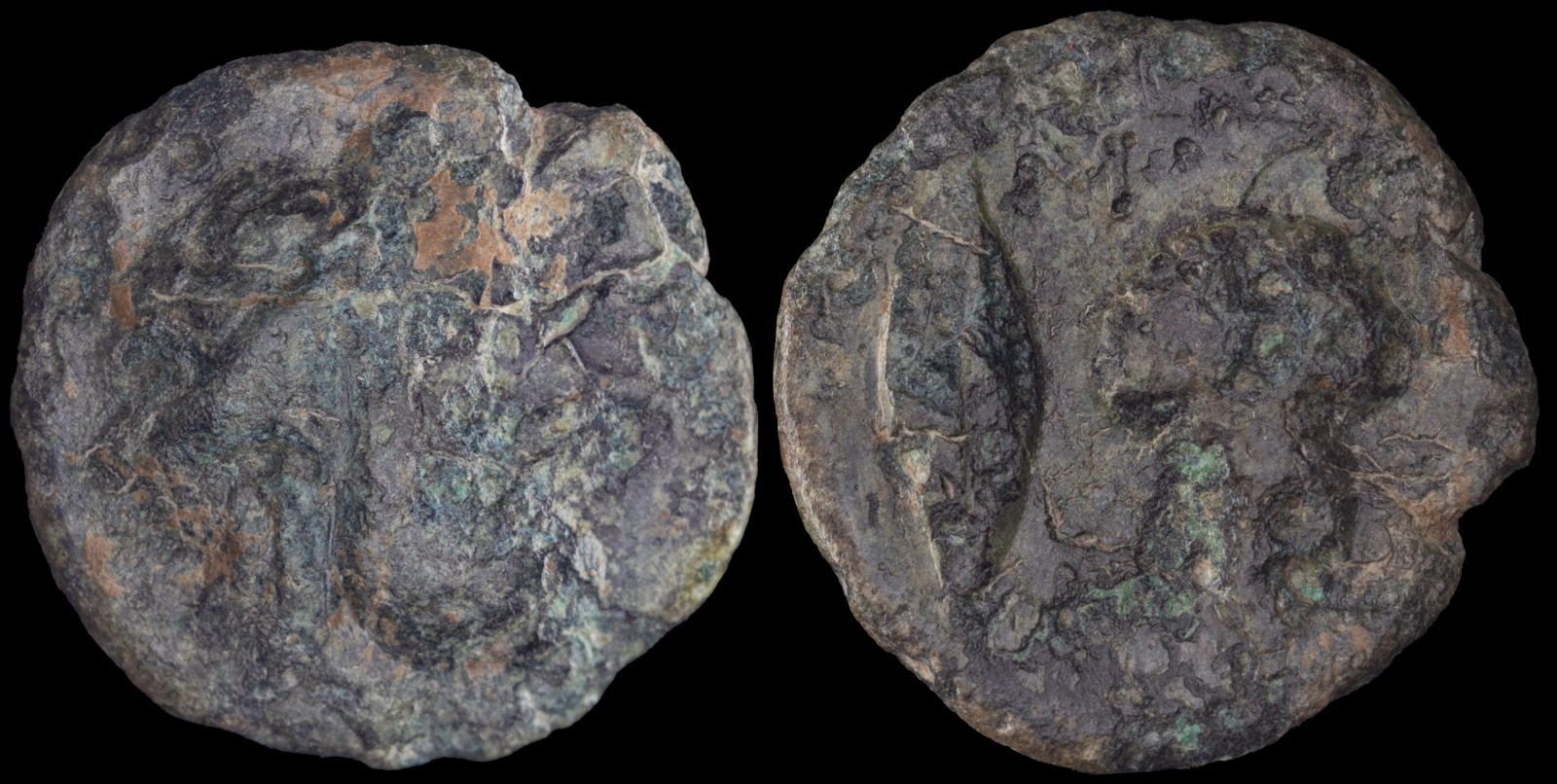
Cyclades, Mykonos
4th-3rd centuries BCE
AE 16mm, 2.44g, 1h
Head of Dionysos to right, wearing ivy wreath.
Rev. M-[Y/K-O] Grape bunch; to left, barley grain
BMC 1-2. HGC 6, 616. SNG Copenhagen 698
Ex Collection of Dr. Paul Probst
Ex Perioikos Collection
Ex Obolos 2021
Some time ago, I purchased what I thought was a very rare coin from Mykonos, only to be (semi-) bitterly disappointed. While it was rare, being from Skamandreia with a nice portrait of the nymph Ida and her name below – just to make the identification clear – it was no coin of Mykonos.
I’d been after a coin from the city ever since spending some time there on vacation. We were there in the month of April, before drunk party-goers occupy the island and clog its streets. Many places we had to ourselves, including several of its famed beaches. Overall, it was a very nice stay and – knowing that ancient coins existed – one moved to the top of my list.
To ensure I didn’t make the same mistake again, I purchased a translation of Svoronos’ “Numismatics and History of Mykonos.” He was born on the island and naturally had a special attraction to its coinage. I then placed it front and center on my desk to remind myself daily of the target. Never had I been so determined to acquire a type.
This guide proved invaluable, because the majority of coins sold as “Mykonos” these days are misattributed – I suspect often maliciously. Another that sold for a hefty sum recently I believe is a fake.
Granted, my coin is in rough shape, but I’m perfectly happy with it. All of the necessary details are there and in fact it’s more detailed than another Mykonos example that sold for more in the same auction (it was smoothed, so it appeared better, but on closer look had lost more details). I was also pleased to obtain it for considerably less than it sold for in 2021. This further proves that ancient coins are awful investments.
Interestingly, while today Mykonos receives the tourists and next door Delos only day trippers (overnighting is not allowed), in ancient times it was the opposite. Delos was the religious center of the Greek world while Mykonos was used for supplies and transit.
Little appears to be known about Mykonos’ ancient history. It never grew powerful enough to be mentioned at any length by ancient writers. Euripides referred to its “beach” – though we don’t know which one. It was also mentioned sparingly by Ovid, Vergil, and Statius.
Clearly from this coin we can see that wine production, which continues today, existed on the island. However, in an overview of the best wine producing regions in Athenaios, Mykonos is never mentioned. In modern times, though, our neighbors – who traveled with us – received the rudest treatment when they ordered a glass of French champagne there. If I recall, they were selling bottles for $1500/each or glasses at $50, so they ordered a glass and the guy in charge barked loudly to the waitress “give these peasants a glass.” I would have waltzed straight out of there, but they drank it. We’d previously toured the Champagne region of France with them and they said this one wasn’t very good.
But, moving on, back then Mykonos wasn’t snooty but poor. Its coinage, as detailed by Svoronos, was long and varied, but never common. I’m not sure if there exists a die analysis, but I wouldn’t be surprised if each type used one reverse die, and obverse dies were shared between types. This was typical for small cities. I do believe my coin is a double die match to the cover of Svoronos’ book, which gives an idea of the limited issue.