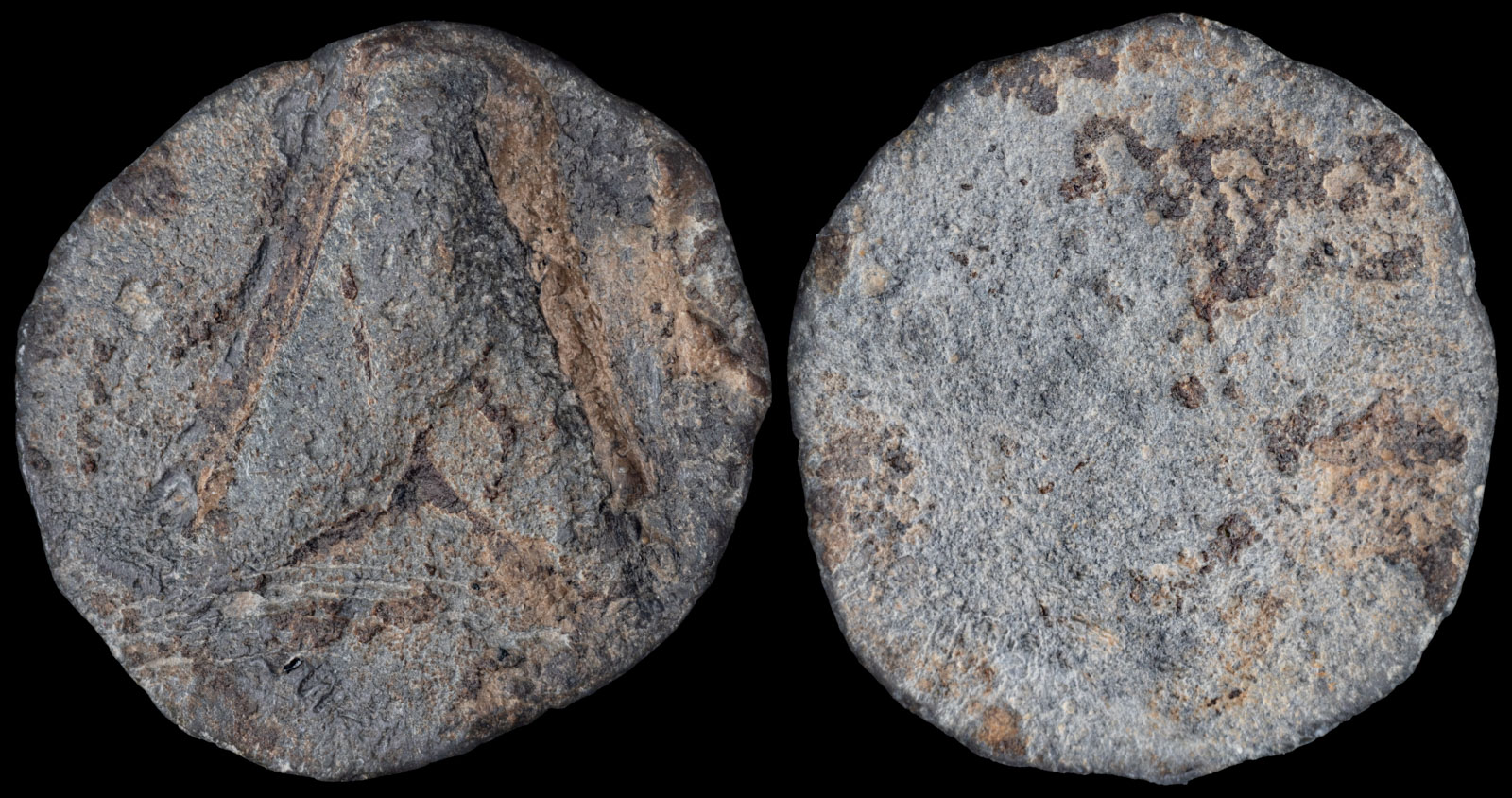
Minturnae(?), Latium
2nd – 1st Century BCE
Pb 16.51mm 1.83g
Obverse: Fly
Reverse: Blank
Stannard, Numismatic Evidence for Relations Between Spain and Central Italy at the Turn of the Second and First Centuries BC, coin 25
Recently, I was attracted to this strange lead token with an image of a fly. After some investigation, I found it was covered in Stannard’s work “Numismatic Evidence for Relations Between Spain and Central Italy at the Turn of the Second and First Centuries BC”.
What is fascinating about this article is that extremely similar types were found in both Baetica, Spain and central Italy – in particular Minturnae where many of these lead tokens were found.
However, a later paper titled “Trade between Minturnae and Hispania in the Late Republic” found something even more intriguing. They performed lead-isotope analysis on this exact type, among others, and found that the lead came from Baetica! Therefore, the theory that these types had to do with trade between those regions was extremely likely.
Baetica was home to lead mines, and the speculation is these coins had something to do with that business. Now, what did the fly mean?
It’s very difficult to say. It may have been the badge of some social or commercial group. There’s also a chance it symbolized the Musca family, whose name means “fly”. There were multiple prominent members of that family, so it would be impossible to determine which one.
Minturnae makes war against Rome in the Second Samnite Wars
Minturnae becomes a Roman settlement