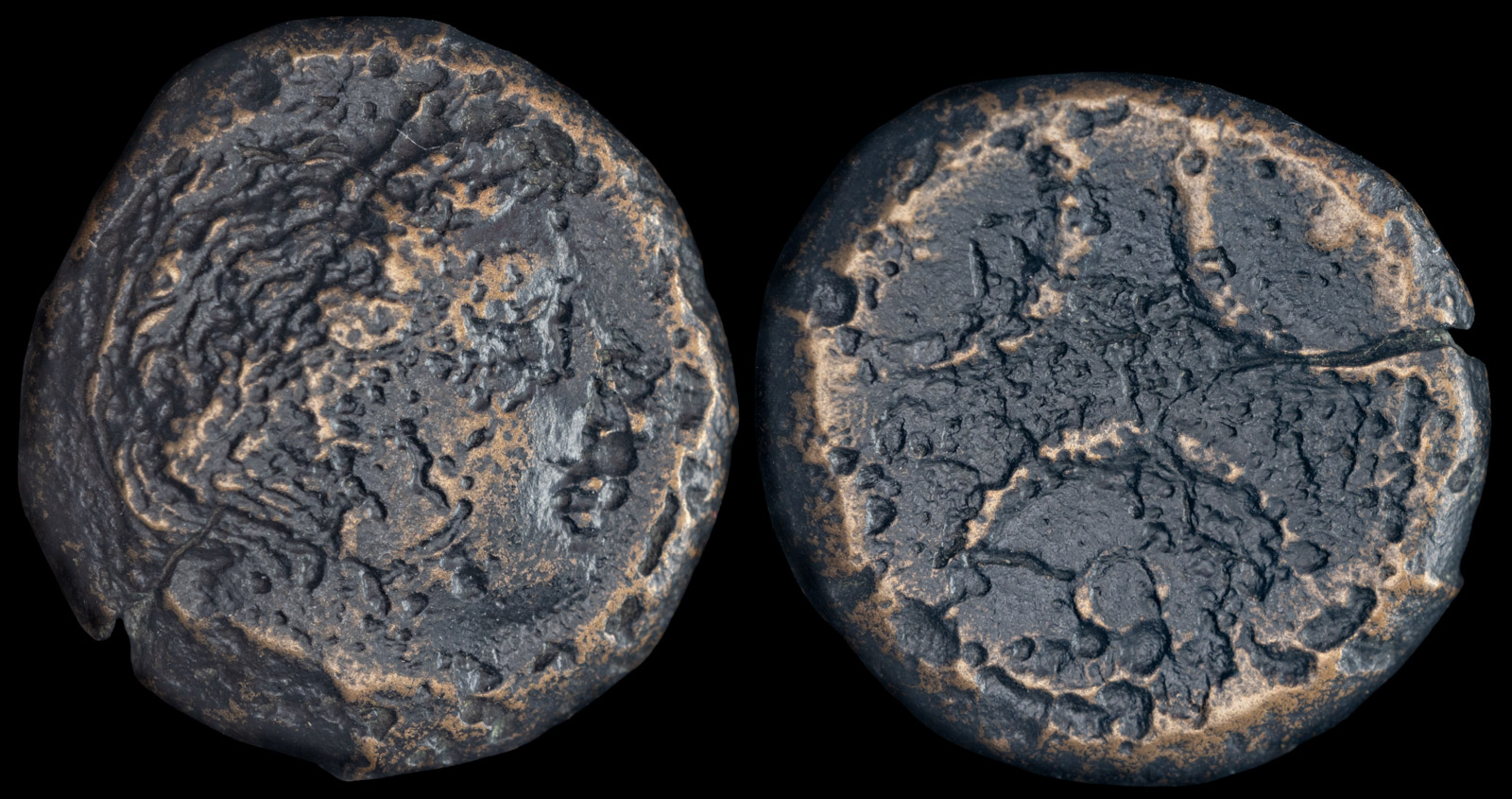
Bruttium. Kroton
300-250 BCE
AE 16.71mm 5.36g
Obverse: Wreathed head of Persephone right
Reverse: [K P] O within three crescents
SNG ANS 444
Kroton was one of the principal cities of Magna Graecia and a major factor in Greek history. Among its famous citizens was Pythagoras, who founded his school in Kroton and was eventually killed by a mob (in some versions) there.
It was founded in the late 8th century BCE and grew rapidly to a population of 50,000 to 80,000 by 500 BCE. The city walls alone stretched twenty kilometers. Its athletes were prolific at the Olympic Games and its physicians were world famous.
Kroton later formed a famous rivalry with nearby Sybaris, resulting in a war that ended when Kroton destroyed its rival.
In the 4th century BCE, the city began to decline, as evidenced by twice being taken by Syracuse during this time. It submitted to Rome in 277 BCE, but due to a betrayal it wound up supporting the Carthaginians in the second Punic War. After the war, the city continued to decline.
Kroton founded as an Achaian colony
Kroton and Sybaris destroy Siris
Pythagoras founds a school at Kroton
Kroton begins a war against Sybaris
Kroton sends a ship with the famed athlete Phayllos to support the Greeks at Salamis
Rough founding of Terina by settlers from Kroton
Kroton captured by Dionysios of Syracuse
Agathokles of Syracuse takes Kroton
Kroton submits to Rome
Kroton betrayed to the Brutii by Aristomachos
Kroton recaptured by Rome after the Battles of Kroton
A Roman colony is founded at Kroton