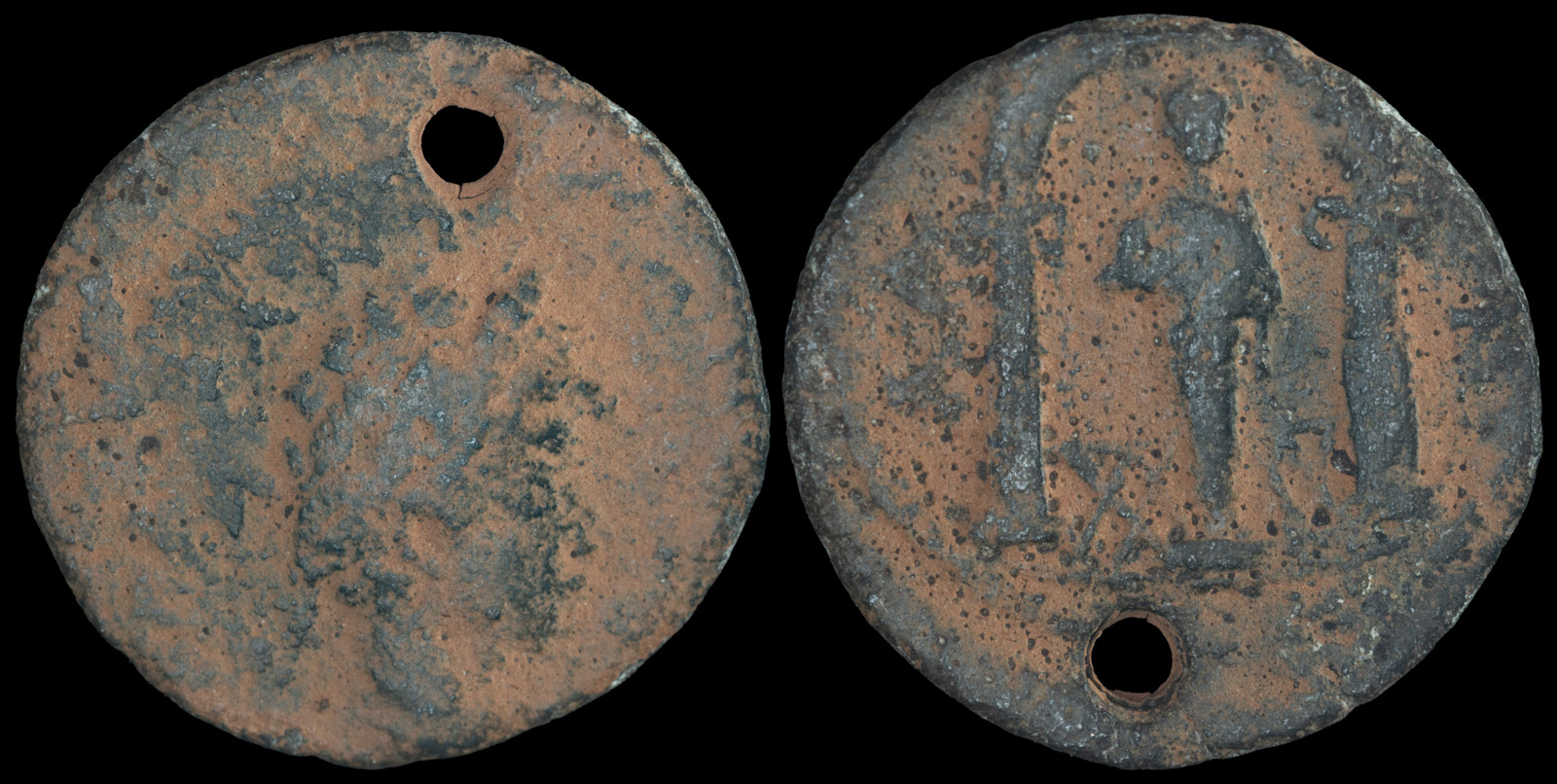
Lakonia, Las
Caracalla. 198-217 CE
Struck circa 202-205 CE
Æ Assarion 21mm, 4.53 g, 6h
Laureate, draped, and cuirassed bust right, seen from behind /
Terminal figure (of Las?), cloaked and holding an uncertain curved object, before a balustrade under a curved arch supported by two columns
BCD Peloponnesos 990; BMC –; NCP –
We don’t know very much about the life of the Hero of Las. Archeologists have uncovered papyri business cards stating only “Hero. Las” along with an indecipherable address and Instagram.
Back in those days, each city had a designated hero. Whenever a dragon wandered into town or an aimless drunk began violating sheep, the hero was there. Then, when there were important quests, the hero would seek out fame for his home city. Unfortunately, in the case of the Hero of Las, a girl got involved.
That girl was none other than Helen, sinker of cities. Pausanias wrote about some confusion there. (3.24.10)
At a spot called Arainon is the tomb of Las with a statue upon it. The natives say that Las was their founder and was killed by Achilles, and that Achilles put in to their country to ask the hand of Helen of Tyndareus. In point of fact it was Patroclus who killed Las, for it was he who was Helen’s suitor. We need not regard it as a proof that Achilles did not ask for Helen because he is not mentioned in the Catalogue of Women as one of her suitors.
Today, scholars identify the location of Arainon with the small village of Ageranos. I searched for archeological records and found that the remnants of a number of Roman villas dot the area. To the south, there was a very large Roman building.
We move on to the hole in the coin. I understand that many collectors devalue coins with holes, but in my opinion (and with all due respect) these people are morons.
The thing is, what’s so fascinating about these coins is the history. Imagine all the things these coins have been through. At the time this was minted, the Roman Empire was in full swing and whatever shrine is depicted likely still existed. Countless works that are now forever lost were still extant. On top of that, the coin had an “afterlife” in being used likely in a necklace. Based on the wear, it was very important to someone.
So, in a sense, I got “bonus history” with this coin. I actually paid less and got more.
To me, the hole reaffirms that someone felt either the obverse or reverse (or both) was very important, enough to punch and wear it. Based on the small ridges around the hole on the obverse, the coin appears to have been laid down with the reverse face up and the punch exited through the obverse.
Although it’s very tempting for me to say that this means the reverse (Hero of Las) was valued more than the obverse (Caracalla), I don’t think that was the case. Were this a necklace, which I believe is the simplest and most logical use, the obverse would be correctly oriented, while the reverse would be upside down.
I do find it intriguing that someone would want to wear a necklace of Caracalla back then. After all, he was a twisted psychopath. There are two logical solutions:
a) Caracalla wasn’t such a bad guy in the area
b) The wearer of the necklace didn’t believe the obverse depicted Caracalla
Actually, it turns out that the first solution may be correct.
Cambridge excavations at Sparta have revealed inscriptions showing that Caracalla founded a Spartan cohort and recruited Spartan units for his ill-fated Parthian campaign. Could this have been worn by a mother or wife of one of these soldiers, showing her faith in the emperor for bringing her son back safe, and with much fame?
There are also inscriptions from Hermione, also in the Peloponnese, attesting to unknown honors Caracalla gave to the town.
Finally, Caracalla did extend Roman citizenship to provincials, and this would have included the Peloponnese and Las.
Therefore, it’s entirely possible that all the horrible things Caracalla did never reached Las, and so whoever wore this coin had a positive opinion about him. It’s of course also possible that Caracalla happened to look similar to a guy she liked. We’ll never really know.
However, the hole in the coin does represent to me the fact that what has trickled down to us in history is typically one-sided, and at the very least the provinces were affected by emperors in vastly different ways than Rome itself, where much of our history of the times was written.