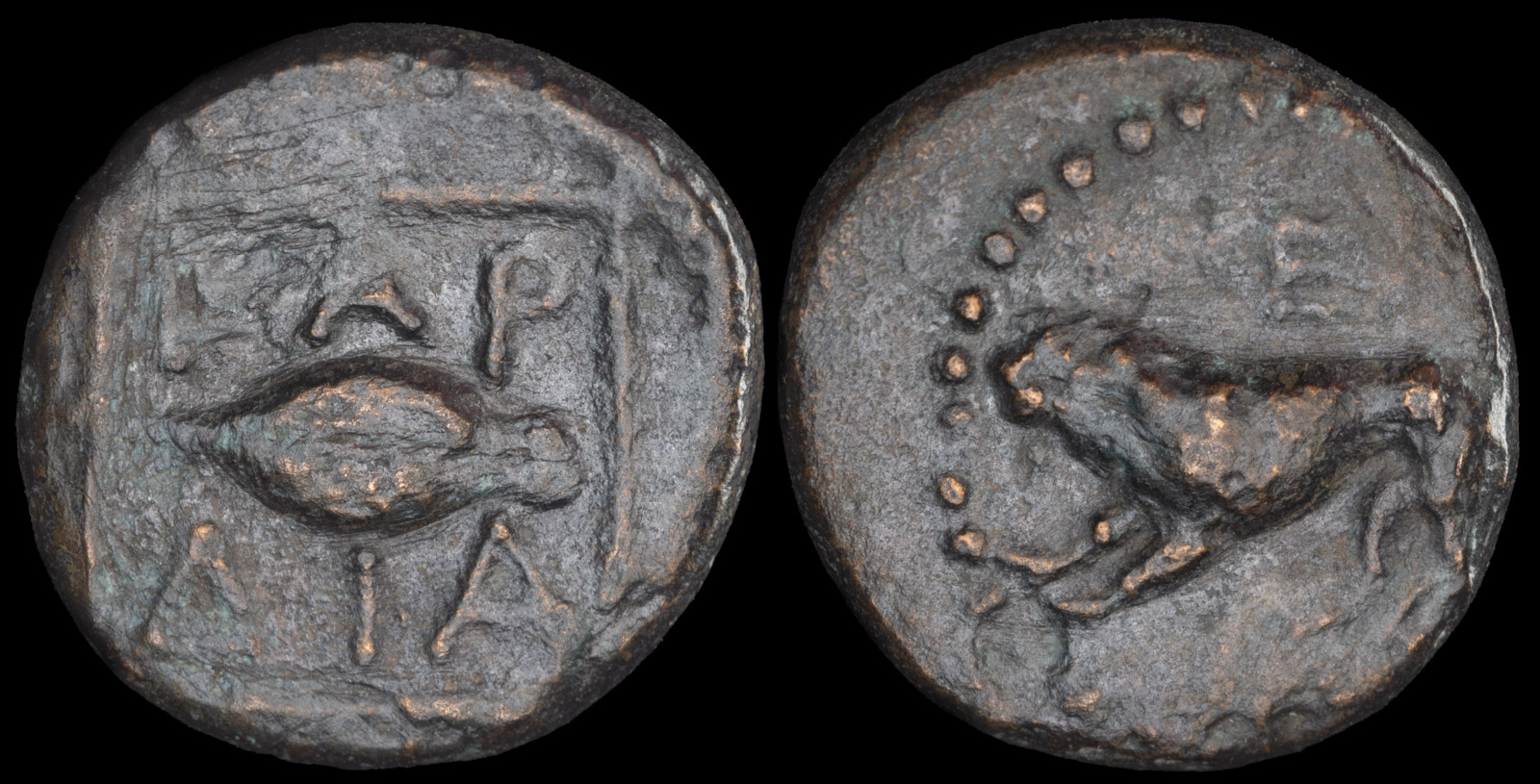
Hekataios of Kardia
Thrace, Kardia
Circa 350-309 BCE
AE 12,6mm 1,8g
Obv: Lion leaping to left.
Rev: KAP/ΔΙΑ Barley grain within linear square border.
HGC 3.2, 1482. Tzvetkova 122-8
So, who was Hekataios of Kardia? He was mentioned by Plutarch in his biography of Eumenes.
Now, Antigonus paid no heed to the edicts of Perdiccas, being already lifted up in his ambitions and scorning all his associates; but Leonnatus came down from the interior into Phrygia in order to undertake the expedition in behalf of Eumenes. Here, however, Hecataeus the tyrant of Cardia joined him and besought him to go rather to the assistance of Antipater and the Macedonians besieged in Lamia. Leonnatus therefore determined to cross over to Greece, invited Eumenes to go with him, and tried to reconcile him with Hecataeus.
For they had a hereditary distrust of one another arising from political differences; and frequently Eumenes had been known to denounce Hecataeus when a tyrant and to exhort Alexander to restore its freedom to Cardia. Therefore at this time also Eumenes declined to go on the expedition against the Greeks, saying he was afraid that Antipater, who had long hated him, would kill him to please Hecataeus. Then Leonnatus took him into his confidence and revealed to him all his purposes.
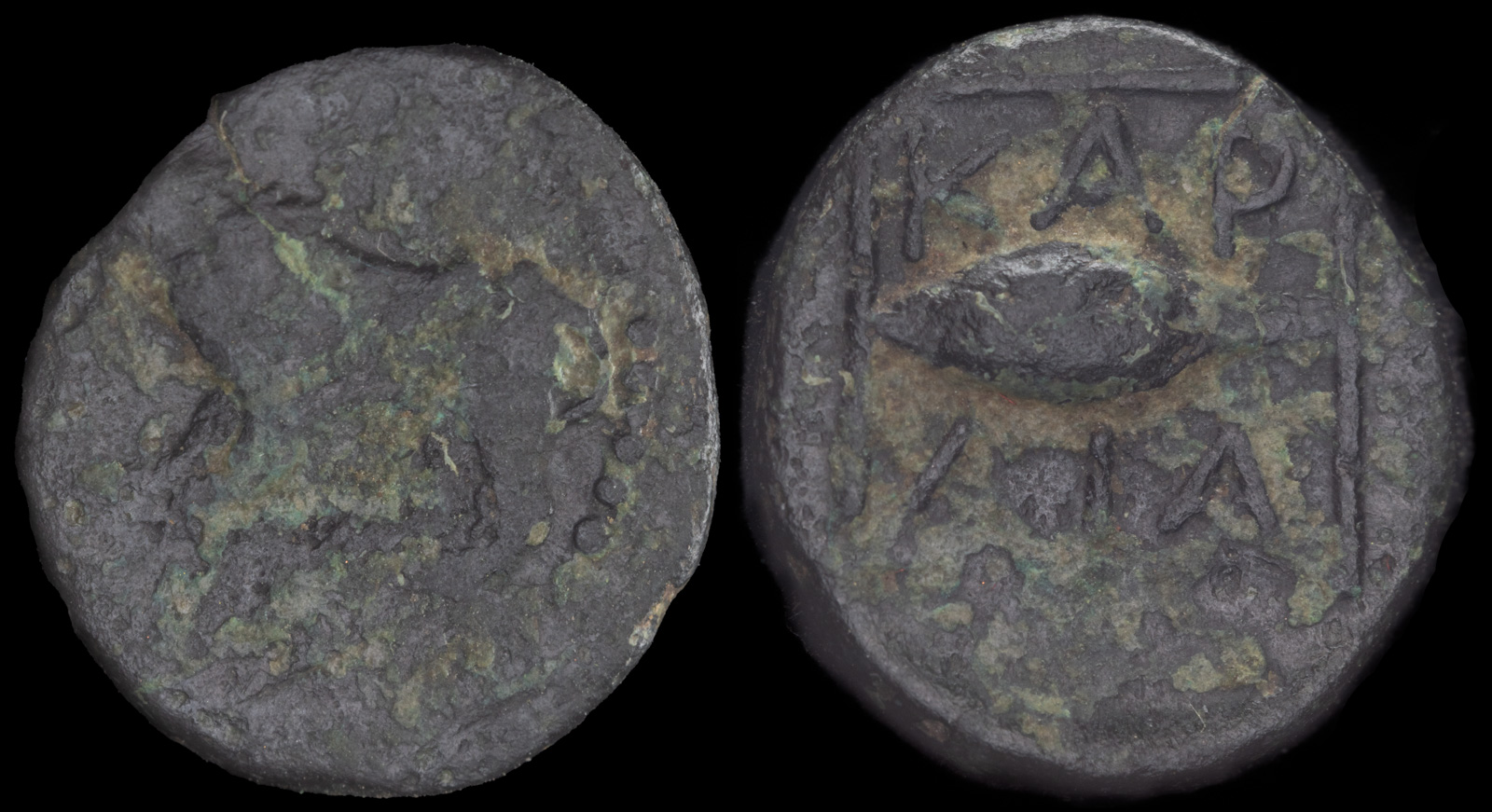
Hekataios of Kardia
Thrace, Kardia
Circa 350-309 BCE
AE 1.58g 13.62mm
Obv: Lion leaping to left.
Rev: KAP/ΔΙΑ Barley grain within linear square border.
HGC 3.2, 1482. Tzvetkova 122-8
We’re not sure exactly what caused the enmity between Eumenes and Hekatios, but Eumenes was from Kardia and they must have had some bad history. It is believed that Hekataios took over Kardia sometime during the reign of Philip II or perhaps when Alexander took power.
Interestingly, these coins are not commonly attributed to Hekataios. The best source on the coinage it Tzetkova, who dates these bronzes to between its subjugation (by negotiations and not siege) by the Macedonians in 346 BCE, and the founding of Lysimachia in 309 BCE – which depopulated many of the cities in the Chersonesos. Therefore, the reign of Hekataios – which occurred at least from 336-323 BCE – overlaps with much of this.
I therefore find it very interesting that the only bronze coinage of Kardia with some form of “magistrate mark”, happens to have an E. For reference, Hekataios in Greek is Ἑκαταῖος. Did this signify Hekataios? We don’t really know, though this attribution is accepted for other cities – such as Herakleia Pontika where Klearchos used a ‘K’. However, since his reign occurred during a good portion of the bronze coinage, I believe even those without the ‘E’ were likely to have been minted by him.