Ephesia
View All Tags
The great sanctuary dedicated to her, the Temple of Artemis, was one of the Seven Wonders of the Ancient World. First constructed in the 6th century BCE and rebuilt after destruction in 356 BCE, it became a monumental symbol of Ephesian identity and wealth. Pilgrims, merchants, and rulers contributed offerings, making the temple not only a religious center but also a major economic institution. The goddess’ image was reproduced widely on coins, reinforcing both civic pride and religious devotion.
The many rounded forms on her torso are often described as “multiple breasts,” symbolizing fertility and abundance. Some scholars argue they may represent bull testicles used in ritual sacrifice, or symbolic gourds or eggs. Whatever their precise origin, they clearly conveyed nourishment, life, and generative power. Animals carved along her body, including lions and bulls, suggest dominion over nature and cosmic order rather than participation in the hunt.
Artemis Ephesia reflects deep cultural blending. Her cult likely preserves elements of older Anatolian mother goddess traditions, merged with Greek religious identity as Ionia became Hellenized. While the Greeks equated her with Artemis, the Ephesian goddess functioned more like a universal protectress of city, fertility, and stability. She was not primarily a maiden huntress. She was the embodiment of prosperity and divine guardianship.
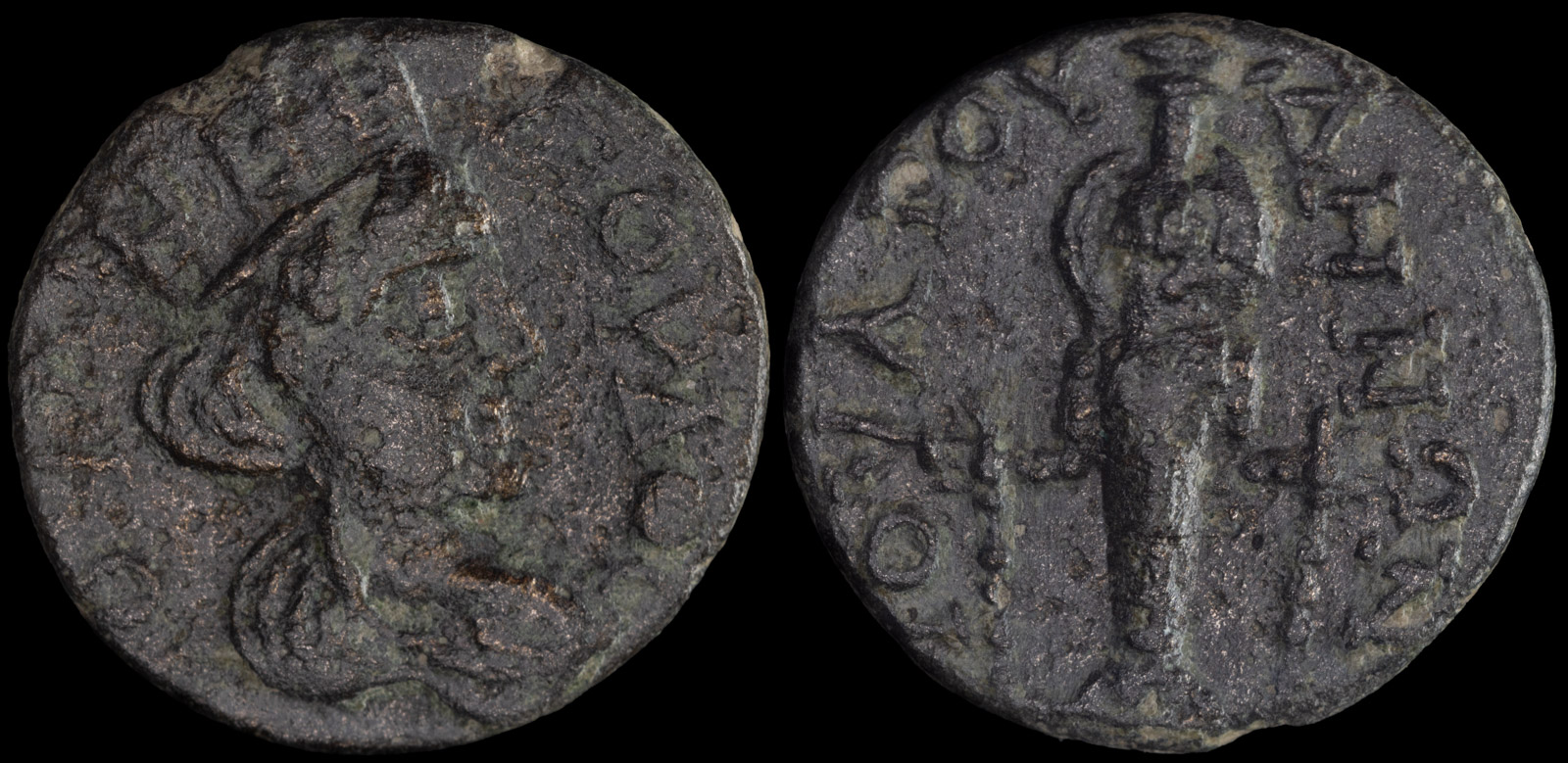
Lydia, Gordos – Iulia
Pseudo-autonomous issue 138-192 CE
Æ 15mm, 2,05g
Turreted and draped bust of Tyche (Fortuna) right /
Facing cult statue of Artemis Ephesia, with supports
RPC IV Online 1261; SNG Copenhagen 157; BMC 10-2