Cicada
View All Tags
The insect consequently had particularly strong associations with Apollo and the Muses. Its song seemed almost disembodied: ancient writers imagined the cicada as living lightly upon dew and producing music without the ordinary bodily concerns of other creatures. This contributed to associations with purity, immortality, and existence somewhere between the mortal and divine worlds. The cicada also became connected with the myth of Tithonus, the mortal lover of Eos who received immortality but not eternal youth. As he withered endlessly with age, one tradition ultimately transformed him into a cicada, preserving only his seemingly eternal voice. The Metropolitan Museum notes this complex of associations—Apollo, the Muses, autochthony, and Tithonus—when discussing the symbolism of the insect in Greek art.
Perhaps the most politically important meaning, however, was autochthony: being literally “born from the earth.” Cicadas spend the early portion of their lives beneath the ground and then suddenly emerge from it. To Greek observers they could therefore appear to be creatures generated by the earth itself. This had enormous resonance at Athens, because the Athenians famously claimed that their ancestors had not migrated into Attica but had always inhabited the land and were, in a mythical sense, children of Attic soil. Thucydides records that aristocratic Athenians of earlier generations fastened their hair with golden cicada ornaments. Later Greek explanations explicitly connected these tettiges with the Athenians’ claim to be earthborn, just as figures such as Erechtheus or Erichthonios were imagined as arising from the soil of Attica.
That background is particularly important when interpreting cicadas on Athenian coins. Beginning around 190 BC, Athens issued small bronze coins on which the cicada itself could occupy the principal side of the coin, paired with such unmistakably Athenian imagery as an amphora or owl. The Athenian Agora catalogue explicitly interprets this Hellenistic revival of the cicada as a revival of the ancient symbol of Athenian autochthony. By the second and first centuries BC, the cicada had effectively become what the catalogue calls a quasi-official Athenian state emblem. In other words, an Athenian looking at such a coin would not simply have seen an insect. The image could evoke the claim: “We are the people of this land, born from Attica itself.”
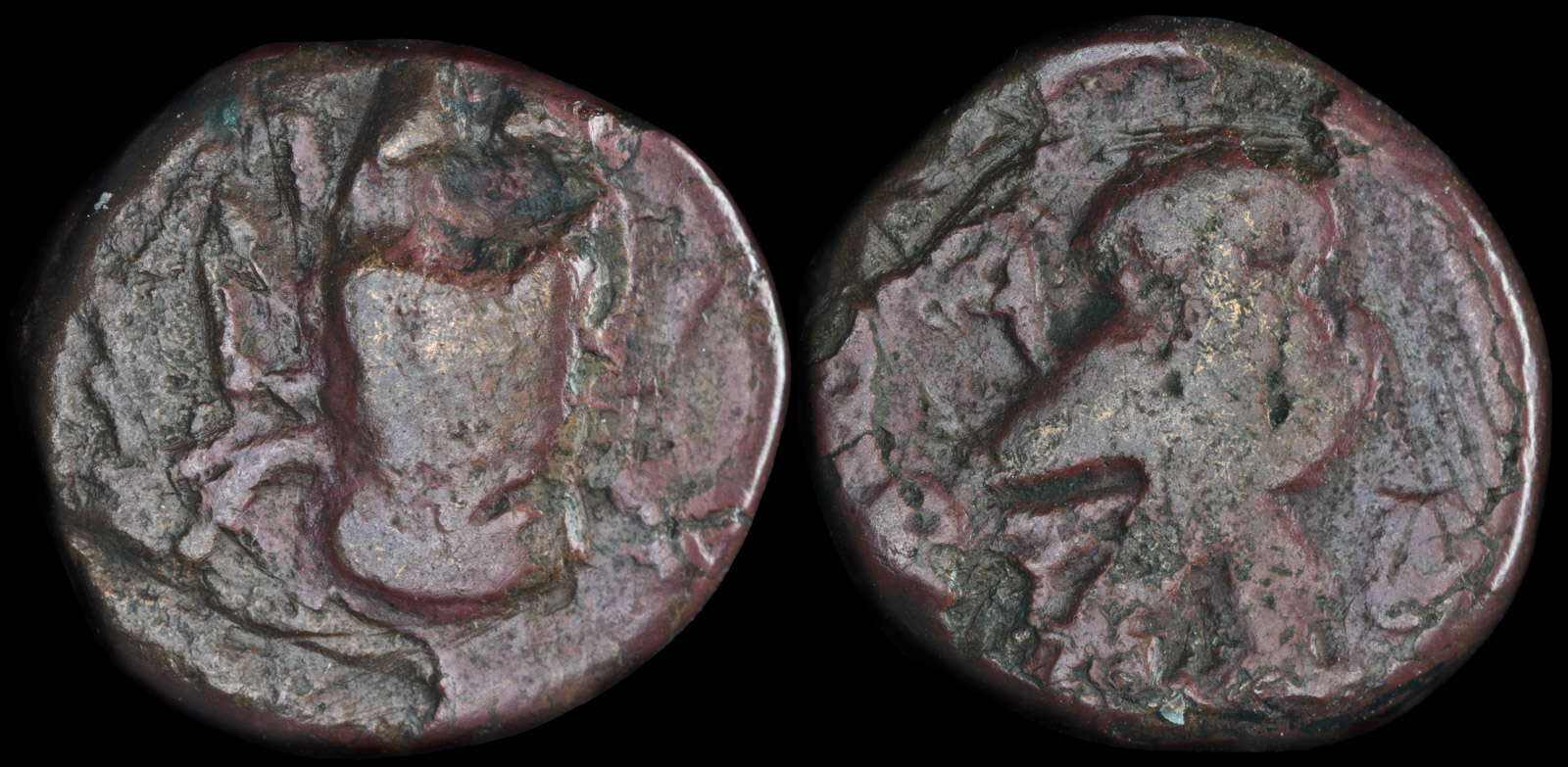
Attica, Athens
Circa 130-90 BCE
Æ 13.5mm, 3.52g, 11h
Cicada /
Owl standing right, head facing, on thunderbolt.
Kroll 100; HGC 4, 1734