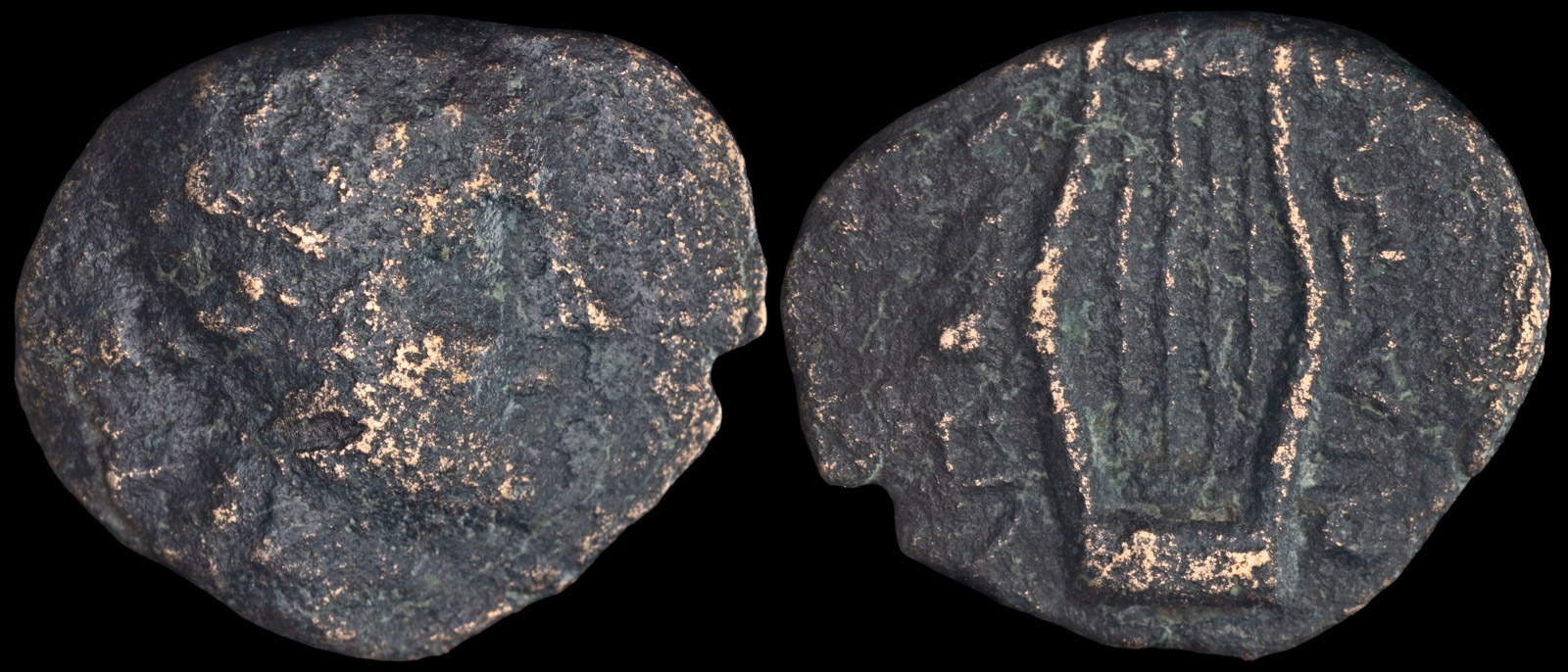
Apollonia, Illyria
2nd-1st century BCE
AE 15mm, 1.7g
Laureate head of Apollo r.
R/ AΠOΛΛO NIATAN, Lyre.
SNG Copenhagen -; BMC –
Today, the ruins of Apollonia are near Fer, Albania. Founded as a colony by Corinth, its original purpose was primarily to feed the mother city. It gradually achieved independence and started an oligarchy that was detailed by Aristotle.
Its location was strategic due to trade routes that linked the eastern Adriatic coast with the interior and the northern Adriatic with the Aegean. It was thus perhaps the most important of the 24 cities named Apollonia. Due to its important location, it has been populated since at least the third millennium BCE.
Supposedly the city was founded by a man named Gylax, and originally was called Gylakeia. Rather than annihilate the locals, the Corinthians achieved good relations with them, perhaps helping the early city to flourish. Later colonists came from Corcyra. It was one of the last cities in the west colonized.
In the mid 5th century BCE, Apollonia expanded towards and took over Thronion, then erected a monument in Olympia to commemorate it, which was still standing and described by Pausanias.
During Hellenistic times, the city blossomed and had at one point 60,000 inhabitants. Its government was interesting enough to be described by Strabo and Aristotle.
The city diminished in the 3rd century CE, when an earthquake changed the course of the river and caused the port to silt up.
Apollonia founded by settlers from Corinth
Apollonia defeats Thronion
Apollonia forms an alliance with Rome
Apollonia comes under Roman protection
Apollonia becomes part of the Roman province of Macedonia
Apollonia, an ally of Julius Caesar, falls to Marcus Junius Brutus
Augustus, then known as Octavian, studies in Apollonia