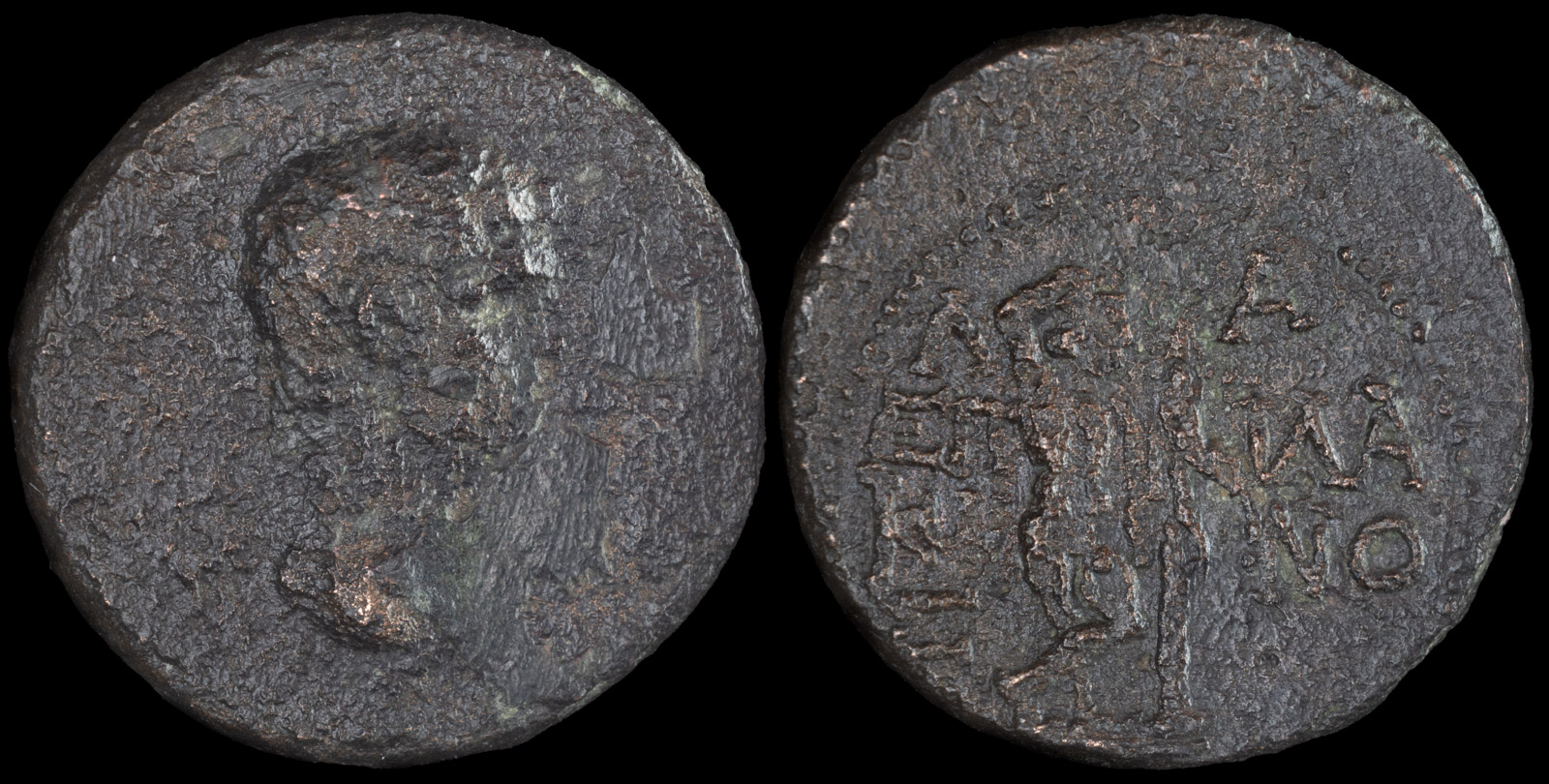
Lakonia. Lakedaemon (Sparta)
Claudius 41-54 CE
AE 24.79mm 12.59g
Obverse: Bare head right
Reverse: Λ-Α / ΕΠ-ΙΛΑ / ΚⲰ-ΝΟ / Σ, Apollo Karneios leaning right on column, holding cornucopia
RPC I 1113; BCD Peloponnesos I 933
My belief is this coin, minted in Lakedaimon, depicts an actual statue that existed of Apollo Karneios.
Pausanias described several temples of Apollo Karneios. There was one in Sikyon, the inner sanctum of which could only be entered by priests. Further from Sikyon, but still within its territory, he described another temple, only the pillars of which were standing in his time, that was likely replaced by the former. Others were in Gythion, Oitylos, Leuctra, and Las.
Pausanias discussed the worship of Apollo Karneios in Sparta, but made no mention of a statue (3.13.3):
The cult of Apollo Carneus has been established among all the Dorians ever since Carnus, an Acarnanian by birth, who was a seer of Apollo. When he was killed by Hippotes the son of Phylas, the wrath of Apollo fell upon the camp of the Dorians Hippotes went into banishment because of the bloodguilt, and from this time the custom was established among the Dorians of propitiating the Acarnanian seer. But this Carnus is not the Lacedemonian Carneus of the House, who was worshipped in the house of Crius the seer while the Achaeans were still in possession of Sparta.
The poetess Praxilla represents Carneus as the son of Europa and Zeus, Apollo and Leto being his nurses. There is also another account of the name; in Trojan Ida there grew, in a grove of Apollo, cornel-trees, which the Greeks cut down to make the Wooden Horse. Learning that the god was wroth with them they propitiated him with sacrifices and named Apollo Carneus from the cornel-tree (craneia), a custom prevalent in the olden time making them transpose the r and the a.
Thus, there are multiple stories for the origins of Apollo Karneios. He does mention a temple to Apollo Karneios, where the statue likely resided (3.14.6):
In the Dromos are two gymnastic schools, one being a votive gift of Eurycles, a Spartan. Outside the Dromos, over against the image of Heracles, there is a house belonging now to a private individual, but in olden times to Menelaus. Farther away from the Dromos are sanctuaries of the Dioscuri, of the Graces, of Eileithyia, of Apollo Carneus, and of Artemis Hegemone.
The temple was located in nearby Amyklai, and its ruins are still visible.