Anubis
View All Tags
Anubis was especially important in funerary ritual. He was regarded as the divine patron of embalmers and was believed to oversee the preparation of the corpse for burial. Priests performing certain parts of the mummification ceremony could wear jackal masks in imitation of Anubis. One of his common titles was imy-wt, often translated as “He Who Is in the Place of Embalming.” Another, khenty-seh-netjer, meant approximately “Foremost of the Divine Booth,” referring to the structure associated with embalming and funerary preparation. Through these roles, Anubis did not simply represent death itself; he helped ensure that the deceased was properly transformed into an effective, protected spirit capable of entering the next world.
He also played a major role in the judgment of the dead. In the famous “weighing of the heart” scene found in the Book of the Dead, Anubis leads the deceased to the scales and supervises the weighing of the heart against the feather of Ma’at, the principle of truth and cosmic order. If the heart was found to be in balance, the deceased could proceed toward a blessed afterlife. Anubis is often shown carefully adjusting or monitoring the scales, while Thoth records the result. This role made him a guide and mediator between the human world and the realm of the dead, rather than a frightening god of punishment.
In Egypt’s earliest religious traditions, Anubis appears to have occupied a position later increasingly associated with Osiris. During the Old Kingdom he could be treated as a principal ruler or protector of the dead, but as the cult of Osiris became dominant, Anubis was incorporated into the Osirian mythology. In later traditions he was commonly described as the son of Osiris and Nephthys, and he became the god who embalmed Osiris after his murder by Seth. This myth supplied a divine prototype for human mummification: every properly embalmed deceased person could symbolically participate in the restoration that Anubis had first performed for Osiris.
The worship of Anubis lasted for thousands of years and continued well into the Ptolemaic and Roman periods. His principal cult center was at Cynopolis, the Greek name for the Egyptian town whose name referred to the “city of the dog,” although he was worshipped throughout Egypt. Under Greek and Roman rule he was sometimes identified or combined with Hermes, another divine guide of souls, producing the syncretic figure Hermanubis. His extraordinary longevity reflects the importance of the ideas he represented: proper burial, protection of the body, safe passage through the dangerous world of the dead, and the hope that death could ultimately lead to renewal rather than annihilation.
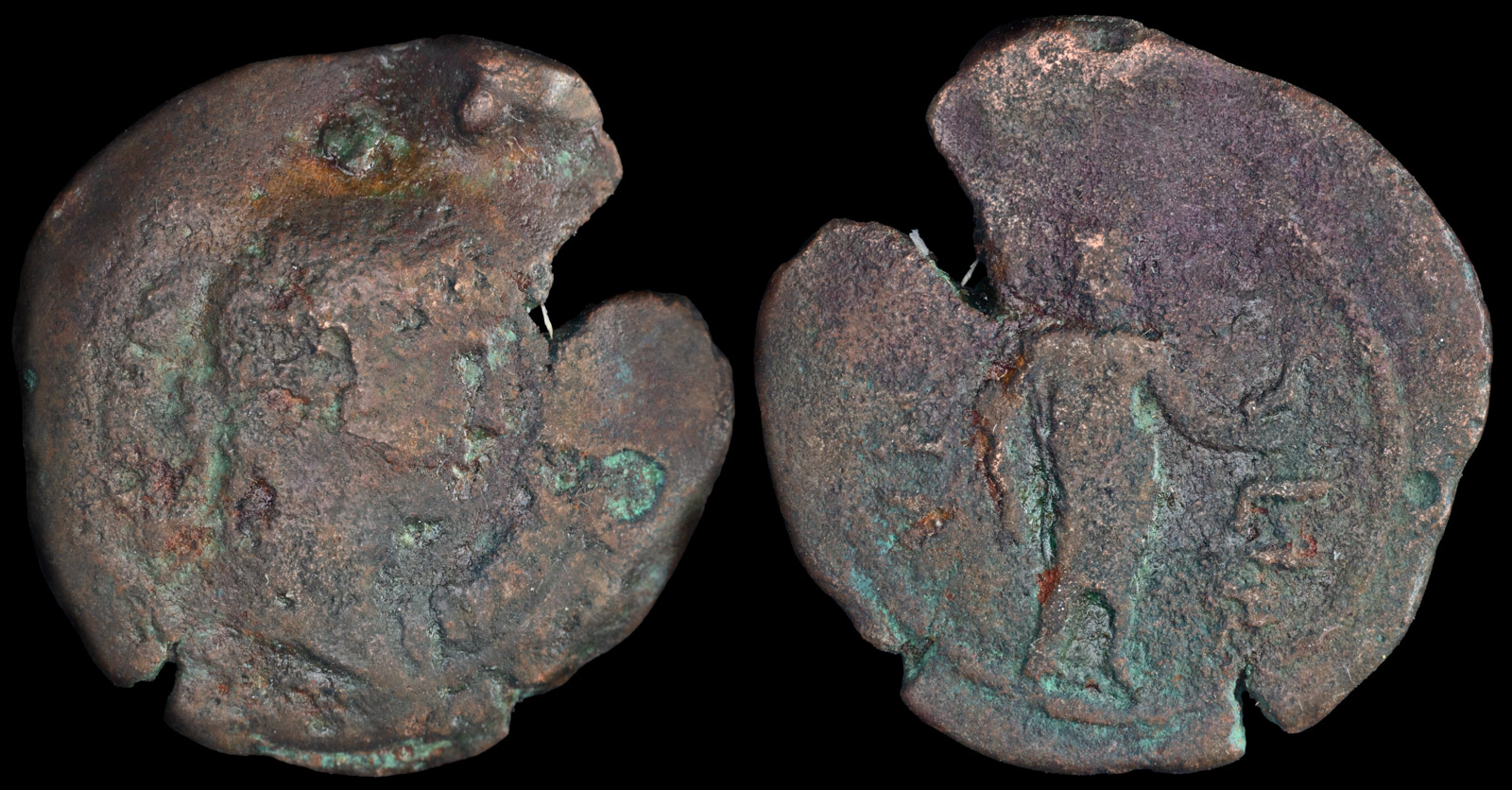
Kynopolis (city of dogs), Egypt
Hadrian 126-127 CE
AE obol 20mm 4.8g
ΑΥΤ ΚΑΙ ΤΡΑΙ ΑΔΡΙΑ CEB laureate head of Hadrian right
Reverse – KVNO L IA (regnal year 11), Anubis standing, facing head left, holding small dog.
RPC III, 6353; Dattari 6235; Geissen 3405-3406; Kampmann/Ganschow N22.3