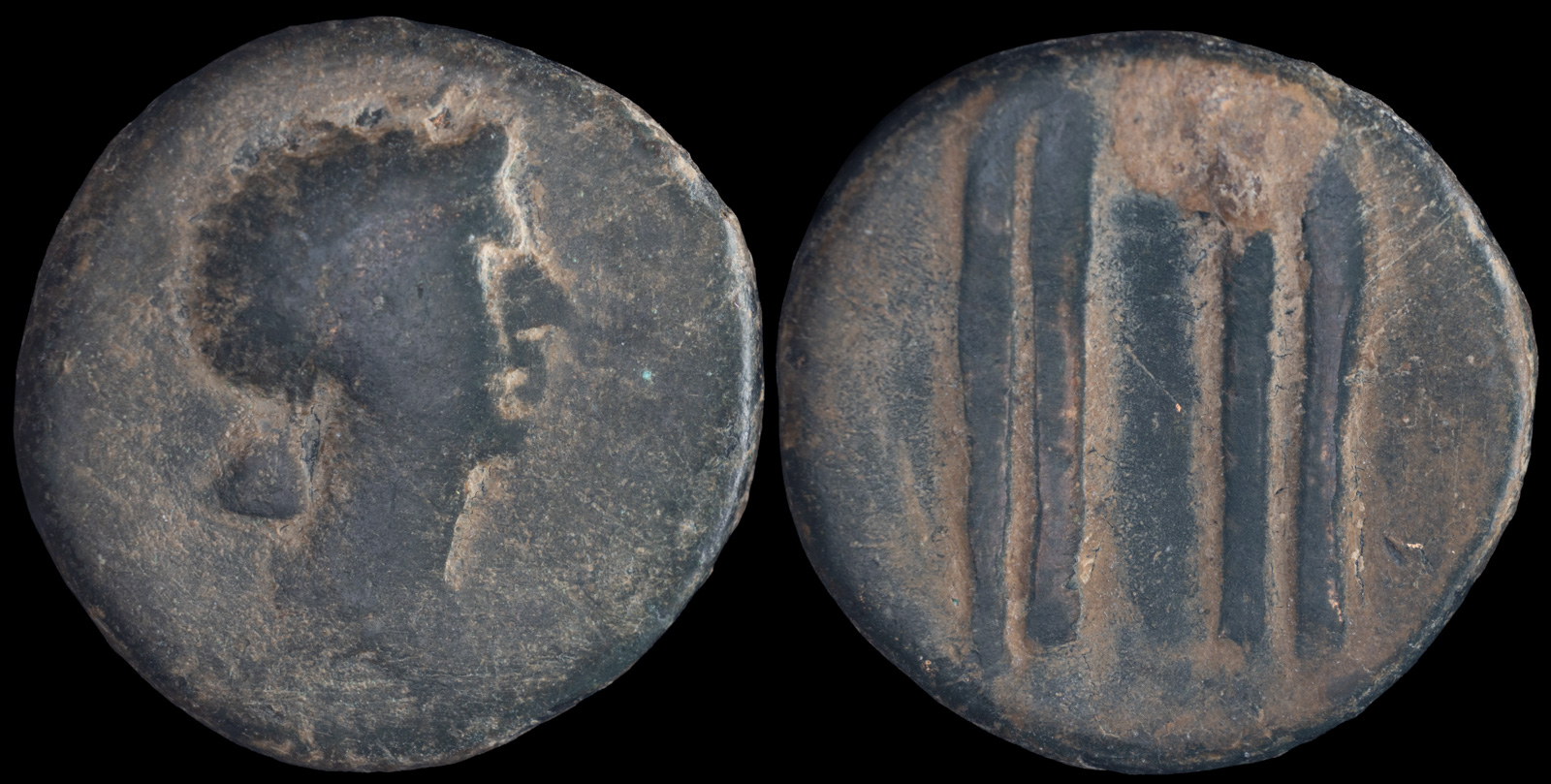
Queen Erato of Armenia
Artaxata (Artashat, Armenia) mint
sole reign, c. 1-2 CE
Bronze octachalkon 1.925g 23.2mm die axis 180o
obverse BA – EPAT (Greek: Basilissa Erato – Queen Erato), diademed and draped bust of Erato right;
reverse aerial view of the city walls of Artaxata, in the shape of an octagon, with six tall round defense towers and two gateways, [E – Γ] (Greek: regnal year 3) above
Kovacs 187, Bedoukian CCA -; Nercessian ACV -; MDHRAC –
The history behind Erato is fascinating, but obscure, and when researching coins I found that so many were incorrect in either attribution, date, or both.
There are three primary sources we’re aware of for Erato – her coinage, and Cassius Dio and Tacitus. The following is from Cassius Dio:
(55.10.23) Nevertheless, war did not break out with the Parthians, either. For Phrataces, hearing that Gaius was in Syria, acting as consul, and, furthermore, having suspicions regarding his own people, who had even before this been inclined to be disloyal to him, forestalled action on their part by coming to terms with the Romans, on condition that he himself should renounce Armenia and that his brothers should remain beyond the sea. The Armenians, however, in spite of the fact that Tigranes had perished in a war with barbarians and Erato had resigned her sovereignty, nevertheless went to war with the Romans because they were being handed over to a Mede, Ariobarzanes, who had once come to the Romans along with Tiridates. This was in the following year, when Publius Vinicius and Publius Varus were consuls [2 CE].
From Tacitus’ Annals:
(2.3-2.4) Artavasdes’ son, Artaxias II, hostile to us on account of his father, defended himself and his crown by virtue of Parthian strength, but following his assassination at the hands of his treacherous relatives, Augustus assigned Tigranes III to Armenia and he was installed in his kingship by Augustus’ stepson, Tiberius. Tigranes’ rule was short; as was that of his son (Tigranes IV) and daughter (Erato) joined, in the oriental manner, in matrimony as well as government.
Next, Artavasdes III was imposed on the country, by order of Augustus, and ejected again not without discredit to us. Gaius Caesar was then delegated to settle Armenian affairs. He granted the Armenian crown to Ariobarzanes, a Mede by origin (he also ruled as Ariobarzanes II of Media Atropatene), who was welcomed by the Armenians for his good looks and noble qualities.
Ariobarzanes meeting an accidental death, his son was not long tolerated; and after experiencing government by the woman called Erato, who was shortly expelled, the weak and wavering people, masterless rather than free, accepted Vonones the fugitive as their king.
Finally, from her coinage there are three types known:
This one, with only her
One with her and Tigranes IV on the obverse, and the mountains beyond on the reverse (Example)
One with someone labeled as the “new” Tigranes on the obverse, and her on the reverse (Example)
I did actually have an interpretation of my own, but then found this paper, which was the first to mention all three types. Yevadian’s conclusion is that Erato ruled three times:
With her brother, Tigranes IV, from 9 BCE to 6 BCE. Yevadian is also unsure whether they were actually married.
With Tigranes V (lineage debated) from 5 BCE to 1 CE
Alone, from 13-16 CE
Erato was the only woman to lead Armenia as queen alone until Zabel in the first half of the 13th century. These are the only two, and in modern times Armenia has never had a female president.
I have to wonder if the design of this coin’s reverse, which has no precedent in Armenian coinage, was in anticipation to Roman hostility to her rule. It seems to be saying “We’re well defended. Try something.”
The obverse is also fascinating, since it’s extraordinarily rare for a woman to both label herself as queen and depict herself on the coinage. As far as I know, the only others to have done this were Cleopatra VII and Gepaepyris of Bosporus.