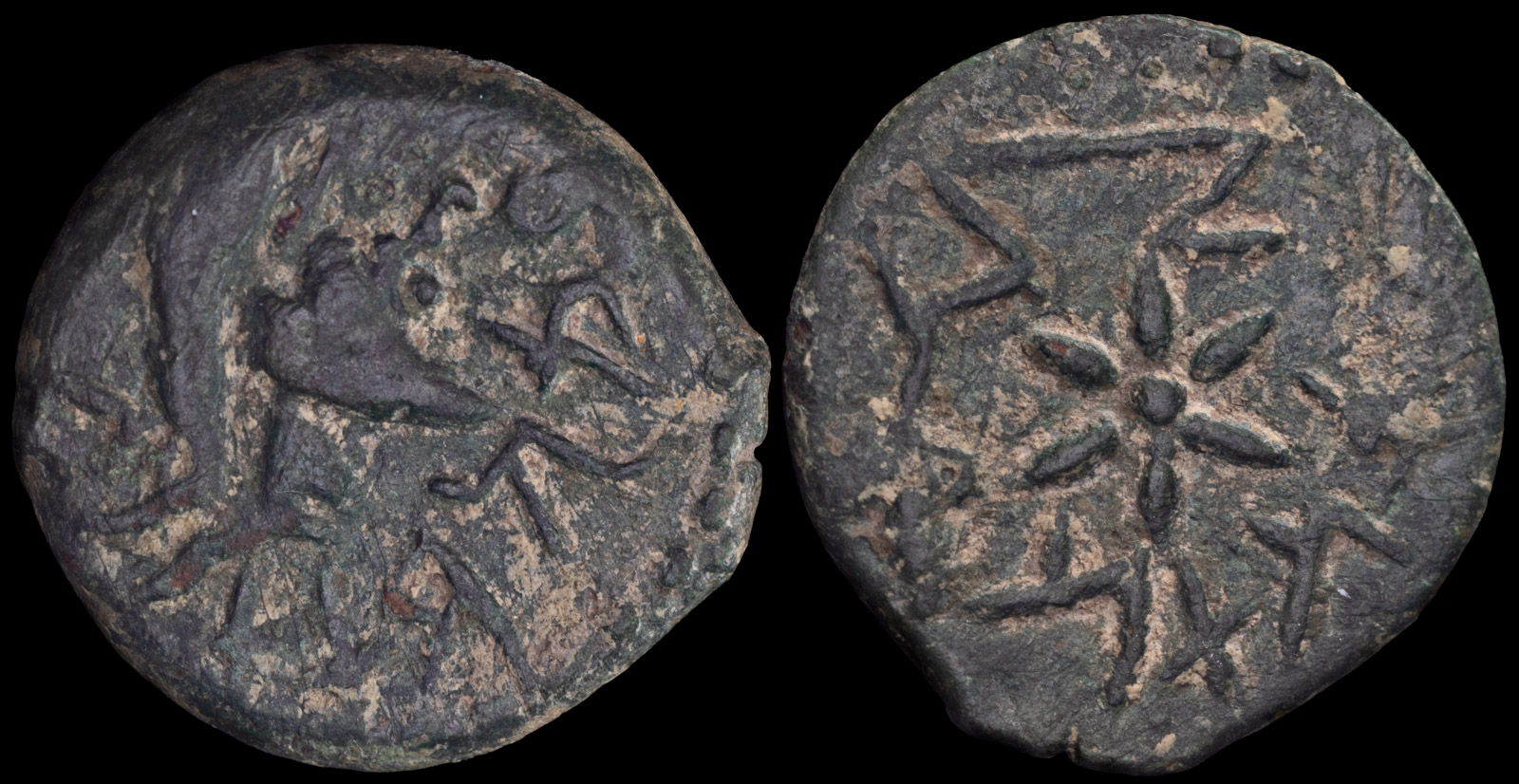
Mauretanian Kingdom. Bocchos I or II
ŠMŠ (Volubilis?) mint
Circa 118-80 or 49-33 BCE
AE 16mm 2.69g
Obv: Neo-Punic legend [BQS HMMLKT], bearded head to right.
Rev: six-pointed star flanked by grape bunch to left and ear of corn to right; zig-zag design above, Neo-Punic legend ŠMŠ below.
MAA 45; Mazard 113 (Lixus mint)
Shemesh, also known as ŠMŠ, was the capital of the kingdom ruled by Bacchus I and Bacchus II. The six pointed star appears to have been a symbol of the kingdom. The name of the city translated to “Sun”. Many of its coins have been confused with Lixus.
Based on coin finds, more numismatists and archeologists now believe Shemesh was located at Volubilis. This is an inland city and, if correct, is now a tourist attraction in Morocco.
Bacchus I ruled Mauretania from 111 BCE to 80 BCE and was a major player in Sallust’s War Against Jugurtha. He was initially Jugurtha’s ally, then chose to betray him and divide Jugurtha’s kingdom with the Romans. He later made a good profit in exporting wild animals to Rome.
Bacchus I gave his kingdom to his son Mastanesosus, and he in turn bequeathed his kingdom to Bacchus II.
Beginning of the rule of Bacchus I at Shemesh
Bacchus I of Shemesh betrays Jugurtha to the Romans
Death of Bacchus I, king of Mauretania and ruling from Shemesh
Kingdom of Mauretania centered at Shemesh goes to Bacchus II
Death of Bacchus II of Shemesh. Mauretania becomes a Roman client kingdom.
Shemesh falls to local tribes and is never retaken by Rome due to its remote location