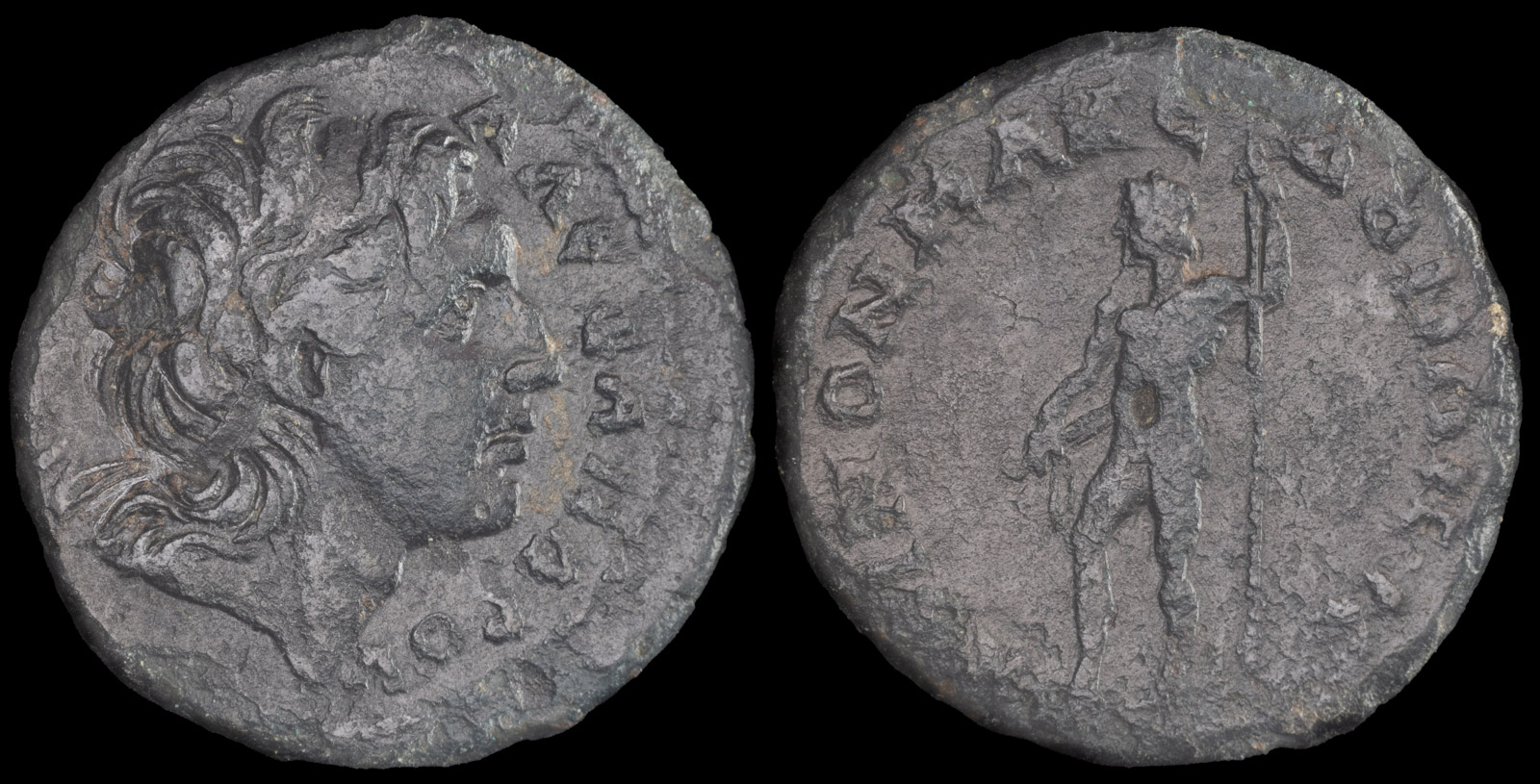
Macedon, Koinon of Macedon
Beroea mint.
temp. Severus Alexander. 222-235 CE
Æ 26mm, 9.35g, 7h
Diademed head of Alexander ‘the Great’ right, with hanging hair /
Zeus standing left, holding thunderbolt and long scepter
RPC VI Online 446.5 (this coin)
Ex Forum Ancient Coins
Ex Aleph Collection (CNG 2023)
Of the fascinating reverses on this series, I have to admit this one isn’t earth-shattering. In fact, I was quite surprised to learn that it’s one of the rarer types. At some point, I’ll want to investigate the varying obverses in this series, but for now I’ll focus on the reverse.
My first thought was to investigate whether there are any known statues with similar poses, and indeed there are.
A small sculpture was unearthed in Paramythia in Epirus and is now in the British Museum. Finding a similar example made me more curious. Could these be modeled after a known sculpture?
Actually, it appears that they’re both copies of the statue of Zeus by Leochares.
Leochares was an important guy in the day. He was one of the four sculptors who contributed to the Mausoleum of Halikarnassos and had a connection to Alexander the Great – being responsible for the sculptures of Philip II, Alexander III, and Amyntas at the Philippaion in Olympia.
Our particular statue of Zeus, though, was someplace else. Where exactly it was is confusing. According to Pausanias, he created a statue of Zeus in Athens. According to Pliny, his statue of Zeus was moved to the Capitol in Rome. This would all make sense if it weren’t for the fact that Pliny wrote before Pausanias, and I doubt the Romans would have gifted the statue back to Athens.
It’s not impossible that Leochares made two statues of Zeus. It’s also possible that one was a copy – most likely that in Athens to replace the original, looted to the British Museum… sorry, I mean Rome.
The question remains: did my coin and the Paramythia Zeus resemble either of them?
Well, it turns out a number of people have visited that question already. J. Charboneaux, C. Rolley, Sabina Veseli, and others have strongly suggested they have the same design.
The clearest evidence in my opinion is this other coin, depicting the statue of Zeus in the Temple of Jupiter Tonans. There are silver and gold versions and both are beyond my price range. This design is similar to mine, and is generally believed to be the same Zeus by Leochares.
Beyond these coins, art historians cite the numerous statues and statuettes which share a similar style, and thus suggest they were modeled after a single well-known source, and stylistic dating – with 4th century characteristics making an attribution to Leochares plausible.
So, was my coin modeled after the original by Leochares? My feeling is not, and neither was the Paramythia Zeus. The sculpture was often copied in antiquity and one probably existed in Beroea, which the engraver used as a model. Still, I will be adding this to my sculpture collection in my next update.
One question that naturally occurs is: why did the engraver choose this particular sculpture? Well, the connection is obvious. Alexander the Great himself cultivated the “son of Zeus” connection. As for why this particular image of Zeus was used, perhaps the engraver liked the connection between Leochares and Alexander the Great. I’d like to think there was a deeper connection.
Since Leochares and Alexander were roughly coeval, could Leochares’ statue of Zeus have been meant as an homage to Alexander? Could it have been commissioned by Athens in the ultimate brown nosing, or perhaps created as a token measure to show appreciation of Alexander during one of the times they completely pissed him off?
Those details are lost to the winds, but I’d like to think there was a connection and the engraver knew it. The more conservative numismatists, though, will point out that this was an extremely common image of Zeus at the time the coins were minted, and thus it would have been an easy choice.
These types of questions and learnings are why I enjoy researching my coins further, both to understand meanings of the imagery that aren’t so obvious (I had no idea before starting that the sculpture could be reasonably attributed) and to wonder aloud details we no longer know.