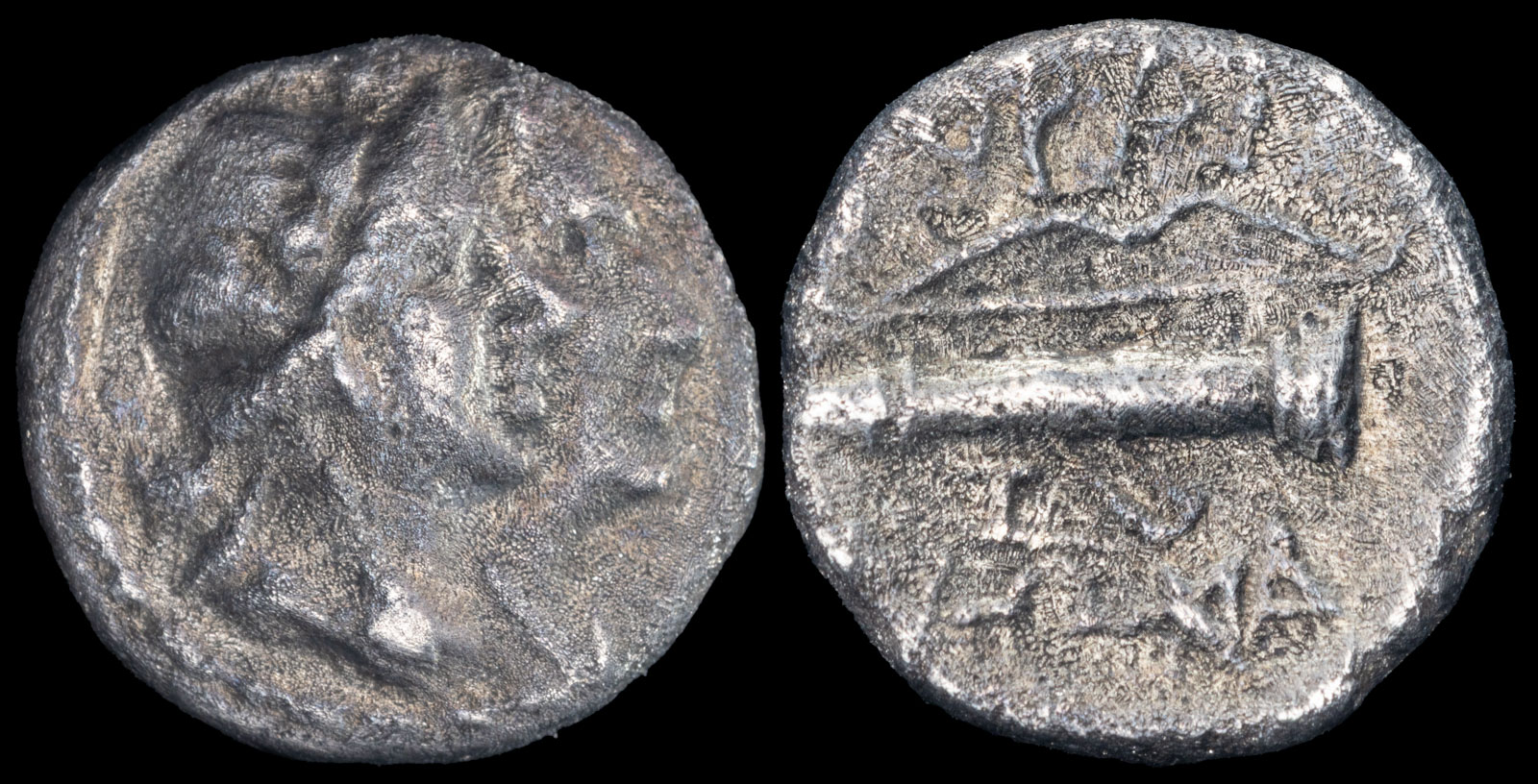
Phrygia, Gordion
2nd-1st centuries BCE
AR Obol 9.5mm, 0.65g, 1h
Jugate laureate and draped busts of Artemis and Apollo right, quiver over Artemis’s shoulder /
Quiver and bow; H to inner left, ΓOPΔI-ANΩN (partially retrograde) at sides
Fischer-Bossert, Gordion, pp. 21–2, and fig. M var. (orientation of ethnic, no H on rev.); H. P. Borrell, “Unedited Autonomous and Imperial Greek Coins” in NC 1845–1846, p. 27 var. (same); N. A. Corfù, “Zwei Unikate aus Kleinasien?” in SM 260 (2015), pp. 103–5 var. (same; Gordiukome in Bithynia)
Gordion was the ancient capital of Phrygia. It was situated at the intersection of two rivers and thus was a strategic stronghold over a fertile plain. It was inhabited at least from 2300 BCE and was a center of Phrygian civilization. Many tumuli exist on the modern day site and it’s now designated a UNESCO World Heritage Site.
Per mythology and ancient Greeks, Gordion was controlled by the King Midas, the same one whose touch turned everything to gold. In roughly 800 BCE, Gordion was destroyed by what is believed to have been a Cimmerian attack. Per Strabo, this resulted in the death of King Midas, allegedly by suicide from drinking bull’s blood.
When the city was taken by the Persians in 546 BCE, it lost its position as the head of the Phrygian kingdom, and instead became part of Hellespontine Phrygia. From the time of Alexander the Great, Galatians moved into the area. It was the site of the Gordion knot, supposedly unbreakable. Whoever loosened it would rule Asia. Alexander did so by cutting it with a sword.
Gordion is destroyed, which per Strabo resulted in the death of King Midas
Gordion besieged and taken by the Achaemenid Empire