Aquarius
View All Tags
In Greek myth, Aquarius was most commonly identified with **Ganymede**, the beautiful Trojan prince whom Zeus carried to Olympus to serve as cupbearer to the gods. In this interpretation, the stream flowing from Aquarius’ jar represents the divine drink poured for the Olympians. Ganymede’s placement among the stars also gave the constellation themes of **divine favor, elevation, immortality, and service to the gods**. Ancient writers did not always agree on the identity of the Water-Bearer, however. Other traditions connected the constellation with figures such as **Deucalion**, survivor of the great Greek flood, which reinforced Aquarius’ association with overwhelming waters, destruction, and subsequent renewal.
For the Romans, who inherited much of Greek astronomical mythology, Aquarius retained these same associations. Latin writers generally understood the constellation as **Aquarius**, literally “the water-bearer,” and frequently repeated the identification with Ganymede. Roman astrology added another dimension: Aquarius became one of the twelve signs of the zodiac and was traditionally considered the **house of Saturn**. Saturn’s influence could give the sign qualities quite different from modern popular astrology—gravity, restraint, endurance, age, difficulty, and seriousness. Aquarius was also classified as an **air sign** despite its watery imagery, illustrating that the astrological elements were part of a theoretical system rather than simply descriptions of the constellation’s picture.
The symbolism of Aquarius was therefore somewhat paradoxical. Visually it represented **water being released**, but astrologically it belonged to air and to Saturn. Its water could symbolize both abundance and danger: the rain that nourishes crops, the river that sustains civilization, or the flood that destroys an old world before a new one begins. For an ancient Greek or Roman viewer, Aquarius would consequently have evoked less the modern idea of the eccentric humanitarian or revolutionary and more an interconnected set of ideas involving **water, seasonal change, divine service, celestial order, and the alternation between destruction and renewal**.
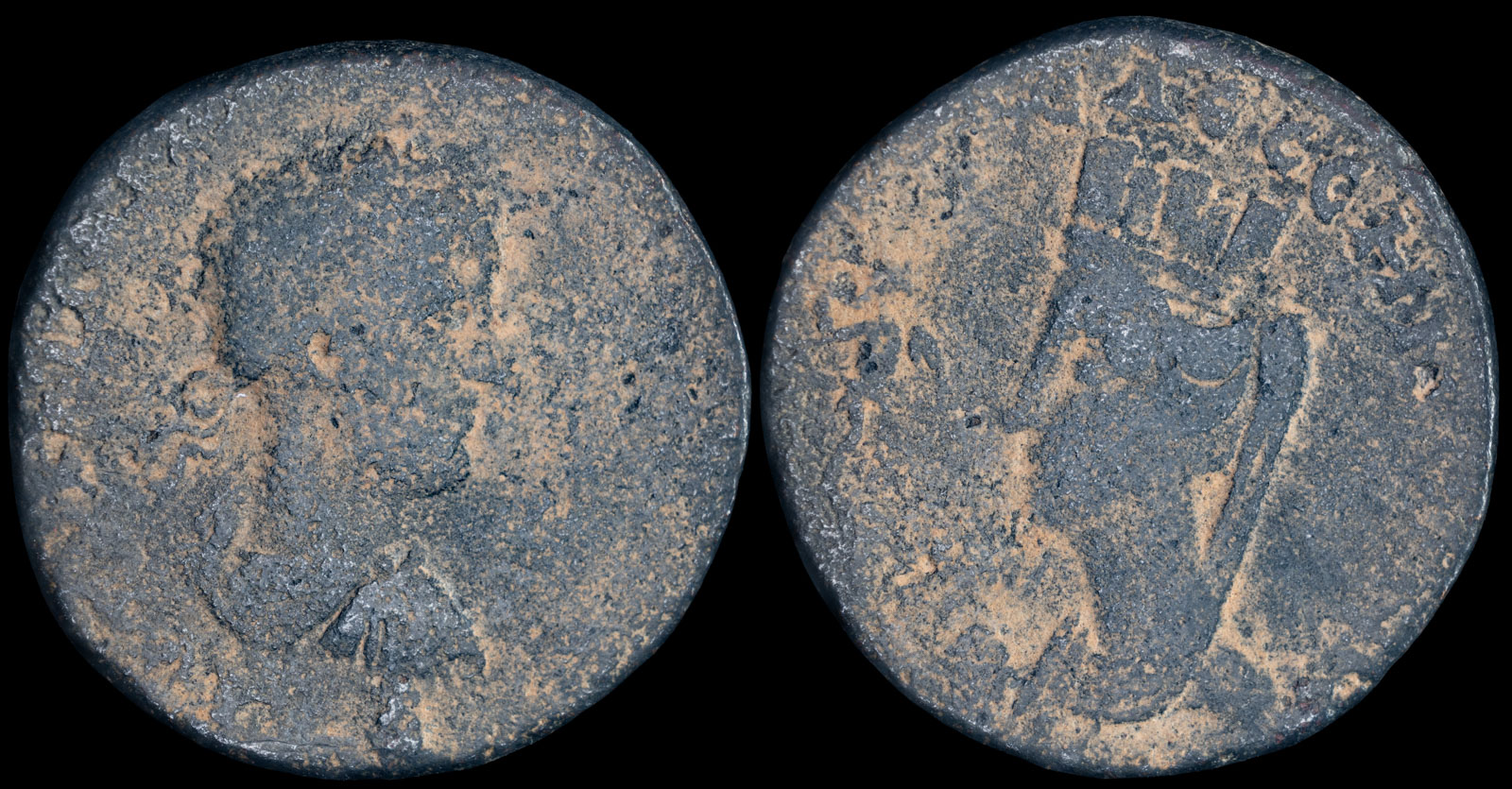
Edessa, Mesopotamia
Gordian III (238 – 244 CE)
Ae 28.0mm, 15.0g
Obv: AVTOK K M ANT ΓORΔIANOC CEB; Laureate bust right
Rev: MHT KOΛ EΔECCHNωN; Turreted and veiled bust of Tyche left; to left, small altar and Aquarius standing right on pedestal
BMC 128 – 130