Miysis
View All Tags
Miysis was normally represented as a **lion-headed man**, sometimes carrying knives or other weapons. His lion form expressed qualities that the Egyptians closely associated with kingship: ferocity, strength, courage, and the ability to annihilate enemies. He could consequently function as a divine defender of the pharaoh and of the ordered world. Some traditions gave him formidable titles emphasizing slaughter and the wielding of the knife, reflecting the idea that divine violence could be legitimate when directed against chaos and the enemies of Egypt.
His family relationships varied according to the region in which he was worshipped. Miysis was particularly connected with the great feline goddesses **Bastet and Sekhmet**. At Bubastis in the Nile Delta he could be regarded as the son of Bastet, while elsewhere he was associated with Sekhmet, herself a terrifying lioness goddess of war and destructive solar power. His father could be identified as **Ra or Ptah**, depending upon the local theological tradition. These relationships placed Miysis within a larger family of Egyptian solar and leonine deities whose ferocity protected both the gods and legitimate kingship.
Miysis also possessed a strongly **solar and protective character**. Like other lion gods, he could represent the scorching and aggressive power of the sun. He was sometimes understood as participating in the defense of Ra against **Apep**, the enormous serpent embodying chaos who threatened the solar god during his nightly journey through the underworld. In this role, Miysis was not simply a god of indiscriminate violence; he represented **violence placed at the service of cosmic order**, destroying the forces that threatened gods, kings, and humanity.
One of his principal cult centers was **Leontopolis**, the “City of Lions” of Greek sources, where living lions were reportedly maintained as sacred animals. The association was particularly appropriate because the lion itself embodied the god’s presence and power. By the Greco-Roman period, when Egyptians, Greeks, and Romans increasingly interpreted one another’s gods through their own religious traditions, the Egyptian Mahes appeared under Greek forms such as **Miysis, Mihos, and Mios**. Nevertheless, his essential symbolism remained Egyptian: **the lion as royal protector, warrior, solar power, and destroyer of chaos**.
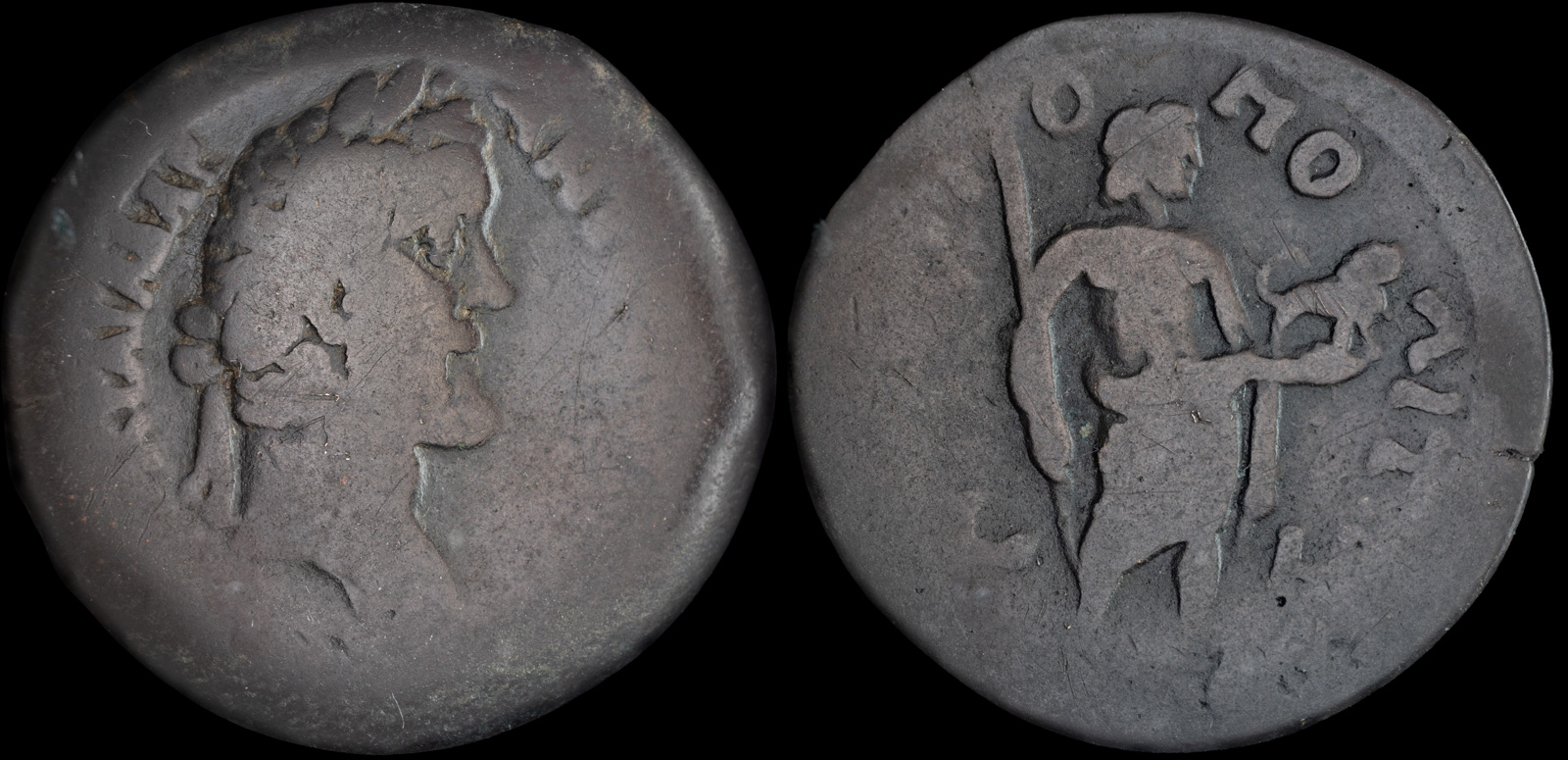
Egypt, Leontopolites
Antoninus Pius, 138-161 CE
AE Drachm 34.00mm., 22.06g
Obv: ΑΥΤ Κ Τ ΑΙΛ ΑΔΡ ΑΝΤω[ΝΕΙΝΟϹ] ϹΕΒ ΕΥϹ; laureate-headed bust of Antoninus Pius wearing cuirass and paludamentum, right, seen from rear
Rev: ΛΕΟΝΤ]ΟΠΟΛΙΤ L Η; nome (Leontopolites): young Miysis standing, facing, head, right, holding spear and lion
Poole 1892 p. 344 No. 16; RPC IV.4 781
NEx Naville Numismatics 2024