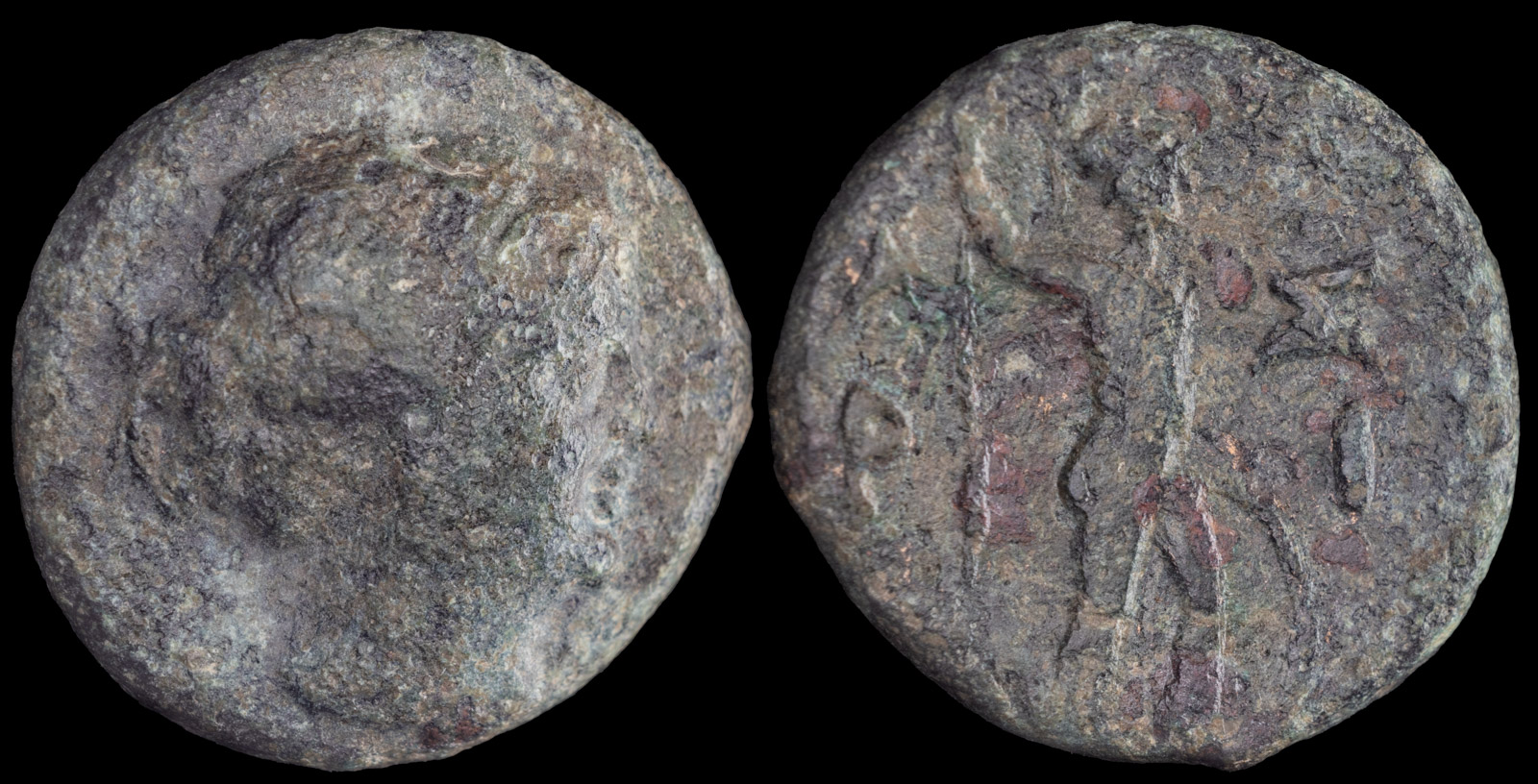
Argolis, Methana (as Arsinoe)
Circa 221-203 BCE
Bronze, 18mm, 6.13g, 12h
Head of Arsinoe to right.
Rev. A/P-Σ/I Warrior, nude except for helmet, standing to right, holding spear with his right hand and resting his left hand on a grounded shield.
BCD Peloponnesos 1331.3 (same obverse die). BMC -. Gill 2.a. HGC 5, 773. SNG Copenhagen 147
Methana dates to at least 8000 BCE, with many Mycenaean artifacts excavated there. Egyptian records mention the city.
Methana was located in Argolis and for most of its history was in the territory of Troizen. Its coinage is rare and has therefore been mistaken. As Meadows details in the best paper on the coinage – The Coinage of Arsinoe Methana, these issues were initially taken for Arsinoe, Crete, until a find near Methana changed that.
I actually wasn’t even familiar with this issue until it came up for auction, but it turns out there’s been some confusion over when Methana was actually founded, and minted coins. Before Meadows’ paper, it was thought that the ‘ME’ coinage was from the 4th-3rd centuries BCE, and this came afterwards. When Ptolemy II Philadelphos “liberated” Greece, he seized the polis of Methana, renamed it to “Arsinoe” and made it an important naval base.
That didn’t sound too “liberating”, and so after further investigation, Meadows realized that the ‘ME’ coinage came after this one. Methana existed as a geographic place before Ptolemy II, but not as a polis. Previous descriptions either referred to the promontory, or were mistakes in dialect – not helped by the fact that in the Messenian dialect, they referred to themselves as ‘Methenians’.
So Ptolemy II created the polis as Arsinoe – because that’s what they called most of their cities – and it was later renamed to Methana.
The obverse is most likely Arsinoe II, though Meadows also points out that it could be a generic image of a Ptolemaic empress. The reverse is more curious. There are two types of this issue. Mine belongs to the more numerous “Group 1”, but there also exists a less common “Group 2”, of poorer style with the letters in random positions. Most importantly, it includes a serpent at the bottom of the spear.
That serpent leads Meadows to tentatively attribute the reverse to Ares. After further research, I couldn’t find any better answer. The helmet, snake, spear, and shield all point to him. I considered Diomedes – but he’s typically depicted with a palladion. Asklepios was often depicted with a snake, but the shield and spear don’t match.
I did consider Theseus, who was originally from Troizen, but the snake doesn’t fit well.
A depiction of Ares would be unusual. Although I have several coins that depict him, they typically focus on his head.
Pausanias, for his part, doesn’t help. He visited Methana and noted temples to Herakles and Hermes. Neither fits the reverse.
He did detail an extremely odd tradition. Supposedly, when a wind called the Lips arrived, it would blight the buds of their vines. So, what would you do in that case? I’m sure your average gardening manual would have some suggestions, but not what they actually did.
Two men would take a chicken and cut it in half. Not any chicken would do. The feathers would have to be all white. Each of them would then take a half of the chicken and run in opposite directions around the vines. When they met where they started, they buried both halves of the chicken there.
I have so many questions on the actual mechanics of this, but alas such monumental details like these are lost to history.