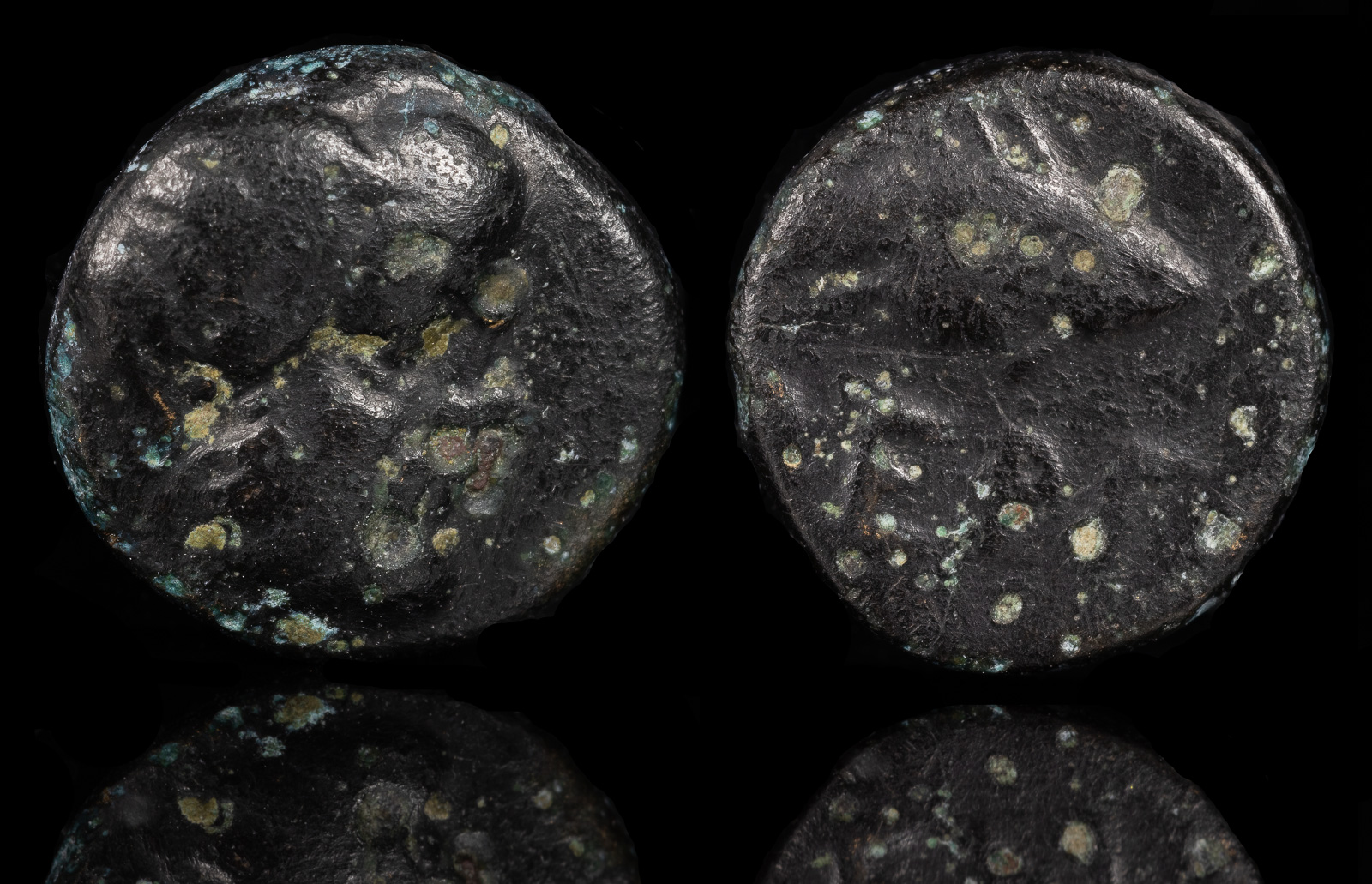
Kings of Thrace. Bergaios.
Early 4th Century BCE
10.30mm 1.05g
Obverse: Bearded head of Silenos right
Reverse: BEPΓ, fish right
Attribution: SNG Stancomb 288
I was perhaps three years old when I learned the Easter Bunny wasn’t real. Santa Claus came later and, though I was very young, I still remember it. However, far more shocking is the recent revelation to me that King Bergaios of Thrace never existed!
The facts were known as early as 2002 by the researcher Selene Psoma, who released the monumental paper “Le tresor de Gazôros (CH IX 61) et les monnaies aux legends..” that was immediately suppressed by the illuminati as potentially destabilizing to world religions and democracy.
However, her findings were summarized as a footnote in the later critical work “Coins of Thracian Kings and Rulers from Western Thrace, Eastern and Central Macedonia (5th–3rd c. BC).” by Christos Gatzolis, Vasilis Poulios, and Domna Terzopoulou, and just recently I located it. The effects have been tremendous.
Her arguments were that a) Bergaios’ coins aren’t consistent with those of other known Thracian kings, b) the grammar on the coins doesn’t make sense for a person c) most of the coins were found around Berge and d) no sources mention any ‘Bergaios’.
To put it succinctly: King Bergaios of Thrace never existed. He was a figment of all of our imaginations. All of those coins with his name? They were actually minted in Berge, founded as an Athenian colony in Thrace.
Aptly, Berge was the home of the real-life Antiphanes of Berge. He wrote in ancient times a book called “Unbelievable Things”, which weren’t believable because they weren’t true. There probably was something about Bergaios in there. From him comes the Greek word for “to tell ridiculous things”. Antiphanes also wrote a book on courtesans that has also sadly not escaped the ravages of time. I would have loved reading that one, though some of it may have trickled into Athenaios’ treatise on the same topic – which is highly entertaining.
I bet you didn’t expect a post that starts with Santa Claus and the Easter Bunny to diverge into prostitution, but there it is.
Berge became less important after the rise of Amphipolis, and thus the myth of Bergaios was likely constructed to bolster it.