Kalathos
View All Tags
One of the most common associations of the kalathos was with agricultural wealth. Because the basket was closely connected with the storage and transport of harvested crops, it became a natural symbol of plenty and sustenance. Deities linked to fertility and the earth, such as Demeter, Cybele, and Tyche, are often shown wearing a kalathos on ancient coins. In these contexts, the headdress signified the ability of the deity to provide nourishment, ensure successful harvests, and protect the economic well-being of a community.
The kalathos also developed a civic and cosmological meaning. When worn by Tyche, the tutelary goddess of a city, the kalathos could represent the prosperity and stability of the urban community itself. In some regions, particularly during the Hellenistic and Roman periods, the headdress evolved into a symbol of divine rulership over the inhabited world and the orderly distribution of nature’s bounty. Its elevated cylindrical form may have suggested a container overflowing with blessings, making it a fitting emblem for deities entrusted with the welfare of entire populations.
On ancient coins, the kalathos often served as an important identifying attribute. A goddess wearing a mural crown might represent a specific city, while one wearing a kalathos often emphasized fertility, abundance, or universal beneficence. The symbol was especially popular in the eastern Mediterranean, where Greek, Anatolian, Syrian, and Egyptian religious traditions frequently blended. As a result, the kalathos appears on the coinage of many cities and kingdoms, sometimes adorning local deities whose identities combined multiple cultural influences.
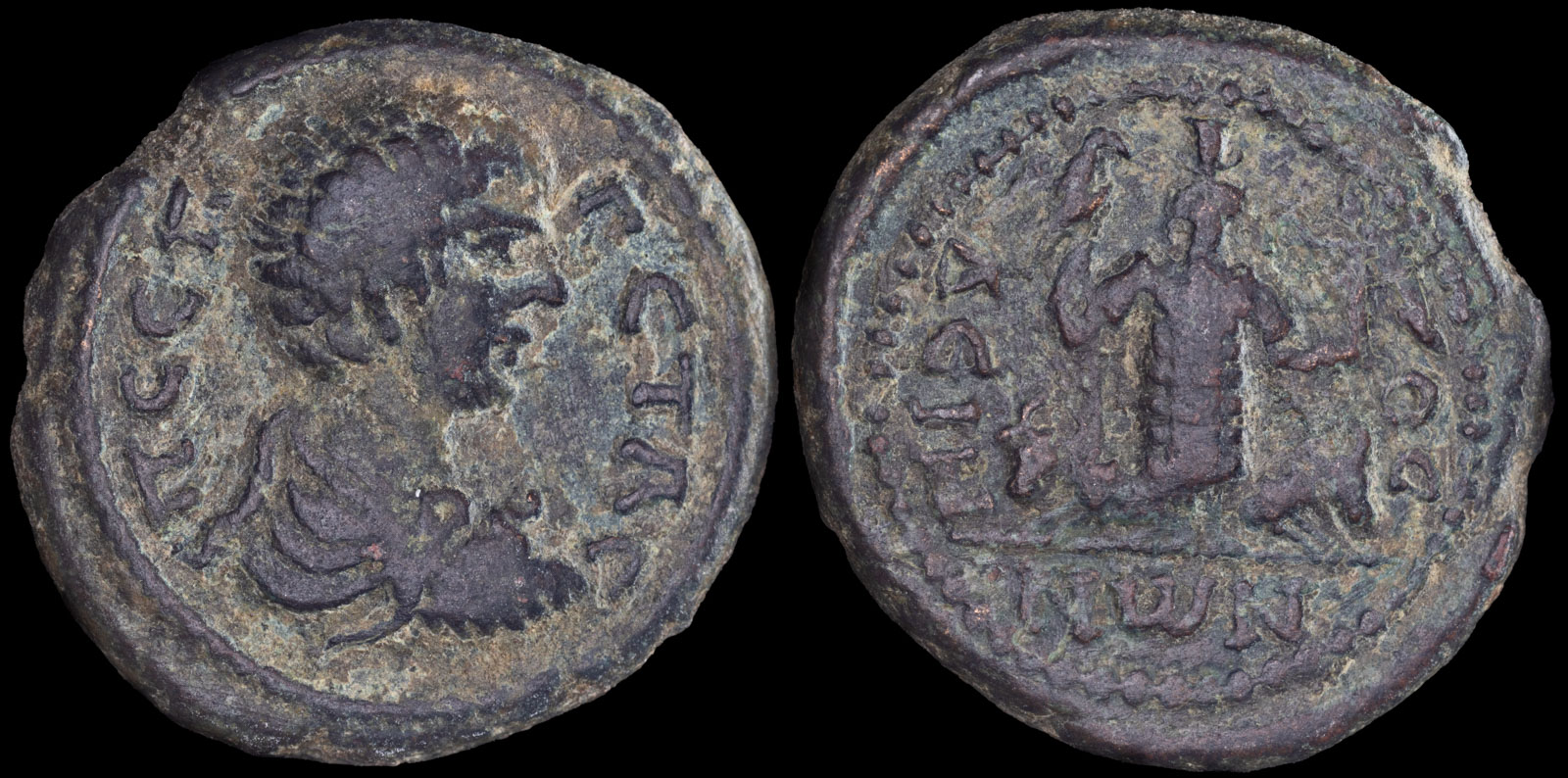
Decapolis, Dium
Geta. As Caesar
Dated CY 270 of Septimius Severus (207/8 CE)
Æ 25mm, 13.35g, 12h
Bareheaded, draped, and cuirassed bust right, seen from behind /
War–god Hadad standing facing, wearing kalathos with bull horns, holding eagle–tipped scepter and Nike; recumbent bulls flanking, OC (date) to right.
Spijkerman 7; RPC V.3 Online 68424; Rosenberger 6; Sofaer 6-7
Ex Classical Numismatic Group Electronic Auction 2014