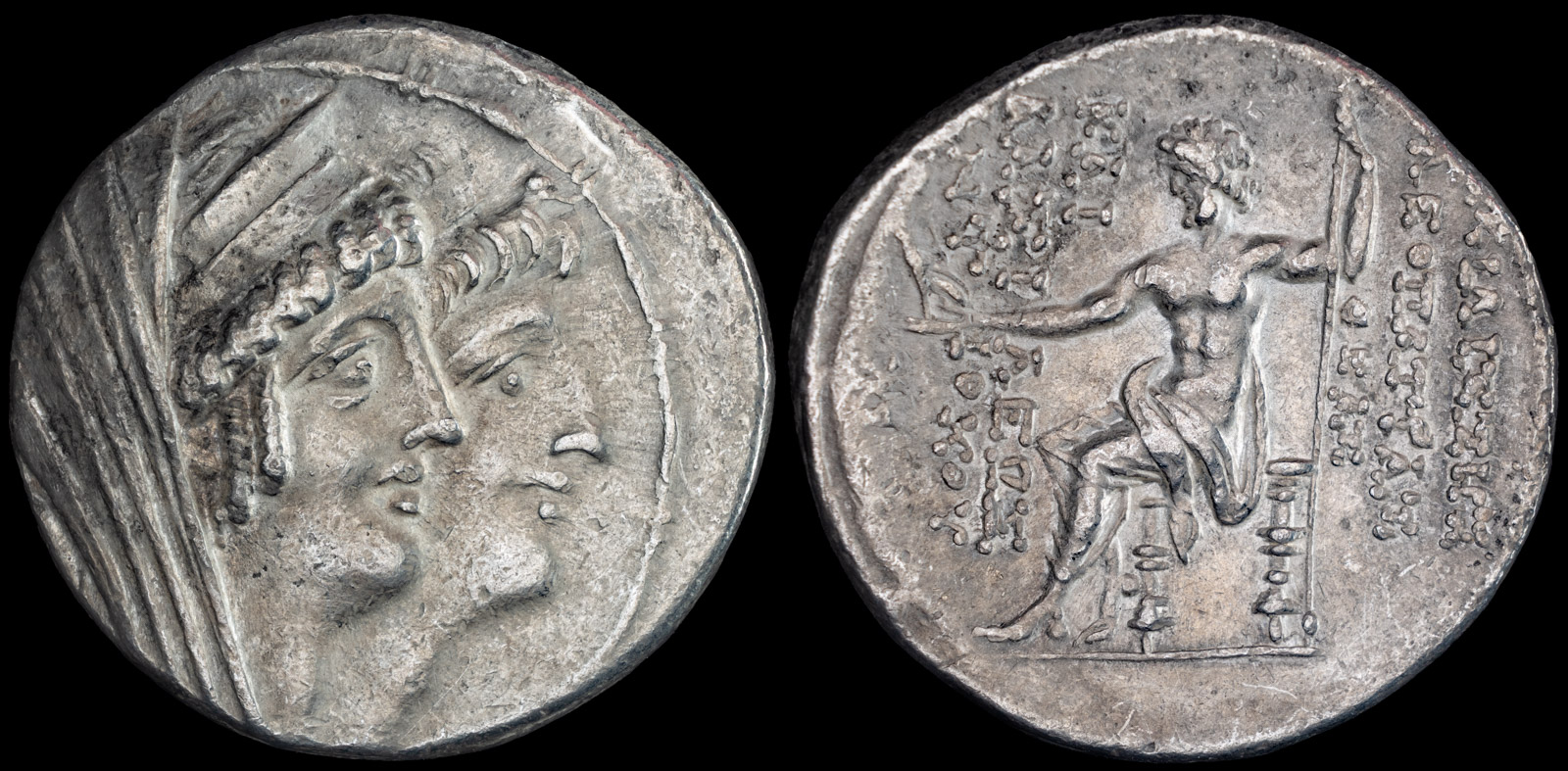
Seleukid Empire, Kleopatra Thea & Antiochos VIII
Ptolemaïs (Ake) mint
125-121 BCE. Struck ca 124 BCE
AR Tetradrachm 30mm, 16.46g, 12h
Jugate busts right of Cleopatra, wearing veil and stephane, and Antiochos VIII, wearing diadem / Z
eus Nikephoros seated left; monogram to outer left.
SC 2271.1; HGC 9, 1182g
Cleopatra Thea is believed to be the only ancient sole female monarch whose mother also ruled alone. She was the daughter of Ptolemy VI and Cleopatra II of Egypt and was soon an integral part of the dynastic power struggle of both Egypt and the Seleukid Empire. This occurred when her father, as part of an alliance with the Alexander Balas, wed her with the Seleukid king who had recently defeated Demetrios I Soter.
Things were complicated when Demetrios’ son, Demetrios II invaded. Cleopatra Thea’s father Ptolemy VI invaded in the pretenses of helping, but then took territory himself, including Antioch. By her father’s orders, Cleopatra divorced Alexander Balas and married Demetrios II. Per the marriage contract, Ptolemy VI would help Demetrios defeat Alexander, and in exchange Egypt would receive Coele-Syria.
Alexander Balas, though, wasn’t done. He confronted the forces of Demetrios and Ptolemy and was defeated and killed. Unfortunately for Cleopatra, her father Ptolemy VI was mortally wounded and died shortly afterwards. Demetrios saw his opportunity and tossed aside the marriage contract, though not Cleopatra herself. He massacred the Egyptian garrisons, but due to his harsh methods soon found himself beset by rebellions. Chief among these was that of Diodotos, a former general of Alexander, who abducted one of Cleopatra’s children as a figurehead, then murdered him and proclaimed himself king.
Things turned worse for Cleopatra when Demetrios was captured by the Parthians in 139 BCE and held prisoner. He would be under their control for ten years, during which time he took a Parthian wife. Under threat of Diodotos, Cleopatra retreated to Seleukia in Pieria and made an offer of marriage to Antiochos VII Sidetes, the younger brother of Demetrios. Antiochos accepted, then defeated and killed Diodotos in 138 BCE.
Then, in 130 BCE, after Antiochos VII had solidified his hold on the kingdom, the Parthian king Phraates II released Demetrios in order to spark a civil war between the brothers. The plan sort of worked. Phraates successfully killed Antiochos in an ambush at Ekbatana, but by then Demetrios was already on the march in his own country and couldn’t be recalled. Cleopatra remarried Demetrios and all seemed merry, though she was furious he had married a Parthian woman, and she sent away her son with Antiochos for safety.
In 128 BCE, Demetrios tried to play the good son-in-law and marched an army to Egypt to aid Cleopatra’s mother, Cleopatra II, who was having a tiff with her brother and husband Ptolemy VIII. This is what happens when spouses have their separate armies. Unfortunately for Demetrios, the plan fell apart when his own soldiers deserted him, and Cleopatra then chose the moment to rebel by installing her son with Antiochos, Antiochos IX Kyzikenos, on the throne.
Complicating the matters, a pretender son of Alexander Balas, Alexander II Zabinas, invaded. This forced Cleopatra from Antioch to Ake Ptolemais. Her husband Demetrios, meanwhile, was defeated by Alexander II Zabinas and Egyptian allies. When he attempted to flee to Ake Ptolemais to join his wife, Cleopatra barred him. He escaped to Tyre, where Cleopatra had him executed.
After this, the eldest son of Cleopatra and Demetrios, Seleukos, attempted to proclaim himself king. Cleopatra by this time had grown tired, so she had him killed by archers. Instead, she installed her young son Antiochos VIII Grypos as king, but effectively ruled herself from 125 to 121 BCE.
Grypos eventually grew more uncontrollable. Couldn’t he see that mother knows best? Frustrated at his insubordination, Cleopatra prepared a vile of poison to remove him. Grypos, though, suspected the trick and ordered his mother to drink it. Cleopatra was forced to drink it and died.