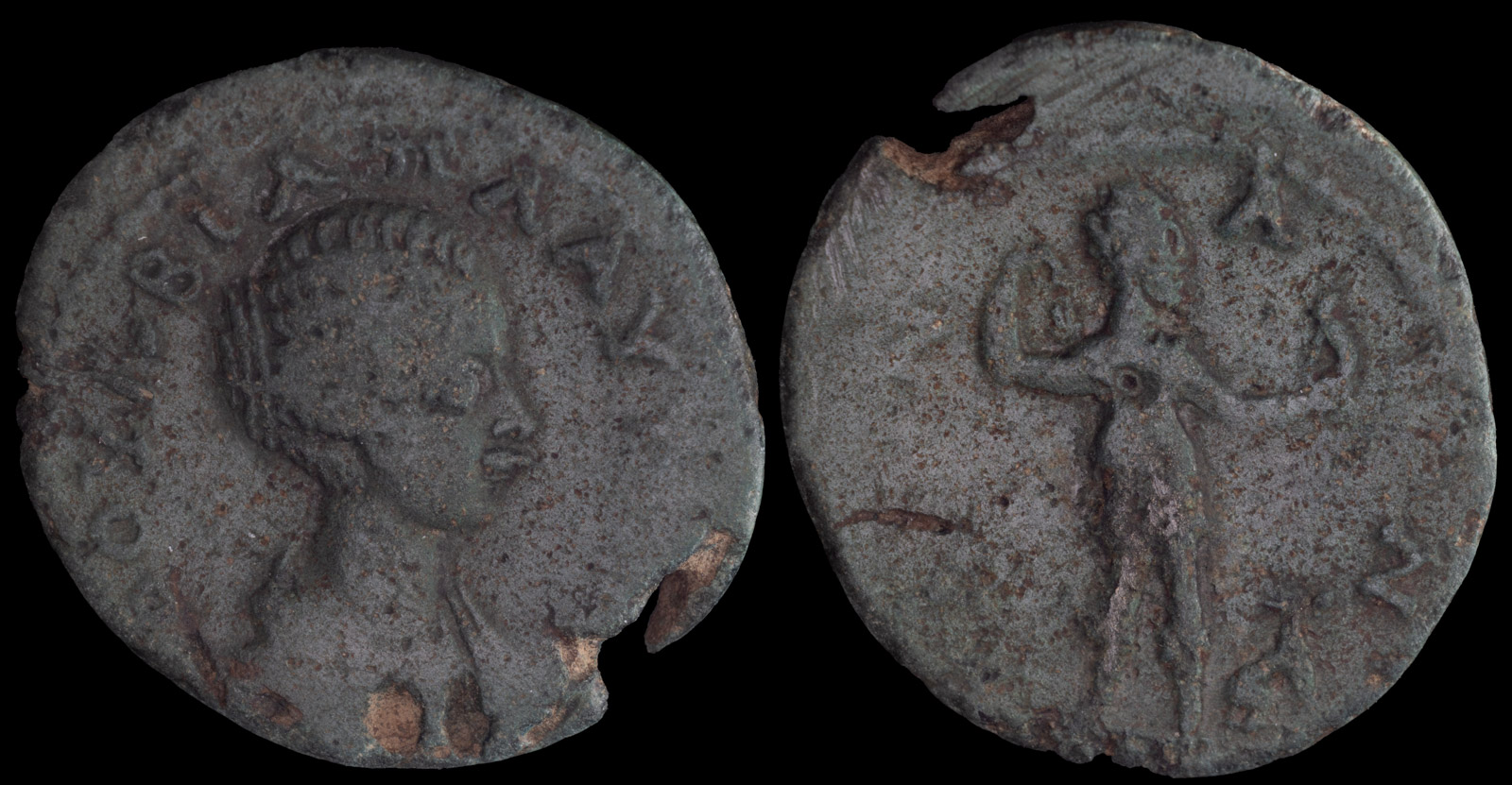
Achaia, Aegira
Plautilla, Augusta, 202-205 CE
Struck under Septimius Severus and Caracalla, 202-205 CE
Æ Diassarion 23mm, 5.17g, 9h
Draped bust right /
Artemis standing right, holding bow and drawing arrow from quiver on right shoulder; at feet right, hound seated right.
Hainzmann 4; Kroll, Bronze –; BCD Peloponnesos 422.1; BMC 6; NCP p. 89. 1, pl. S, IV
Ex Heather Howard Collection
Pausanias wrote of Aigira:
(VII 26.3) The Hyperesians gave their city its present name of Aegeira from the goats, and where the most beautiful goat, which led the others, crouched, they built a sanctuary of Artemis Agrotera, believing that the trick against the Sicyonians was an inspiration of Artemis.
(VII 26.5) There is also a temple of Artemis, with an image of the modern style of workmanship. The priestess is a maiden, who holds office until she reaches the age to marry. There stands here too an ancient image, which the folk of Aegeira say is Iphigeneia, the daughter of Agamemnon. If they are correct, it is plain that the temple must have been built originally for Iphigeneia.
It is believed this coin depicts the statue of Artemis that existed in the temple. Agrotera was an epithet for Artemis as huntress, and is believed to derive from the city of Agrai, where Artemis first hunted after arriving from Delos. A famous temple was setup in Agrai to her that lasted until 1778, when Ottoman troops dismantled it to build a wall.
The reuse of a temple to Iphigenia for Artemis is intriguing. In the Iliad, Agamemnon offends Artemis, and is thus pushed to sacrifice his daughter Iphigenia to her for the invasion to be successful.