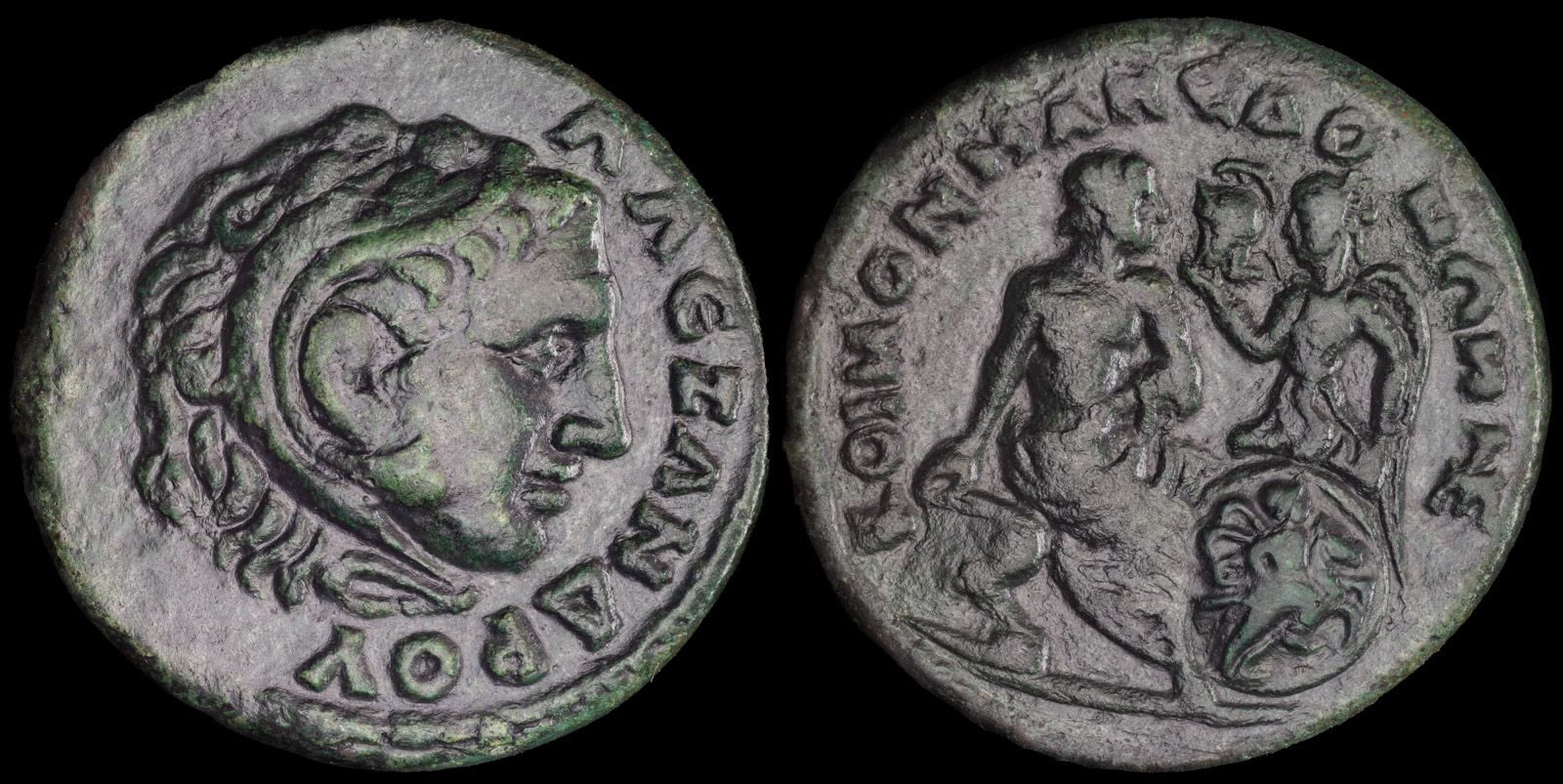
Macedon, Koinon of Macedon
Pseudo-autonomous issue, Beroea
time of Severus Alexander, circa 231-235 CE
Tetrassarion AE 26mm, 10.00g, 6h
AΛЄΞANΔPOY Head of Alexander ‘the Great’ to right, wearing lion skin headdress
Rev. ΚΟΙΝΟΝ ΜΑΚЄΔΟΝΩΝ NΕ Alexander, nude to the waist, seated right on low throne ending in lion feet, resting his right hand on the throne and his left in his lap; before him, on the right, Nike standing front, head to left, presenting crested Attic helmet to the king with her right hand and placing her left on a shield set on ground; shield boss decorated with Achilles slaying Penthesilea.
AMNG III -. Dahmen, Alexander -. Leu 10 (2021), 2268 (same dies). Nomos 16 (2019), 79 corr. (same dies, but reverse legend misdescribed). RPC VI online 465
Although it has one of my best portraits of Alexander, the reverse is really what drew me in. Depicting Nike presenting a helmet to Alexander the Great, in preparation for his conquest of the world, while Alexander sits on a lion throne with the shield of Achilles at his feet, it mirrors a similar image on one of the famed Aboukir medallions.
Causing a global stir when they were unearthed in 1902 and underwent a tremendous bidding war, these medallions have been greatly debated since being unearthed. By far the best resource on them that I’ve found is by Karsten Dahmen. The following is a summary:
The weights of the medallions are not uniform at all – varying from 60g to 120g
Twenty were found in Aboukir, Egypt and another three near Tarsos
The purity also varies considerably
There are die matches between the medallions, proving that most were made in the same workshop
This workshop was likely private and not state-run
In a number of cases, they mirror images on the Koinon of Macedon coinage
Although previous studies believe the coins were based on the medallions, Karsten finds no proof of this. It is uncertain which came first.
Both the coins and the medallions were based from the same model – either sculptures or paintings
With near certainty, they were minted in Macedon – based on the numerous similarities with the Koinon of Macedon coinage, images which tend not to be represented elsewhere
They were minted during the reigns of Severus Alexander or Elagabalus
Interestingly, my coin is rare enough (4 examples cited on RPC) that Dahmen was unaware of it.
The scene of Nike presenting Alexander with his arms (Dressel E, U [same die]) is an invention of one of our anonymous die engravers, because there are no known earlier or contemporary parallels. The scene is likely inspired by representations of Thetis, who equipped her son Achilles with a new set of weapons. The unique reverse type (Dressel G) depicts Alexander sitting on a heap of arms, behind him his mount Boukephalos, both lanked by two warriors in full armor.
The similarity between the two images is simply too close for them not to be related. However, there is a noticeable difference. Although all attributions I’ve found for my coin state that the shield depicts Achilles battling the Amazonian queen Penthesilea, I just don’t see it.
At the front, it certainly looks like two legs and the head of a horse. It seems to have wings, and someone is riding it. My belief is this is Thetis delivering Achilles’ armor on a hippocamp. The same theme was used on a coin minted 500-600 years earlier in Larissa Kremaste.
The existence both of a shield in the royal tombs and a shield on the Aboukir medallion depicting the same battle could be coincidental, or there could have been a now lost ancient source describing that shield. Since there was only a description (probably stating simply that the two were battling) the exact depiction would have been up to the engraver.
However, my coin contains no such battle. After thinking through it a bit, my theory is this was deliberately done by the engraver. First, I strongly agree with Dahmen that these images likely came from the same painting or sculpture.
The representations of Alexander and the known veneration of a cult to Alexander the Great suggest that statues and paintings in existence at Beroia inspired the types of both medallions and coins. Even with portraits in the round as likely prototypes, the stylistic features of the Alexander images on the medallions and bronze coins of the koinon (facial line, windblown hair, elaborated front) bear witness to an interaction between these two groups.
My suspicion is this was a painting, potentially by Apelles, who according to Pliny painted a vast number of pieces depicting Alexander. At least several of them lasted to Roman times, where they were seen by ancient writers including Pliny. Paintings were also often copied.
Comparing my coin’s reverse with the Aboukir medallion, I believe the engraver intentionally used the image of Thetis delivering Achilles’ armor because there was simply not enough space to accurately depict Achilles vs Penthesilea. Any ancient person, though, would have immediately understood the image of Thetis delivering Achilles’ armor, and thus recognized the shield as Achilles’. Since this is the only detail where the two images differ, I believe the original painting depicted Achilles against Penthesilea in a similar manner to the Aboukir medallion, but that simply wouldn’t work on this coin.
This was one of the earlier Koinon of Macedon pseudo-autonomous issues (without any emperor mentioned or depicted) since only one Neokoros is mentioned. That places it during the reign of Severus Alexander.