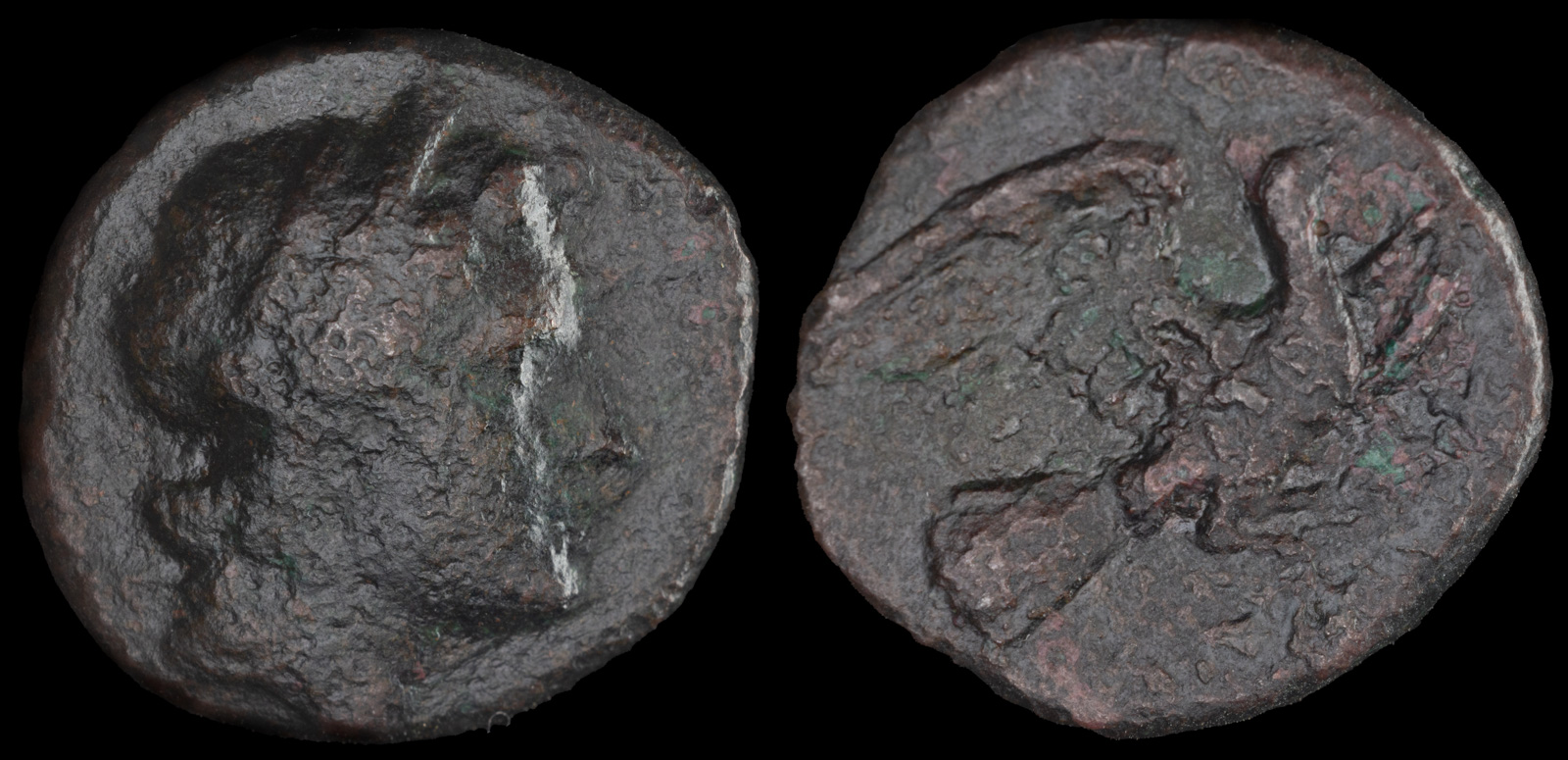
Islands off Lakonia, Kythera
Circa 100-50 BCE
Tetrachalkon Bronze, 18 mm, 5.61g, 12h
Head of Aphrodite to right, wearing stephanos.
Rev. K-Y Dove flying right, holding wreath in its claws.
BCD Peloponnesos 998. BMC 2. HGC 5, 647. Very rare. Somewhat rough, otherwise, fine.
Ex Collection of Dr. Paul Probst
Ex Collection of J. Cohen
Ex CNG 2017
Ex Spartan Numismatics 72
Ex BCD Collection
Kythera is one of the Ionian islands, with the others being Korkyra, Leukas, Paxos, Ithaka, Kefalonia (with the ancient cities of Kranion, Pronnoi, Same, and Pale), and Zakynthos. All except Paxos minted coins. Kythera itself is located roughly between the mainland and Crete.
Like many of the islands, Kythera has been occupied for a long time. It was once a Phoenician port, and the snail that produces Tyrian purple is native to the island. In Greek times, it was famous for its Temple of Aphrodite Ourania, who is most likely depicted on the obverse of this coin. Per Herodotus, it was the most ancient of all temples to her. Pausanias stated similar and said her worship was brought to Kythera by Phoenicians. Archeological evidence places its construction in the 6th century BCE.
Around the 6th century BCE, Kythera was seized from Argos by Sparta, then was occupied by Athens three times during the Peloponnesian War. Finally, with the Achaian defeat of Sparta in 195 BCE, Kythera began minting its own coins. That is likely when this one was minted. Their freedom did not last overly long, as Augustus later rewarded Kythera back to Sparta.
One myth tells of Aphrodite coming ashore on Kythera and not at Paphos. This is the origin of Kytherean Aphrodite.
From ancient through modern times, Kythera has often been affected by earthquakes.
Athens occupies Kythera
Kythera obtains independence and begins minting its own coins