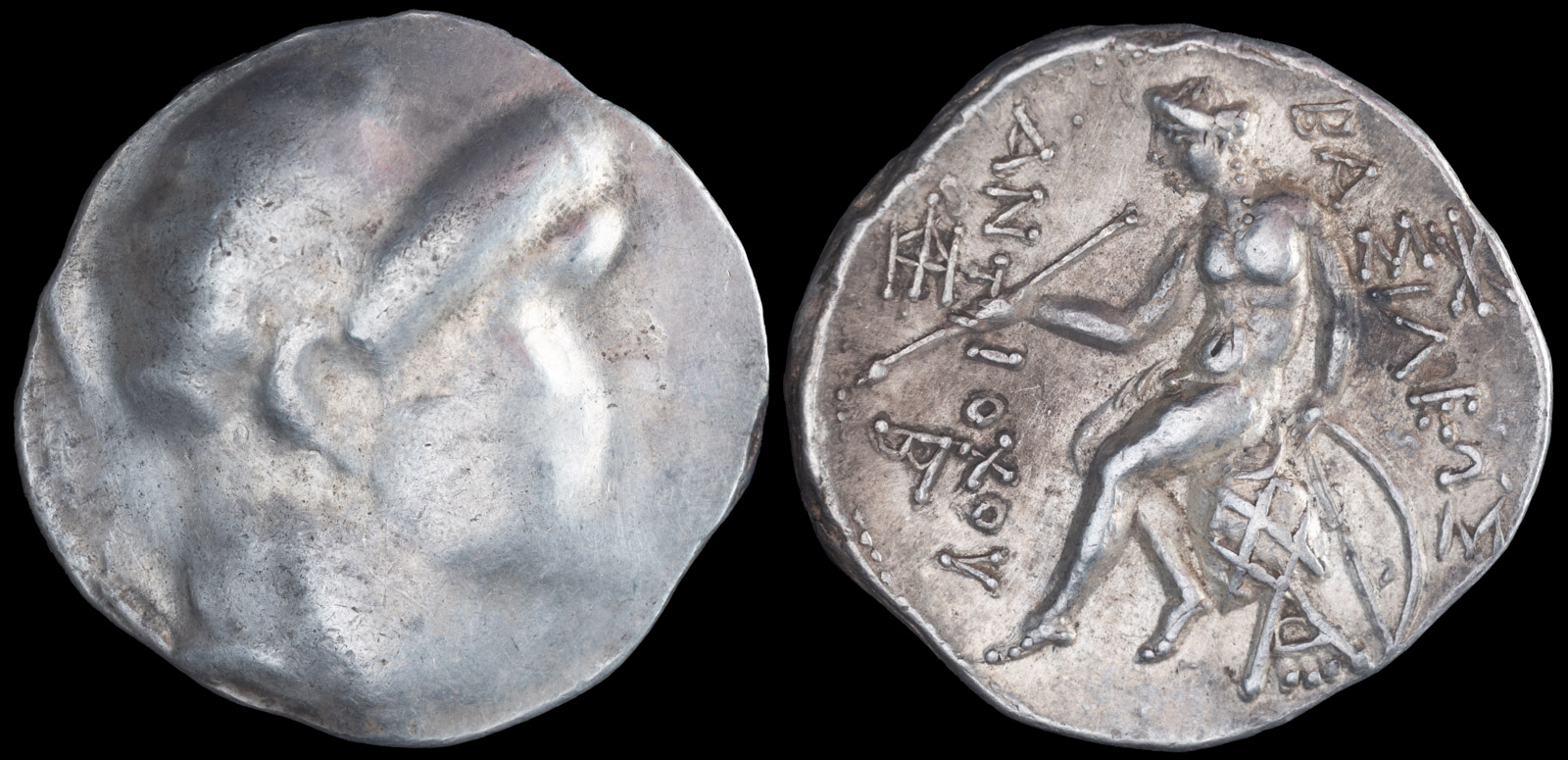
Seleukid Kingdom, Antiochos II Theos
261-246 BCE
AR tetradrachm Alexandria in Aria (Artacoana)
17.11g 26.6mm
diademed head right //
Apollo seated left on omphalos, holding arrow and resting hand on grounded bow, two monograms to outer left, one to outer right, and another in exergue
SC-612.11; Ehling-22-23, Houghton-1277
The city was mentioned by Arrian (Anabasis 3.25)
Tarrying here fifteen days, he offered sacrifice to the gods according to his custom, and celebrated a gymnastic contest, after which he began his march towards Parthia; thence to the confines of Areia and to Susia, a city in that province, where Satibarzanes, the viceroy of the Areians, came to meet him….While Alexander was on his way to Bactra, he was informed that Satibarzanes, viceroy of Areia, had killed Anaxippus and the horse-lancers who were with him, had armed the Areians and collected them in the city of Artacoana, which was the capital of that nation. It was also said that he had resolved, as soon as he ascertained that Alexander had advanced, to leave that place and go with his forces to Bessus, with the intention of joining that prince in an attack upon the Macedonians, wherever a chance might occur. When he received this news, he stopped the march towards Bactra, and taking with him the Companion cavalry, the horse-lancers, the archers, the Agrianians and the regiments of Amyntas and Coenus, and leaving the rest of his forces there under the command of Craterus, he made a forced march against Satibarzanes and the Areians; and having travelled 600 stades in two days came near Artacoana. Satibarzanes, however, no sooner perceived that Alexander was near, than being struck with terror at the quickness of his arrival, he took to flight with a few Areian horsemen. For he was deserted by the majority of his soldiers in his flight, when they also learned that Alexander was at hand. The latter made rapid marches in pursuit of the enemy, killed some of the men whom he discovered to be guilty of the revolt and who at that time had left their villages, fleeing, some one way, some another; and others of them he sold into slavery. He then proclaimed Arsames, a Persian, viceroy over the Areians.
We don’t know exactly where Artacoana was, but most (including the Barrington Atlas) believe the city was where modern day Herat, Afghanistan resides. This seems likely to me as well, since – though I haven’t been to Afghanistan (yet) – I’ve been to that part of the world and green places are re-used. Alexandria Eschate is modern-day Khujand, Maracanda is Samarkand, etc.
From what I can tell, issues from Artacoana began during the reign of Antiochos II and finished under Seleukos II Kallinikos, when the appear appears to have come under Mauryan control after a back-and-forth for some period. I wonder if these issues were minted to pay for those wars.
I picked this type over the more common issues of Antiochos II (Seleukeia on the Tigris and Antiochia on the Orontes for example) because of the rarity of coins from this mint, the “funky” style of the reverse, and the unusual wear.
During the auction, the seller mentioned that this coin likely spent some time in a river, with the obverse facing the water and the reverse sealed in the mud. Several such coins have come on the market recently and I at first wondered why they all happened to land face-up, but then realized that the attribution would be nearly impossible on face-down examples since a relatively clear reverse is necessary to see the monograms. In this case, the reverse was kept exceptionally well, so that what in the local language is called Apollo’s “bul-bul” is clear.
While I know many frown on coins with such wear, to me it makes the coin fascinating. Since this was a fair amount of money, I don’t believe its own just happened to say “hey! let’s put my savings in a river!” Of course, we’ll never know the story. The coins could have been on some cart that toppled over during a crossing, but I’d like to think a soldier had them on him during a battle where he fell or drowned during a river crossing. Perhaps the waters were raging and the coins were dislodged as his body tumbled through the rapids, then became lodged in some mud down the way.
Of course, Lorber and Houghton had to rain on my parade with a completely different idea. All of the known examples of this type used the same dies, and they suspect the obverse was simply very worn. Looking at some examples sold by CNG recently – where I was outbid – the reverse is a different type and the obverse appears to be the same die but a bit less worn, so that theory appears to be the correct one. However, when I show people the coin I’ll still use the river story because it’s way more interesting.